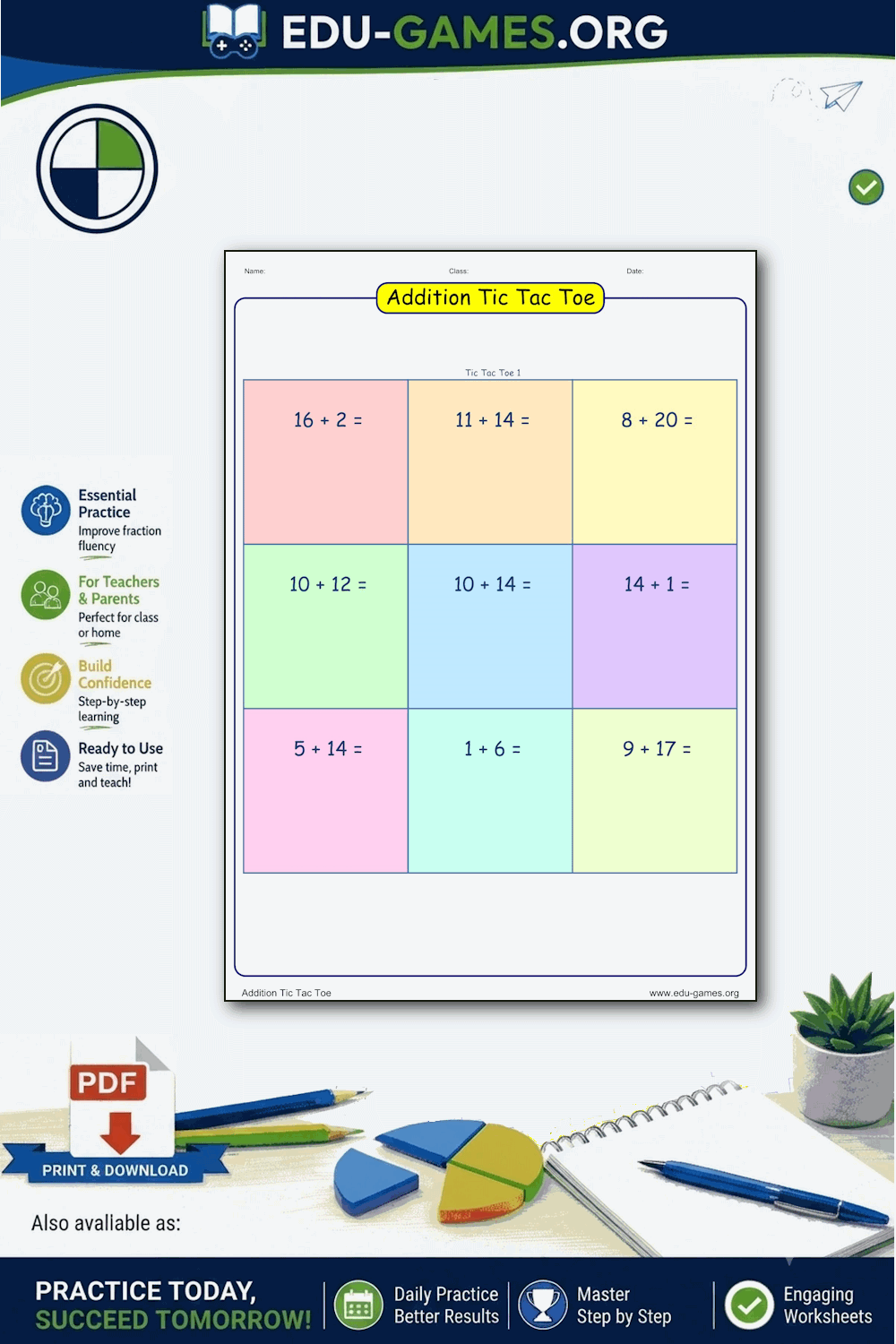
Addition Tic Tac Toe Worksheet
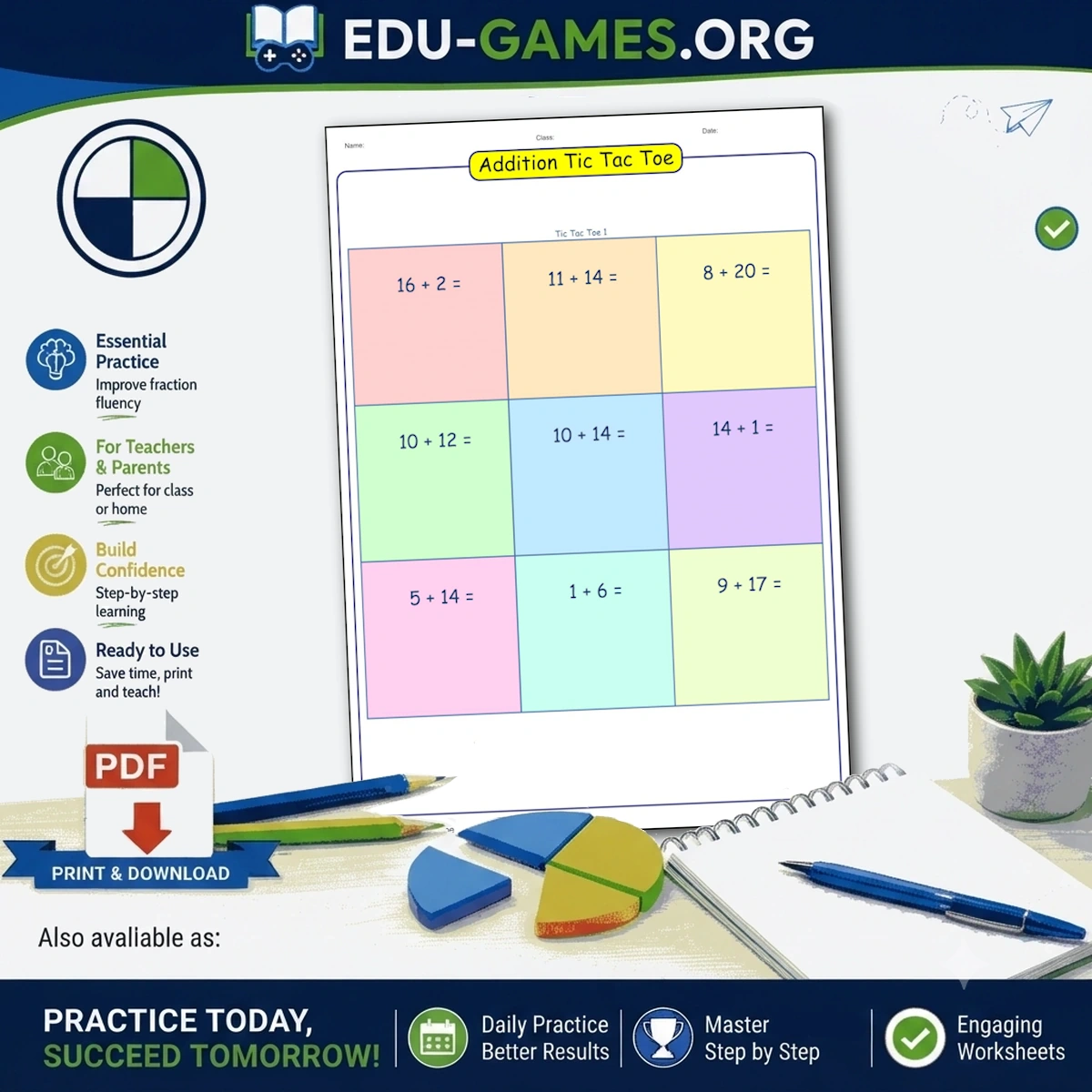
Generate a free printable Addition Tic Tac Toe worksheet. Choose your number range, create a 3×3 grid of addition problems, and download an instant PDF with optional answer key.
Used by teachers worldwide · Instant PDF download · No account required
Create an Addition Tic Tac Toe Worksheet
Why Addition Tic Tac Toe Works
There is a reason kids who groan at an addition drill sheet will lean forward for Addition Tic Tac Toe: the arithmetic is no longer the point — winning is. Every square on the grid is an addition problem, and a player can only claim it by solving it correctly. That single rule turns a dry facts drill into a two-player contest where speed, accuracy, and strategy all matter.
For teachers, the setup is zero effort: generate a worksheet in seconds, print it, and hand it out. Because every puzzle is randomly generated, no two sheets are the same — so you can run the game with the whole class at once without students copying each other. Choose the max number to control the difficulty, and the generator builds every problem within that range alone, making it easy to match the worksheet to exactly what your students are practising this week.
Print one game per page for a focused partner activity, two games for back-to-back rounds, or four games when you want a full set for a math center or a fast-finisher pack. Add the solution page toggle and the answer key prints on a second page — no separate prep needed.
How to Play Addition Tic Tac Toe
Print the worksheet and hand it to two players. The 3×3 grid works like classic tic-tac-toe, but each square is guarded by an addition problem.
- Players take turns choosing a square.
- To claim the square, the player must solve its addition problem correctly.
- A correct answer: mark the square with your symbol (X or O).
- An incorrect answer: the turn passes to the opponent; the square stays unclaimed.
- First player to get three in a row — horizontally, vertically, or diagonally — wins.
Use the max-number selector to adjust the difficulty. Choose up to 10 for early learners, or up to 100 for a two-digit addition challenge.
Share this free Addition Tic Tac Toe worksheet