Fifth Grade Math: Skills & Curriculum Guide
What fifth graders need to know in math — and why it matters. Covers the key skills: fractions with unlike denominators, decimal arithmetic, multi-digit multiplication and division, geometry including volume, and the coordinate plane.
Used by teachers worldwide · Instant PDF download · No account required
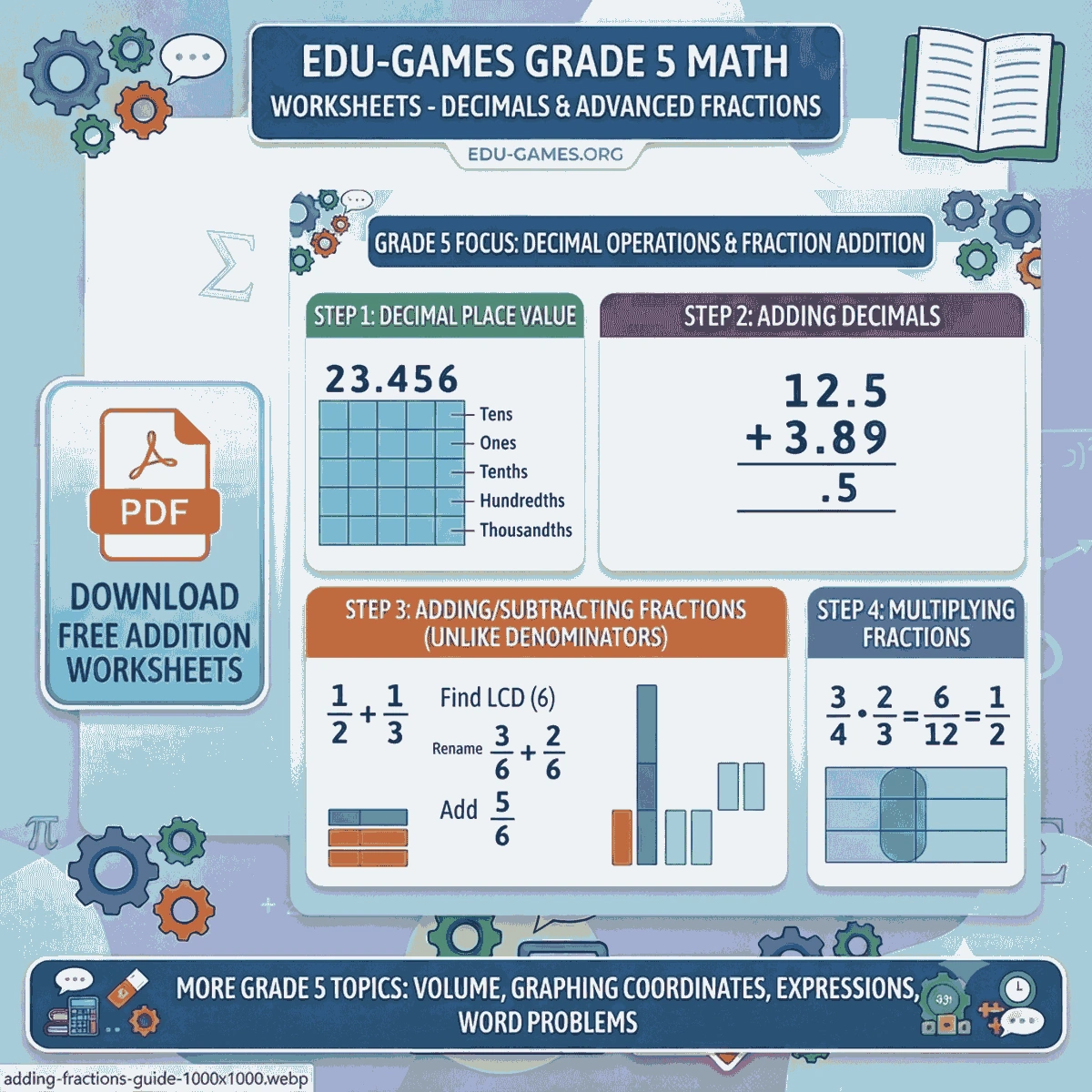
This is the curriculum guide, not the worksheet library. If you need printable sheets to download right now, go to browse all fifth grade math worksheets. If you want to understand what children should be able to do by the end of fifth grade, how those skills build on fourth grade, or which resources to use for a specific topic — read on.
Free Fifth Grade Math Resources
- Grade 5 Fractions Worksheets — adding, subtracting, multiplying, and dividing fractions with unlike denominators; comparing and converting between fractions and decimals.
- Grade 5 Printable Math Games — maze, bingo, balance-scale, and logic puzzle formats; ideal when students need engagement alongside fraction and arithmetic practice.
- Browse all fifth grade math worksheets — a broad collection covering every fifth grade topic in one place, including decimals, geometry, volume, and measurement.
Fifth Grade Math Learning Goals
By the end of fifth grade, students are expected to have mastered these core skills:
- Fractions – Add and subtract fractions with unlike denominators; multiply fractions and mixed numbers; divide fractions using the inverse operation; convert between fractions and decimals.
- Decimals – Read, write, compare, and round decimals to thousandths; multiply and divide decimals; understand place value through the millions and down to thousandths.
- Multiplication & Division – Multiply multi-digit whole numbers fluently; divide multi-digit numbers with and without remainders; apply these operations in multi-step word problems.
- Geometry & Volume – Classify two-dimensional figures by properties; calculate area and perimeter; find the volume of rectangular prisms using unit cubes and formulas.
- Coordinate Plane – Plot and interpret points in the first quadrant; understand the relationship between coordinates and real-world distances.
- Measurement & Data – Convert between units of measurement within the same system; interpret line plots that include fractional data.
- Algebraic Thinking – Write and evaluate simple expressions using parentheses; identify and extend numerical and shape patterns.
Where to Start — A Quick Decision Guide
Not sure which resource to use? Here is a short guide based on where your child or student currently stands:
- Just starting fifth grade / consolidating fourth grade — Check that fraction equivalence and multi-digit multiplication are solid before moving on. If times tables still cause hesitation, multi-digit decimal work will be very slow. A brief review using the Fractions Worksheets at the equivalence level is the right starting point before attempting unlike denominators.
- Mid-year, on track — Work through adding and subtracting fractions with unlike denominators (the central fifth-grade challenge) alongside decimal multiplication. Use Math Games to keep engagement high; the games require the same fraction skills as the drill sheets but feel less repetitive during an intensive practice phase.
- Ready for a challenge — Move into fraction multiplication and division, decimal division, volume of rectangular prisms, and the coordinate plane. The broad Grade 5 Worksheets collection covers all of these alongside algebraic expression work.
- Bridging to sixth grade — Ensure all four fraction operations are fluent, decimal arithmetic is reliable across all four operations, and the coordinate plane (first quadrant) is understood. Sixth grade builds directly on these with ratio, rate, and proportional reasoning — all of which depend on automatic fraction fluency.
Key Grade 5 Worked Examples
These short examples show what fifth-grade work looks like in practice — useful for checking whether a student is using the right method.
Adding fractions with unlike denominators
Problem: 3/4 + 1/6
Find a common denominator: 12. Rewrite: 9/12 + 2/12 = 11/12.
Multiplying and dividing fractions
Multiply: 2/3 × 3/4 = 6/12 = 1/2 (multiply numerators, multiply denominators, simplify).
Divide: 3/4 ÷ 1/2 = 3/4 × 2/1 = 6/4 = 1½ (flip the second fraction and multiply).
Decimal multiplication
Problem: 2.4 × 3
Think of it as 24 × 3 = 72, then shift the decimal one place left: 7.2. Count decimal places: 2.4 has one, so the answer must have one too.
Volume of a rectangular prism
Problem: A box 5 cm long, 4 cm wide, and 3 cm tall.
Volume = length × width × height = 5 × 4 × 3 = 60 cm³.
Why Fifth Grade Math Is a Turning Point
Fifth grade is the last full year before middle school and is deliberately designed as a bridge. The curriculum packs in fraction operations across all four operations, decimal arithmetic through thousandths, three-dimensional volume measurement, and the first encounter with a coordinate plane — all in the same year. No other elementary grade covers as much genuinely new conceptual ground.
The reason fraction operations receive so much attention in fifth grade is that fractions underpin nearly all of grades 6 and 7: ratios, proportional reasoning, percentages, and the early algebra that arrives in grade 7 all depend on fluent fraction work. A student who leaves fifth grade uncertain about dividing fractions will carry that gap forward into every subsequent year, because the later curriculum assumes fraction fluency and does not slow down to rebuild it.
Consistent practice across different formats — not just repeated drill on the same problem type — is what builds durable fluency. This is why pairing standard worksheets with game-based formats matters: both are necessary. Games reveal reasoning gaps that drill sheets miss, and drill builds the speed that makes game-based reasoning feel effortless rather than laborious.