Fourth Grade Math: Skills & Curriculum Guide
What fourth graders need to know in math — and why it matters. Covers the key skills: multi-digit multiplication and division, fractions and equivalence, an introduction to decimals, place value up to millions, geometry, and measurement.
1.7M+ worksheets downloaded · Instant PDF download · No account required
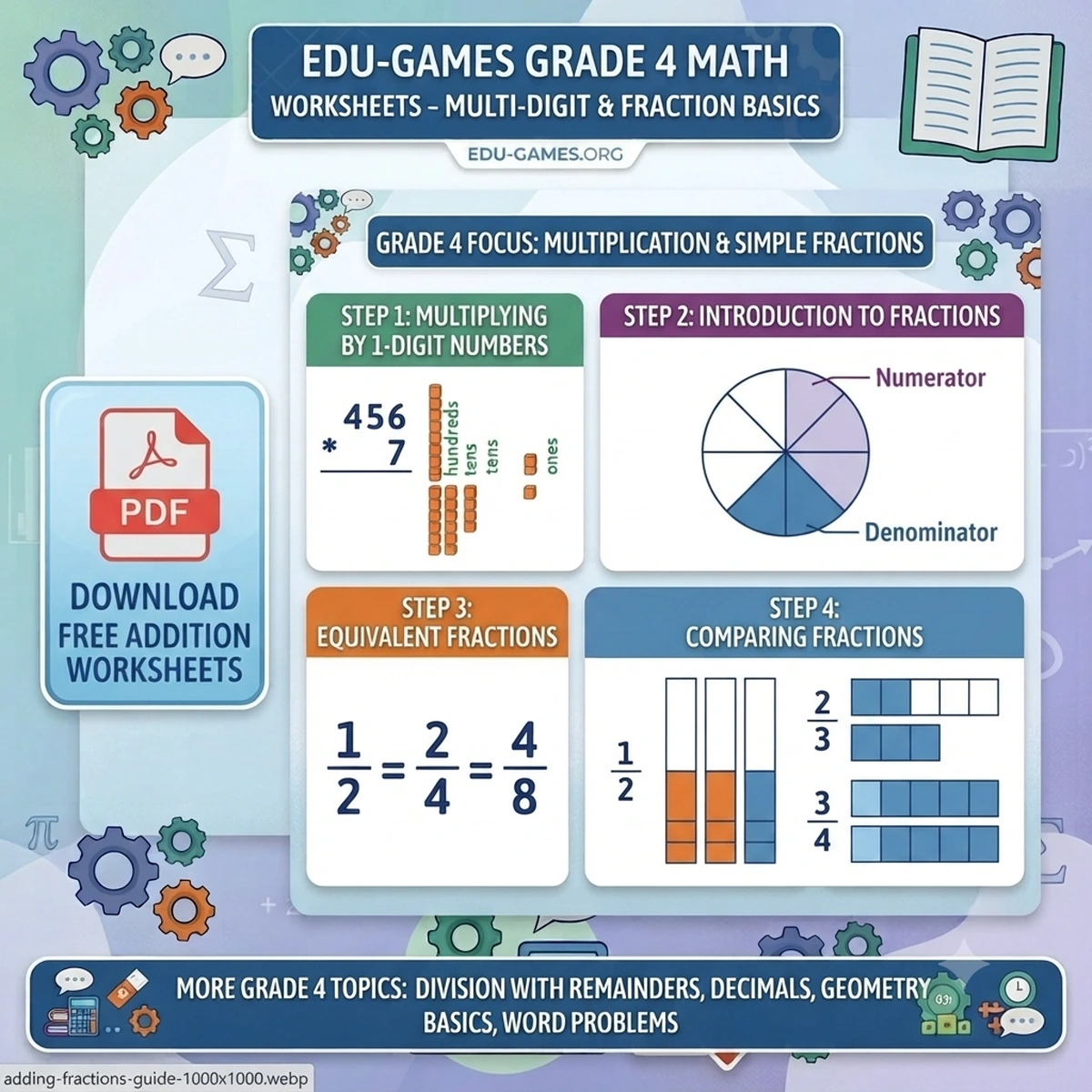
This is the curriculum guide, not the worksheet library. If you need printable sheets to download right now, go to browse all fourth grade math worksheets. If you want to understand what children should be able to do by the end of fourth grade, how those skills build on third grade, or which resources to use for a specific topic — read on.
Free Fourth Grade Math Resources
- Grade 4 Arithmetic Worksheets — multi-digit multiplication and long division drills with adjustable number ranges and operation selection.
- Grade 4 Fraction Worksheets — equivalence, comparison, and addition and subtraction with like denominators.
- Grade 4 Printable Math Games — maze, bingo, and logic puzzle formats; ideal for learning centres and early finishers.
- Browse all fourth grade math worksheets — a broad collection covering every fourth grade topic in one place, including geometry, decimals, and measurement.
Fourth Grade Math Learning Goals
By the end of fourth grade, students are expected to have mastered these core skills:
- Multiplication & Division – Multiply multi-digit whole numbers (up to 4-digit × 1-digit and 2-digit × 2-digit); divide with and without remainders; solve multi-step word problems using all four operations.
- Fractions – Understand and generate equivalent fractions; compare fractions with unlike denominators; add and subtract fractions with like denominators; understand mixed numbers.
- Decimals – Understand decimals to hundredths as an extension of fractions; compare decimals; place decimals on a number line.
- Place Value & Number Sense – Work with numbers up to millions; understand place value at each position; round numbers to any place.
- Geometry – Identify and draw points, lines, line segments, rays, and angles; classify shapes by properties; understand symmetry; calculate perimeter and area.
- Measurement & Data – Convert between units within the same measurement system; read and interpret line plots, bar graphs, and tables.
- Problem Solving – Apply multi-step strategies to real-world problems involving all four operations, fractions, and measurement.
Where to Start — A Quick Decision Guide
Not sure which resource to use? Here is a short guide based on where your child or student currently stands:
- Just starting fourth grade / consolidating third grade — Verify that multiplication facts up to 10×10 are automatic before moving on. If they are not, spend time on the Arithmetic Worksheets at the single-digit level first. Multi-digit multiplication built on shaky times tables causes persistent errors throughout the year.
- Mid-year, on track — Work through long division (start with no remainders, then introduce remainders) alongside the Fraction Worksheets for equivalence and comparison. Use Math Games to keep engagement high during the intensive division practice phase.
- Ready for a challenge — Move into 2-digit × 2-digit multiplication, fraction addition and subtraction with like denominators, and multi-step word problems. The broad Grade 4 Worksheets collection covers all of these alongside geometry and decimals.
- Bridging to fifth grade — Ensure multi-digit multiplication and division are fluent, fraction equivalence is secure, and decimals to hundredths can be read and compared. Fifth grade assumes all of these are automatic and builds directly on them with decimal arithmetic and fraction addition with unlike denominators.
Why Fourth Grade Math Is a Pivotal Year
Fourth grade is the year multi-digit multiplication and long division move to the centre of the curriculum. Until now, students have worked with single-digit facts and simple two-digit operations. The jump to multiplying 3- and 4-digit numbers — and then dividing them — represents the largest procedural leap since first grade. Students who arrive at fourth grade without automatic recall of their times tables will struggle at every step, because multi-digit multiplication and long division both rely on near-instant single-digit retrieval at multiple points in each calculation.
Fractions become a serious topic in fourth grade for the first time. In third grade, fractions were introduced as representations of parts of a whole. In fourth grade, students must work with them operationally — finding equivalents, comparing fractions with unlike denominators, and adding and subtracting fractions with like denominators. The conceptual shift from "what fraction is shaded?" to "which fraction is larger and how do you know?" demands a different kind of reasoning that many children find genuinely challenging.
Decimals appear in fourth grade as a bridge between fractions and the base-10 number system students already know well. Understanding that 0.3 and 3/10 are the same quantity — and that place value extends to the right of the decimal point using the same pattern it uses to the left — sets up every piece of decimal arithmetic, percentage work, and measurement calculation that follows in grades 5 and beyond. Building this connection carefully in fourth grade pays dividends for years.