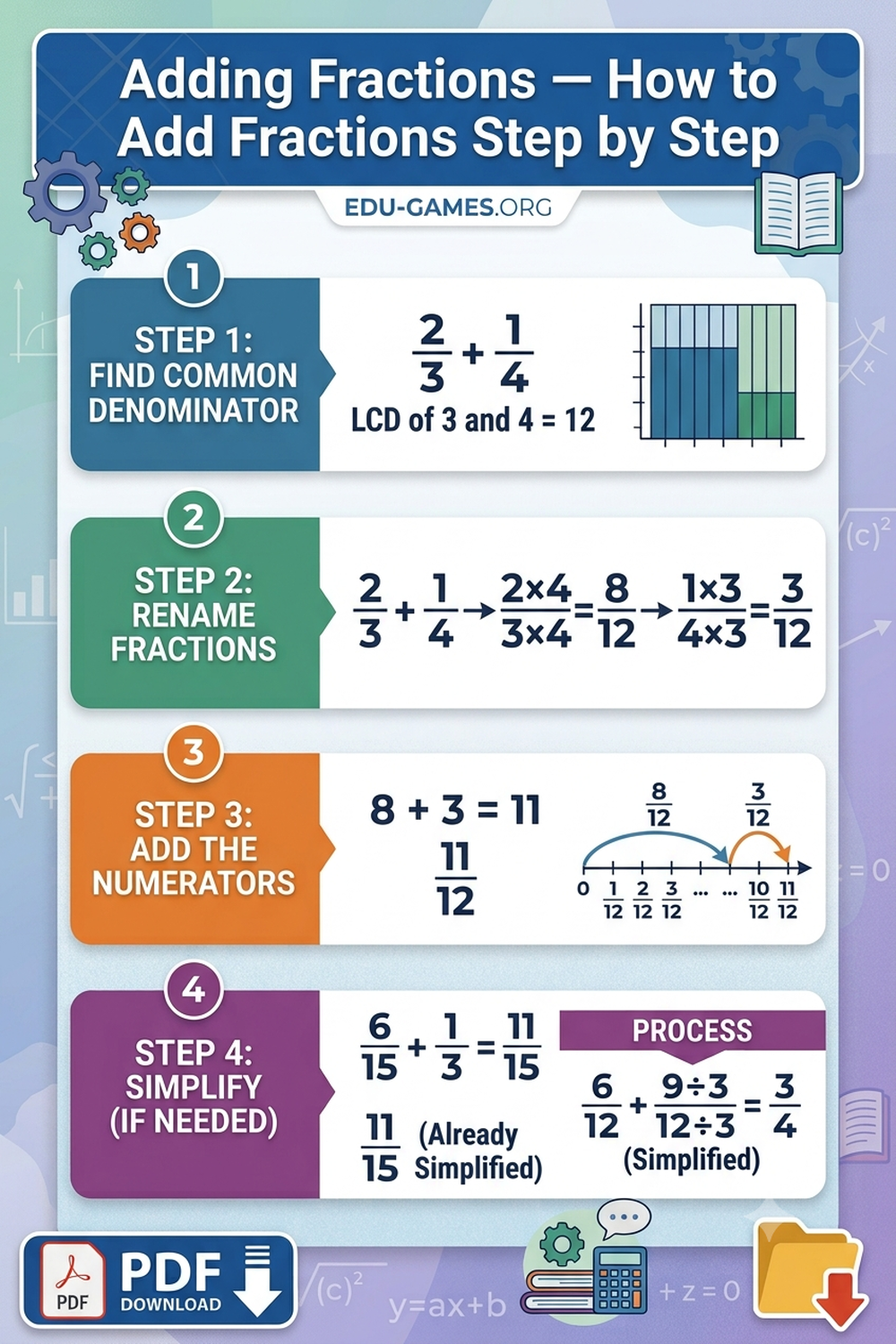
Adding Fractions — How to Add Fractions Step by Step
Master adding fractions with a clear step-by-step guide, worked examples, and free printable worksheets. Covers like and unlike denominators, mixed numbers, and improper fractions — with practice materials for Grades 4–6.
Free printable worksheets · Instant PDF download · No account required

Adding fractions is one of the core skills in Grades 4–6 arithmetic. The key rule is simple: fractions must share the same denominator before you can add them. This guide walks through every case — like denominators, unlike denominators, mixed numbers, and improper fractions — with worked examples at each step.
Understanding Fractions
A fraction represents a part of a whole and consists of two parts:
- Numerator: The top number, which shows how many parts you have.
- Denominator: The bottom number, which shows how many equal parts the whole is divided into.
Example: In the fraction , 3 is the numerator and 4 is the denominator.
Finding a Common Denominator
To add fractions, their denominators must be the same. When denominators differ, find a common denominator:
- The least common denominator (LCD) is the smallest number that both denominators can divide into evenly.
- To find the LCD, list multiples of each denominator and find the smallest matching multiple.
Example: For and , multiples of 4 are 4, 8, 12; multiples of 3 are 3, 6, 9, 12. The LCD is 12.
Steps to Add Fractions
Follow these steps to add fractions:
- Check denominators: If denominators are different, find the LCD.
- Adjust fractions: Rewrite fractions with the LCD as their denominator by multiplying numerator and denominator by the appropriate number.
- Add numerators: Keep the denominator the same and add the numerators.
- Simplify: Reduce the resulting fraction if possible. If the result is an improper fraction, convert to a mixed number.
Examples of Adding Fractions
Example 1: Add fractions with the same denominator
Add + :
Since denominators are the same, add numerators: =
Example 2: Add fractions with different denominators
Add + :
- Find LCD of 4 and 3. Multiples of 4: 4, 8, 12; multiples of 3: 3, 6, 9, 12. LCD = 12.
- Convert:
=,= - Add:
+ =(already simplified)
Example 3: Add fractions with an improper result
Add + :
Denominators match — add numerators: =
Convert to mixed number: = 1
Simplifying Fractions
Simplify a fraction by dividing numerator and denominator by their greatest common divisor (GCD):
- Example: Simplify
. - GCD of 6 and 8 is 2.
- Divide both by 2:
=.
Rules for Adding Fractions
- Find a common denominator first. Never add numerators when the denominators are different.
- Keep the denominator unchanged. Only the numerators are added — the denominator stays the same throughout.
- Simplify the result. Always reduce the fraction to its lowest terms after adding.
- Convert improper fractions. If the result is greater than 1, convert to a mixed number unless an improper fraction is specifically required.
How to Use the Adding Fractions Resources
The resources on this page are designed to take a learner from first principles through to confident independent practice.
1. Work Through the Guide
Read each section in order. The guide builds progressively — understanding what a denominator is comes before finding the LCD, which comes before working through full addition problems. Skipping ahead is fine for review, but the sequence is deliberate for first-time learners.
2. Practise with the Examples
Cover the worked examples and attempt each problem yourself before reading the solution. Self-testing is significantly more effective than passive reading for building procedural fluency.
3. Download Printable Worksheets
Use the adding fractions worksheets to practise on paper. Each generator creates a fresh set of problems so you can return as many times as needed without repeating the same sums.
4. Try the Game Worksheets
For a more engaging format, the fraction addition game worksheets — including maze formats — require students to solve problems and follow the correct path, adding a self-checking mechanism that plain drills lack.
Why Practise Adding Fractions?
Fraction addition is not an isolated skill — it underpins large areas of mathematics from Grade 4 upwards.
Foundation for Algebra
Finding a common denominator is the same process as finding a common expression when adding algebraic fractions in secondary mathematics. Students who are fluent at fraction arithmetic reach algebra with one less barrier.
Builds Number Sense
Repeatedly working with fractions — converting, simplifying, comparing — builds an intuitive sense of how numbers relate to each other. This number sense is difficult to develop through whole-number arithmetic alone and pays dividends across the entire curriculum.
Controlled Difficulty Levels
The printable worksheet generators on this site let you choose denominator ranges precisely. This means you can target the exact difficulty level your students need — starting with simple like-denominator problems and progressing to two-digit unlike denominators as confidence grows.
Unlimited Unique Practice
Every click of the worksheet generators produces a new, unique set of problems. You can generate different worksheets for classwork, homework, and assessment across the full school year without students ever encountering the same problems twice.
Share this adding fractions guide with your friends