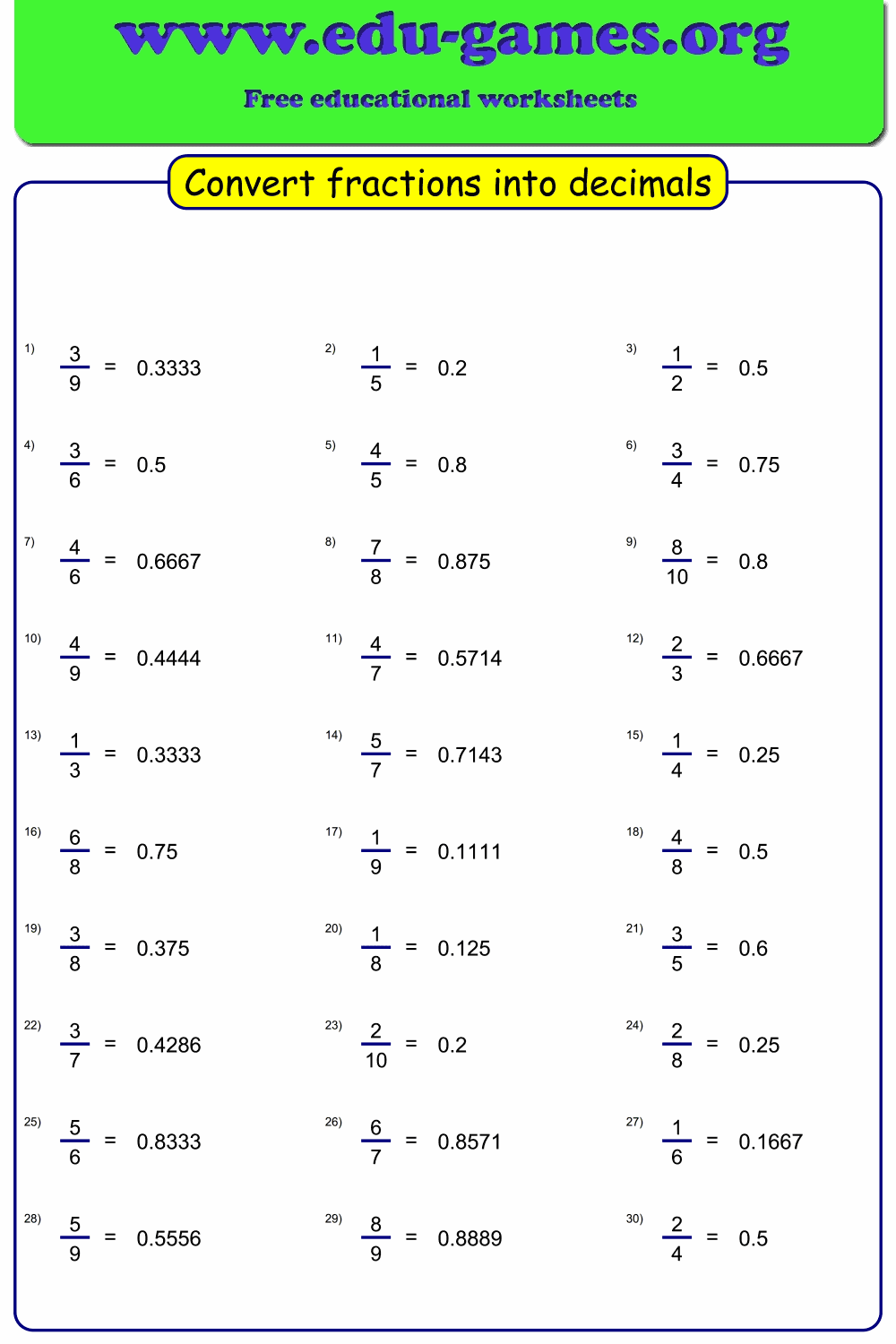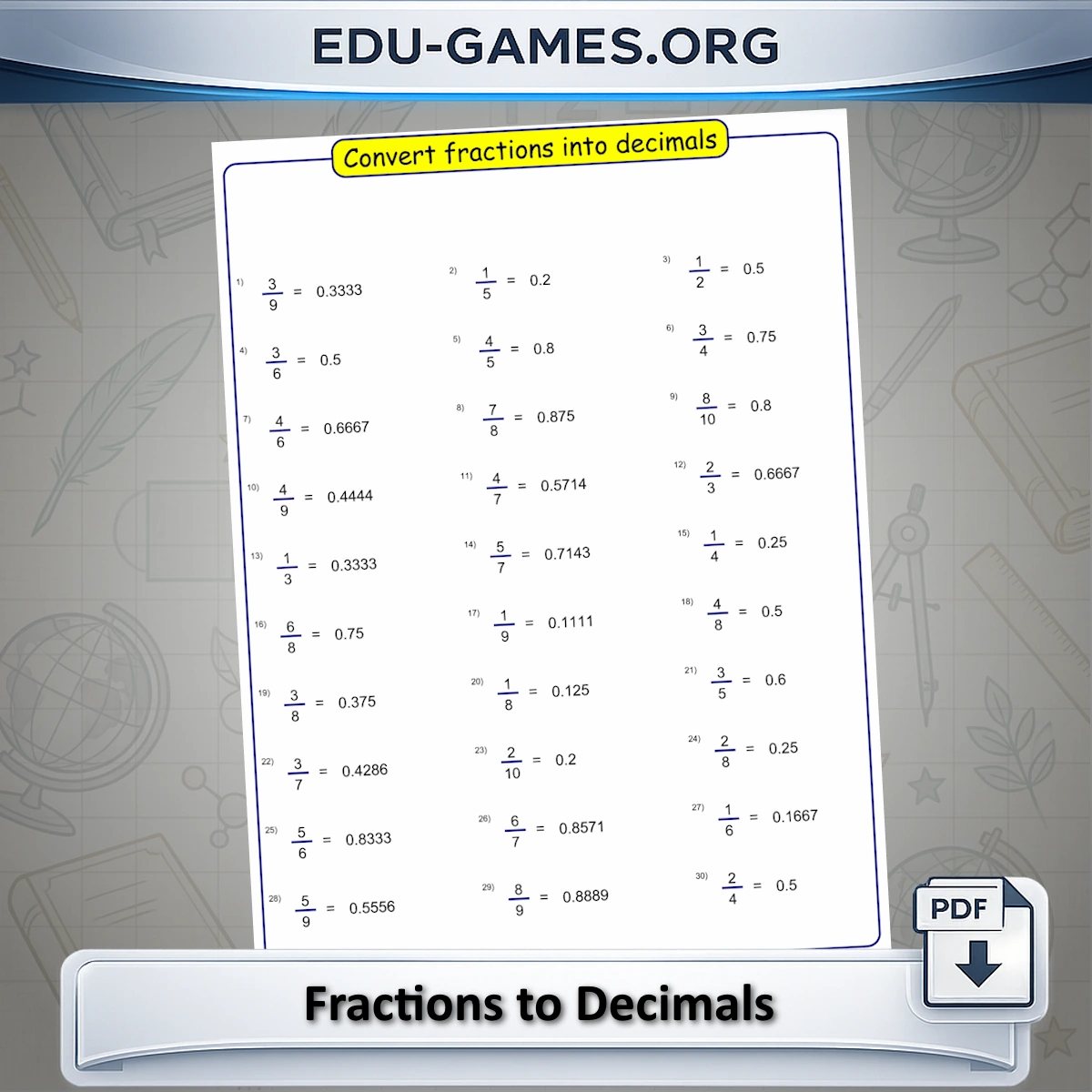
Clear, step-by-step practice for converting fractions to decimals. This page includes simple explanations, two proven methods (long division and equivalent fractions), a worked example, and a printable worksheet with an answer key. Perfect for warm-ups, homework, or quick classroom drills.
Use this fraction-to-decimal worksheet generator to create printable practice sheets for your students. You control the difficulty by setting the denominator range — type in specific values separated by commas (for example, 2, 3, 4) or specify a range using a dash (for example, 5-10). You can also use the preset levels (Easy, Medium, Hard, Extreme) and fine-tune the values if needed.
Worksheets are generated dynamically, so you can download as many PDFs as you want — all for free.
Create Your Fractions-to-Decimals Worksheet
Worked Example — Convert to a Decimal
Method A — Long Division
We want to calculate .
- Divide 3 by 4. Since 4 does not go into 3, write and add a zero → 30.
- Now divide 30 by 4. It fits 7 times because . Remainder = 2.
- Bring down another 0 → 20. Divide 20 by 4. It fits 5 times because . Remainder = 0 → stop.
Final result: .
Method B — Equivalent Fraction with Denominator 100
Rewrite as a fraction over 100. Multiply numerator and denominator by 25: . Now simply read it as .
Mastering Fraction to Decimal Conversion
Converting a fraction to its decimal equivalent is one of the most fundamental skills in middle school mathematics. An improper fraction is simply a representation where the numerator is larger than the denominator, making its value greater than one. To convert it to a mixed number or a decimal, we essentially perform division.
The Long Division Method and Decimal Types
The conversion process involves using long division to divide the numerator by the denominator. This process can result in two types of decimals:
- Terminating Decimals: The division ends with a remainder of zero (e.g., 0.25). This often happens when the denominator's prime factorization contains only 2s and 5s.
- Repeating Decimals: The same sequence of digits repeats indefinitely (e.g., 0.3333…). This occurs when the prime factors of the denominator include numbers other than 2 or 5.
Educational Context and Real-World Application
Understanding this conversion is crucial for working with rational numbers in higher-level algebra and for practical uses in finance, measurement, and engineering. This generator allows students to practice the mechanics of division and build confidence in handling both mixed numbers and decimal formats.
Teaching Strategies and Curriculum Alignment
This resource is ideal for 4th-grade math introduction to mixed numbers and 6th-grade math review of decimal conversion. Teachers can utilize the dynamic generator for:
- Daily Warm-Ups: Quickly generate a small set of 10 problems for a class starter.
- Differentiated Assignments: Use the Denominators Range shortcuts (Easy, Medium, Hard) to create worksheets tailored to individual student needs and pace.
- Quiz Creation: Generate multiple unique versions of the same quiz by simply hitting the "Create New" button, preventing sharing of answers.
Remember, the worksheets are dynamically created, offering an unlimited number of unique variations for continuous, free practice.
Explore Related Fraction and Decimal Resources
Deepen your student's understanding by practicing these related skills:
Share these free fractions to decimals conversion worksheet with your friends