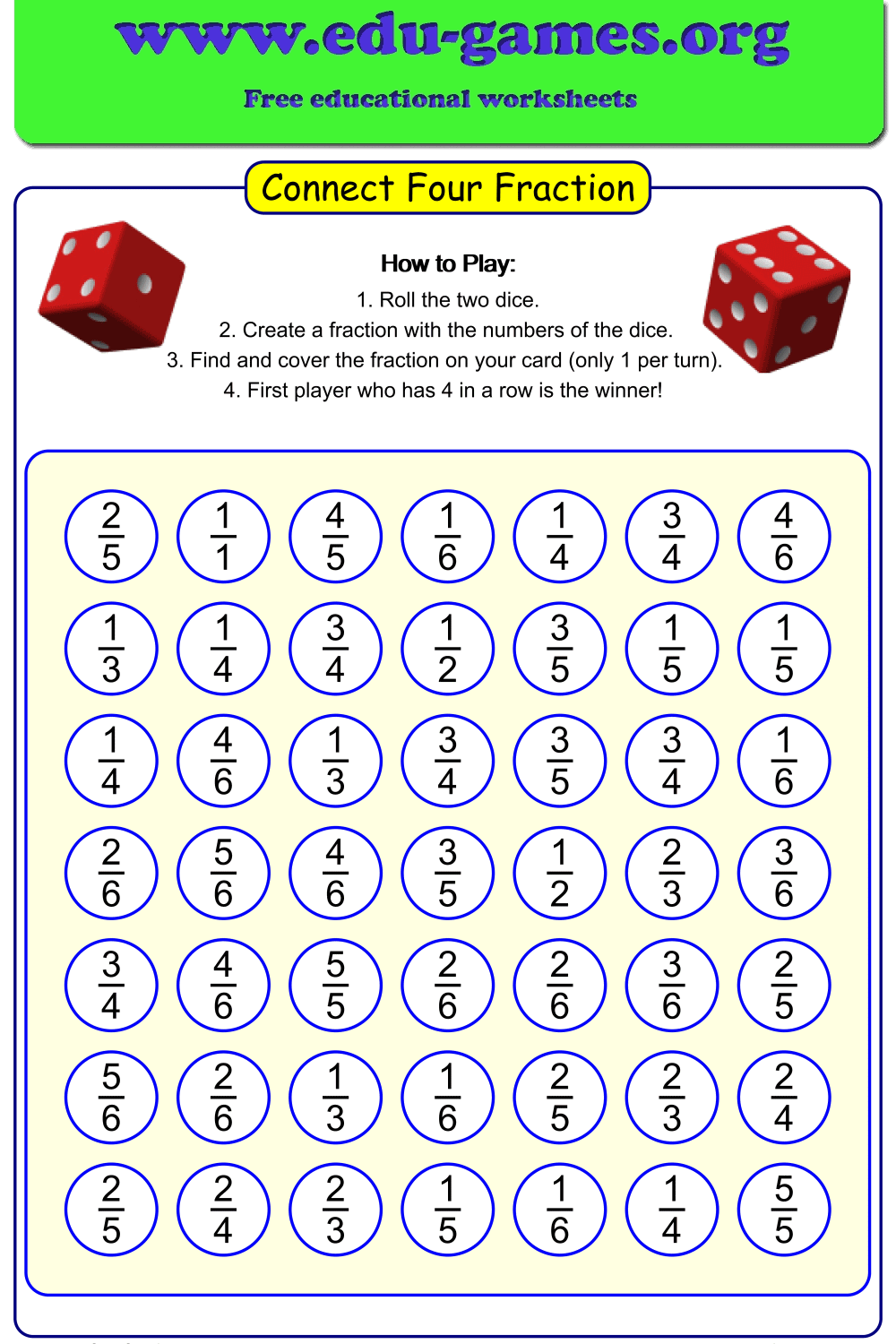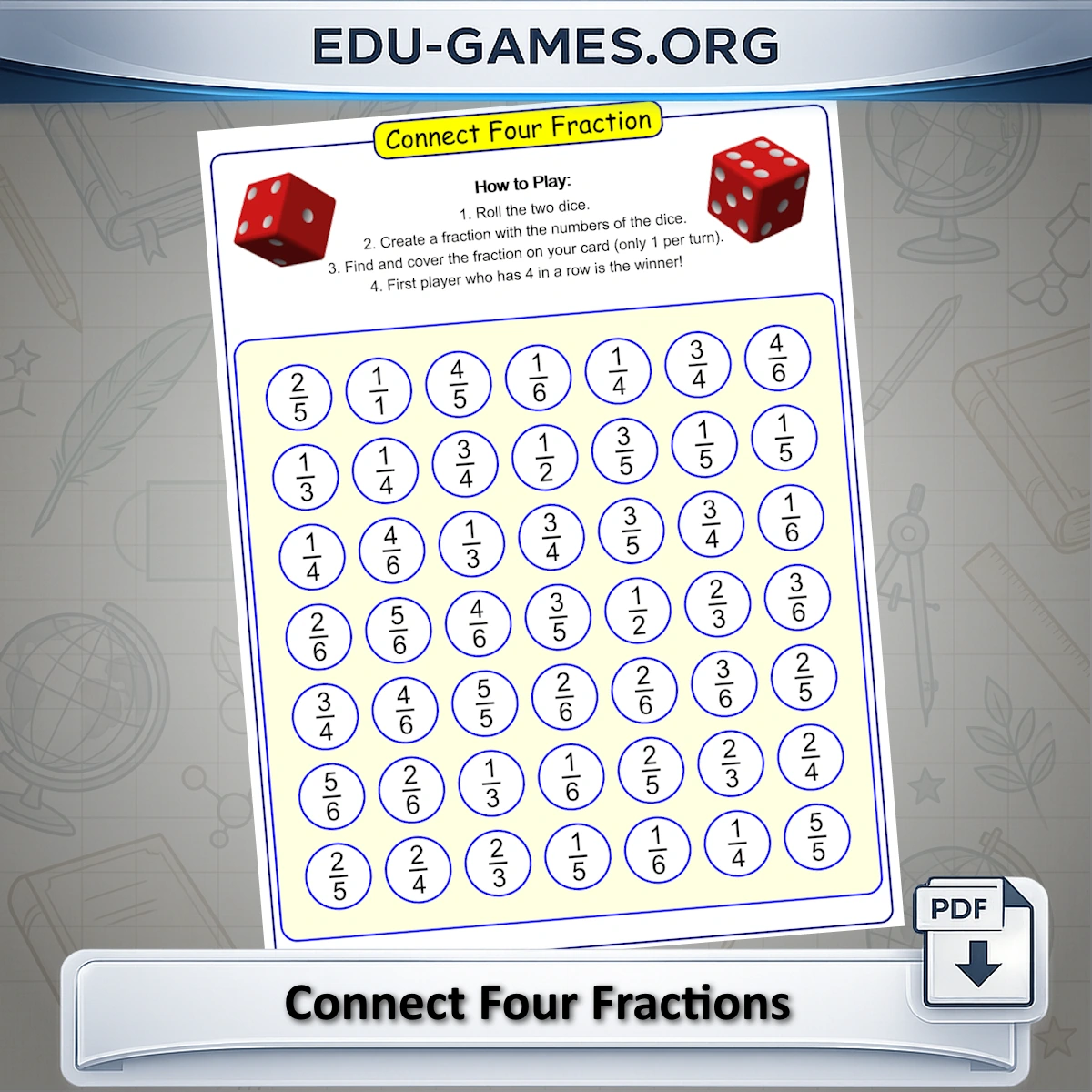
Connect Four Fractions is a printable dice game for groups. Each player gets a unique card printed with fractions. On every turn, a student rolls two dice and uses the numbers to form a fraction — then all players check whether that fraction appears on their card. Cover it with a counter if it does. The first player to cover four fractions in a row — across, down, or diagonally — wins.
Create Your Connect Four Fractions Cards
How to Use This Connect Four Fractions Generator
- Set the number of cards — enter how many unique cards you need. Each card has a randomized layout, so no two players get the same board.
- Edit the instructions (optional) — the instructions text appears on every printed card. Modify it to add classroom-specific rules or simplify the language for younger students.
- Click "Create" — a preview of the cards appears instantly.
- Download the PDF — print and cut the cards. Hand one to each student. Provide two dice per group.
- Play — students take turns rolling the dice, forming a fraction from the two numbers, and covering that fraction on their card if it appears. First player with four in a row wins.
Why Use Connect Four Fractions?
Most fraction activities require students to compute an answer. Connect Four Fractions shifts the focus to fraction recognition — reading a fraction, locating it on a grid, and deciding whether it matches. That distinction matters: students who can recognize fractions quickly and accurately are better prepared for comparison, equivalence, and operation tasks than students who have only ever computed with fractions.
- High repetition rate — because all players respond to every dice roll (not just the active player), every student reads and checks fractions on every turn, producing far more practice events per session than a round-robin format.
- Low barrier to entry — the rules take under two minutes to explain. Students who have just been introduced to fraction notation can play successfully, making it an effective early-practice activity.
- Natural differentiation — the same game works across a range of ability levels. Students who are still building recognition benefit from the repetition; stronger students can focus on the strategic choice of which fraction to form from the two dice numbers.
- Group engagement — the competitive element and the shared dice roll keep all students engaged throughout the session, unlike individual worksheet tasks where early finishers disengage.
Share this free Connect Four Fractions worksheet maker