Sixth Grade Math: Skills & Curriculum Guide
What sixth graders need to know in math — and why it matters. Covers the key skills: ratios and proportional relationships, integers and rational numbers, expressions and equations, geometry, and statistics.
Used by thousands of teachers · Instant PDF download · No account required
This is the curriculum guide, not the worksheet library. If you need printable sheets to download right now, go to browse all sixth grade math worksheets. If you want to understand what children should be able to do by the end of sixth grade, how those skills build on fifth grade, or which resources to use for a specific topic — read on.
Free Sixth Grade Math Resources
- Grade 6 Fractions Worksheets — ratios, unit rates, proportional relationships, and fraction-to-decimal-to-percentage conversion.
- Grade 6 Printable Math Games — maze, bingo, and logic puzzle formats that apply ratio, fraction, and integer skills in a structured challenge.
- Browse all sixth grade math worksheets — a broad collection covering every sixth grade topic in one place, including integers, expressions, equations, geometry, and statistics.
Sixth Grade Math Learning Goals
By the end of sixth grade, students are expected to have mastered these core skills:
- Ratios & Proportional Relationships – Write and interpret ratios; find unit rates; solve real-world problems using proportional reasoning and equivalent ratios.
- Fractions, Decimals & Percentages – Apply all four fraction operations fluently; convert between fractions, decimals, and percentages; solve percentage problems including discount, tax, and interest.
- Integers & Rational Numbers – Understand positive and negative numbers on the number line; add, subtract, multiply, and divide integers; apply absolute value.
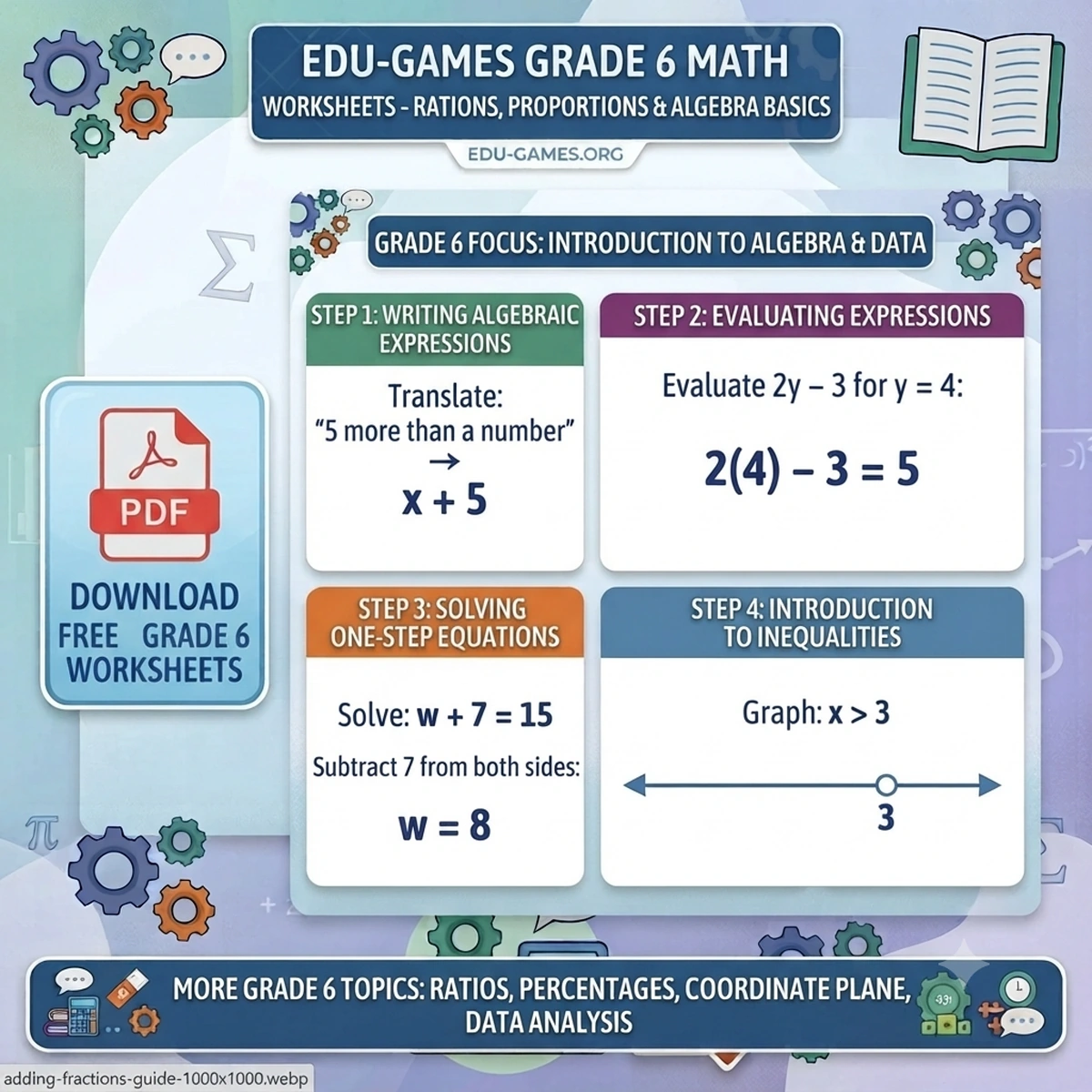
- Expressions & Equations – Write, interpret, and evaluate algebraic expressions; solve one-step and two-step equations and inequalities.
- Geometry – Calculate area and perimeter of polygons; find surface area using nets; calculate the volume of rectangular prisms; work with coordinate geometry in all four quadrants.
- Statistics & Data – Calculate mean, median, mode, and range; describe data distribution; read and create histograms, box plots, and dot plots.
- Problem Solving – Apply multi-step strategies to real-world problems that integrate ratios, fractions, integers, and geometry.
Where to Start — A Quick Decision Guide
Not sure which resource to use? Here is a short guide based on where your child or student currently stands:
- Just starting sixth grade / consolidating fifth grade — Check that all four fraction operations are fluent and decimal arithmetic is reliable before moving into ratio work. Students who are uncertain about fraction division will find ratio and proportion confusing, because the underlying calculation is the same. A brief review using the Fractions Worksheets at the fifth-grade level is time well spent.
- Mid-year, on track — Work through ratio, rate, and proportional reasoning alongside integer operations. These are the two big new conceptual areas of sixth grade and they develop independently, so both can be practised in parallel. Use Math Games to keep engagement high during the heavy conceptual load of the ratio unit.
- Ready for a challenge — Move into expressions and equations, coordinate geometry in all four quadrants, and statistical analysis (mean, median, mode, data distribution). The broad Grade 6 Worksheets collection covers all of these.
- Bridging to seventh grade — Ensure ratio and proportional reasoning are fluent, integer arithmetic is reliable across all four operations, and one-step equation solving is comfortable. Seventh grade builds directly on these with proportional relationships, multi-step equations, and the geometry of scale drawings and constructions.
Why Sixth Grade Math Is a Turning Point
Sixth grade is the year mathematics makes its most significant shift since first grade. Until now, students have worked almost exclusively with positive numbers and the four arithmetic operations. Sixth grade introduces ratios and proportional relationships — a way of thinking about how quantities relate to each other that is fundamentally different from addition and subtraction. Ratio reasoning underpins nearly everything in grades 7 and 8: proportional relationships, scale drawings, percentage calculations, unit conversions, probability, and the early algebra that leads to linear equations.
Negative numbers arrive in sixth grade as well, extending the number line in a direction students have not worked with before. The conceptual challenge is significant: students must reconcile the intuition that "you cannot take away more than you have" with the fact that integer subtraction produces meaningful results below zero. Building this understanding carefully — through the number line model before moving to the rules for multiplication and division of integers — prevents the procedural errors that persist for years when the concept is rushed.
The first algebra also appears in sixth grade: writing and solving expressions and equations. Students who arrive at seventh grade having understood expressions as compressed descriptions of operations — not just symbols to manipulate — are far better prepared for the two-variable work and graphing that follows. Games and puzzle activities are particularly effective here because they require students to think about what an equation means, not just execute a procedure to solve it.