Free Subtraction Resources
- Subtraction Worksheets — single-digit facts, column subtraction with and without regrouping, and multi-digit problems. Set the number range, download a unique PDF with an optional answer key in seconds.
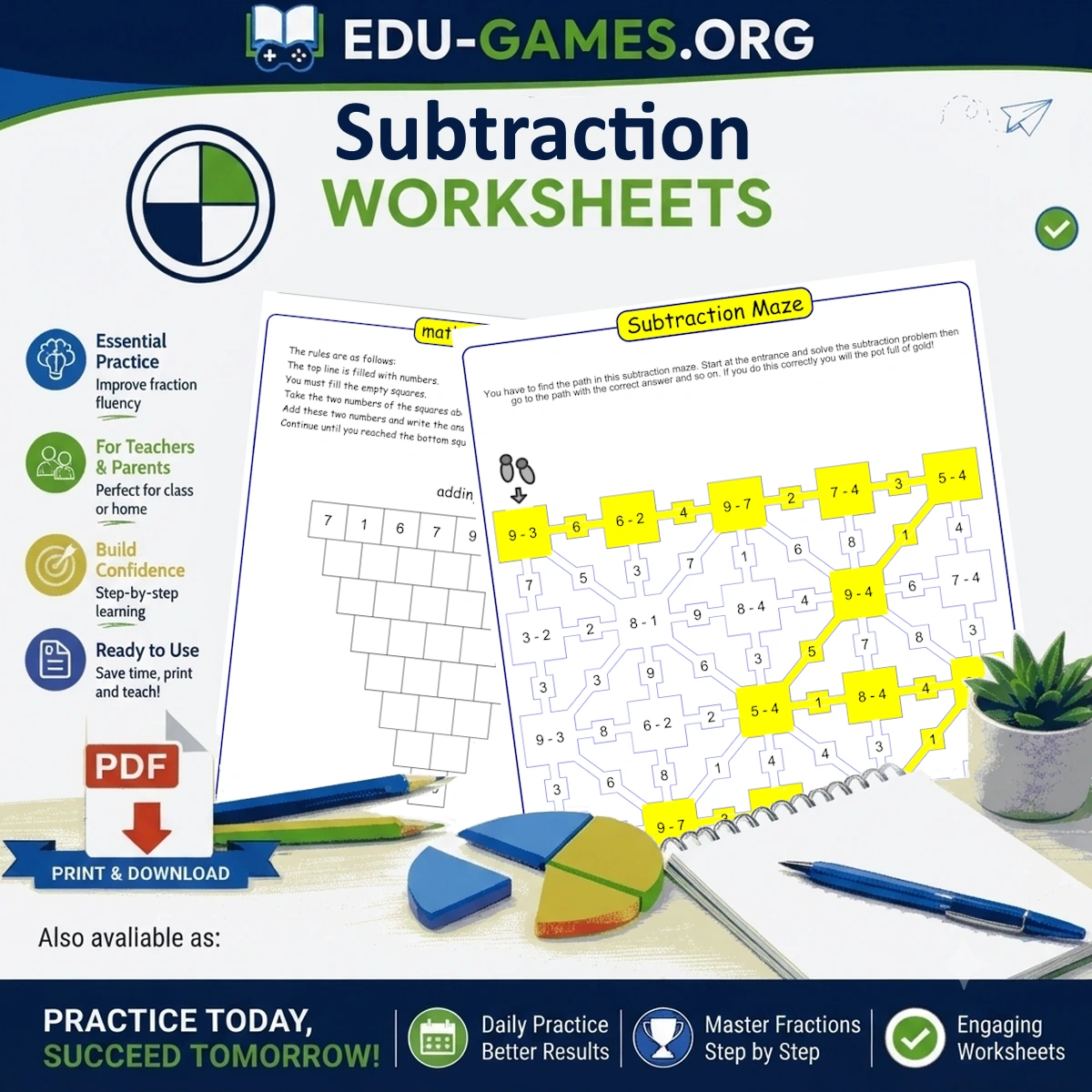
- Subtraction Game Worksheets — bingo cards, mazes, and other activity formats that embed subtraction facts in an engaging challenge. Ideal for math centers and partner work.
How to Use the Subtraction Generators
Choose the format that matches your teaching goal. Use drill worksheets when the priority is building fast, reliable recall of subtraction facts — they deliver a high density of practice problems on a defined number range and are easy to use for timed sessions or daily warm-ups. Use game worksheets when motivation is the limiting factor — the same subtraction facts appear in a maze or bingo layout that gives students a goal to work toward, generating more repetitions per session than a plain drill sheet typically does.
The number range is the key setting to adjust as students progress. Start with differences within 10 for Grade 1, extend to within 20 by mid-Grade 2, then move to two-digit and multi-digit column subtraction as regrouping is introduced. Because every sheet is generated fresh, you can produce differentiated versions at different difficulty levels for mixed-ability groups in the same session.
Why Subtraction Fluency Is the Foundation of Arithmetic
Subtraction fact fluency — the ability to produce differences instantly without counting back — is essential by the end of Grade 2. Every multi-digit subtraction calculation requires single-digit differences to be retrieved at each step; a student who still counts back on 14 − 7 has no working memory available for tracking the regrouping that multi-digit problems require. Automatising facts first makes the procedural steps manageable.
Subtraction fluency also reinforces the inverse relationship with addition, which is foundational for algebraic thinking: understanding that 15 − 8 = 7 because 7 + 8 = 15 directly supports solving equations by inverse operations. The CCSS expects fluency within 20 by the end of Grade 2 (2.OA.2) and within 100 by Grade 3 — meeting those targets on schedule means students arrive at multi-digit work without a basic-fact bottleneck slowing every calculation.
Explore other operations: