Create your word search puzzle with clues
Membership is free.
What is a Word Search with Clues?
A word search with clues is an advanced variation of the classic word search. Instead of receiving a list of words to find, students read a description or clue and must figure out the word before hunting for it in the grid. That double effort turns the puzzle into a powerful vocabulary activity that trains reading comprehension and word memory at the same time.
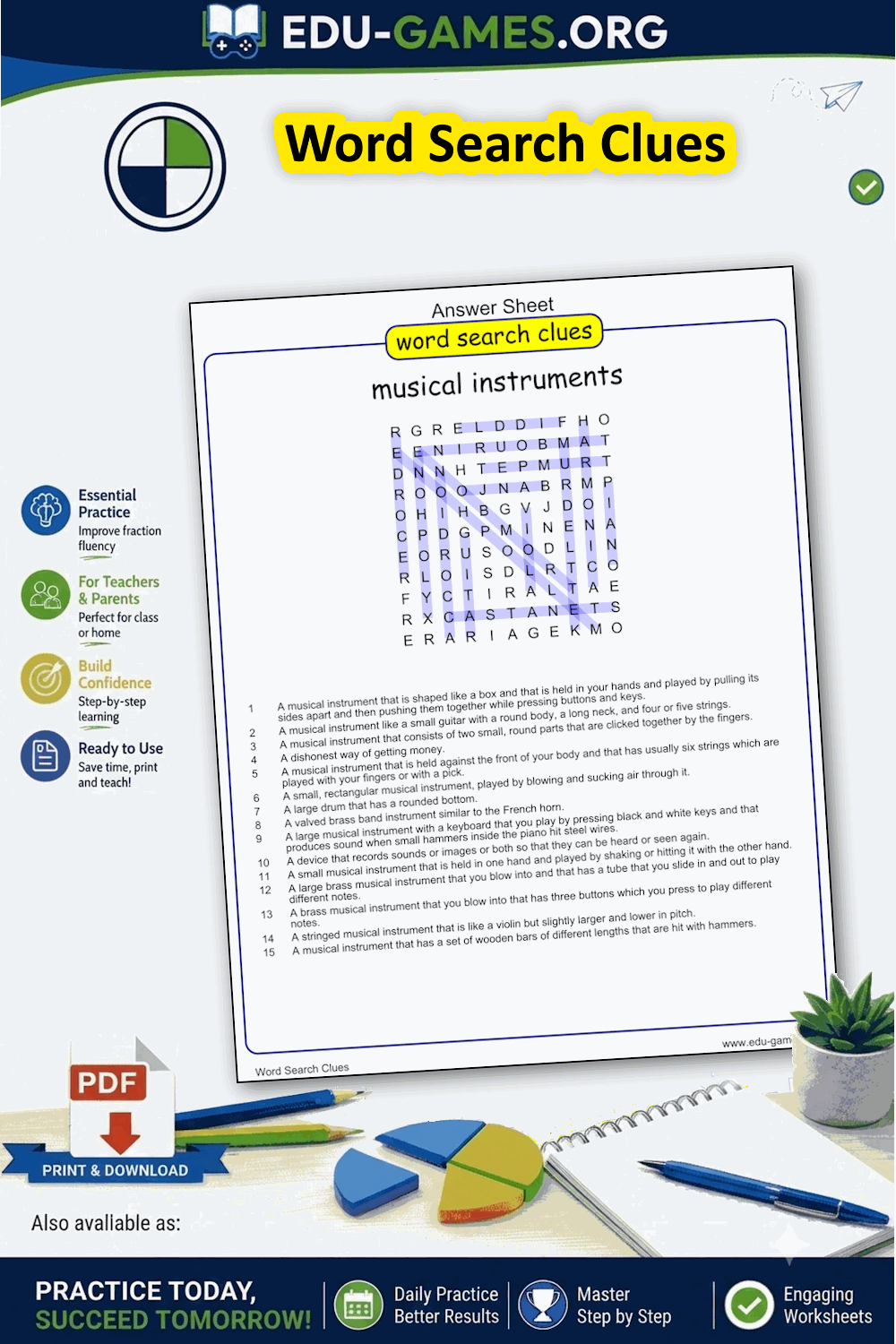
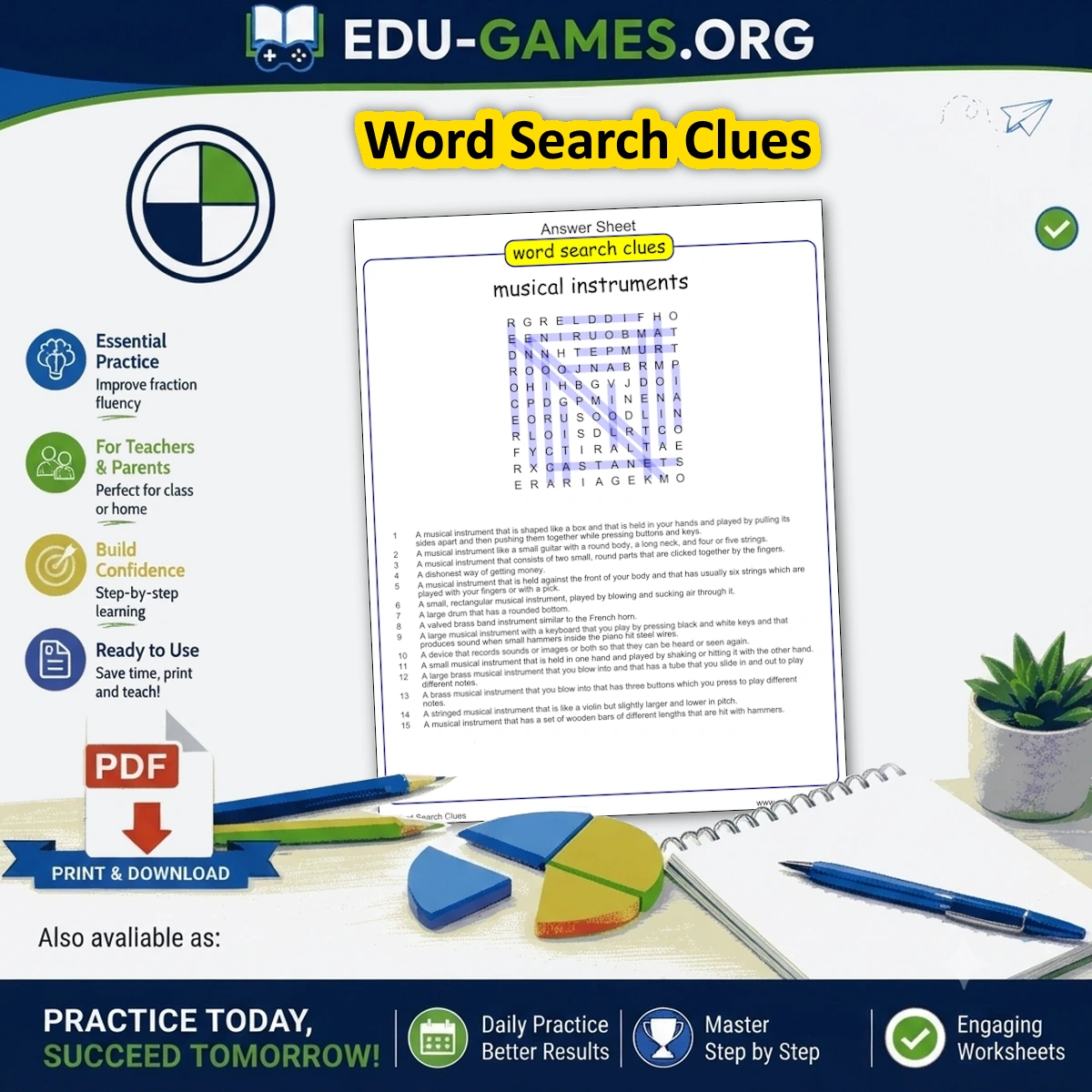
With our free word search maker with clues you can create a printable word search with your own words and clues in under a minute—no account needed. The downloadable PDF includes the clues puzzle and a full solution page ready to print.
How to Create Your Word Search with Clues — Step by Step
- Add a title – give the puzzle a name so students know the topic.
- Enter your words and clues – type each word with its description or definition.
- Choose directions – horizontal, vertical, diagonal, or all eight for maximum challenge.
- Toggle capitalization – uppercase letters add an extra layer of difficulty.
- Generate – click "Generate a New Word Search" for an instant result.
- Download the PDF – print or share digitally. The file includes both the puzzle and the solution.
If you want to practise the same vocabulary in a different format, try our crossword maker or create a worksheet with word scramble— all tools accept the same word list and export to PDF.
Clue Examples for Different Levels
A good clue guides without giving it away. Here are concrete examples to inspire you when you create a word search online for your class:
| Level | Hidden word | Clue |
|---|---|---|
| Beginner | APPLE | A red or green fruit that grows on trees |
| Elementary | LIBRARY | A place where you can borrow books for free |
| Intermediate | SUSTAINABLE | Able to be maintained without depleting natural resources |
| Advanced | AMBIGUITY | The quality of having more than one possible meaning |
Popular printable word search themes
These topics work especially well for a printable word search with clues:
- Science vocabulary – define processes (photosynthesis, evaporation) and ask for the term.
- History & geography – use dates, country descriptions, or historical figures as clues.
- Foreign language (CLIL / EFL) – clues in L1, hidden words in the target language.
- Jobs and professions – "a person who fixes water pipes" → PLUMBER.
- Animals – "the largest land animal on Earth" → ELEPHANT.
Need ready-made puzzles on these topics? Check out our reverse word search for another clue-driven twist, or browse the full range of word scramble worksheets.
Using Word Search with Clues in the Classroom
Standard word searches are often criticized as "busy work" because they only require visual pattern matching. By replacing the word bank with descriptions, synonyms, or clues, you turn this word search generator into a real formative assessment tool.
1. The "Reverse Dictionary" Challenge
Use this vocabulary activity to reinforce unit terms. Instead of providing the word "Photosynthesis," give the clue: "The process by which green plants use sunlight to synthesize nutrients."
- The benefit: Students practise active recall—they must retrieve the term from memory before they can even start searching, mirroring how language is used in real writing and speech.
2. Synonyms and Antonyms
Hide advanced descriptive words and provide everyday words as clues. You can combine this with our word scramble maker to reinforce spelling in the same session.
- How it works: If the hidden word is "Exhausted," the clue is "Very tired." If the word is "Enormous," the clue is "Very big."
- Why it works: It bridges the gap between the student's current vocabulary (the clue) and their target vocabulary (the hidden word).
3. Bilingual Vocabulary (CLIL / EFL)
For language learners or immersion classrooms, this word search maker works as a highly effective translation scaffold. Provide clues in the student's native language and ask them to find the translated target word in the grid. You can then use the crossword maker with the same word list to practise writing the words.
- Pro tip: Especially effective for practising irregular verb forms or gender-specific nouns.
Share this free printable word search clues puzzle maker