Countdown Numbers Worksheets – Generate Unlimited Printable PDFs
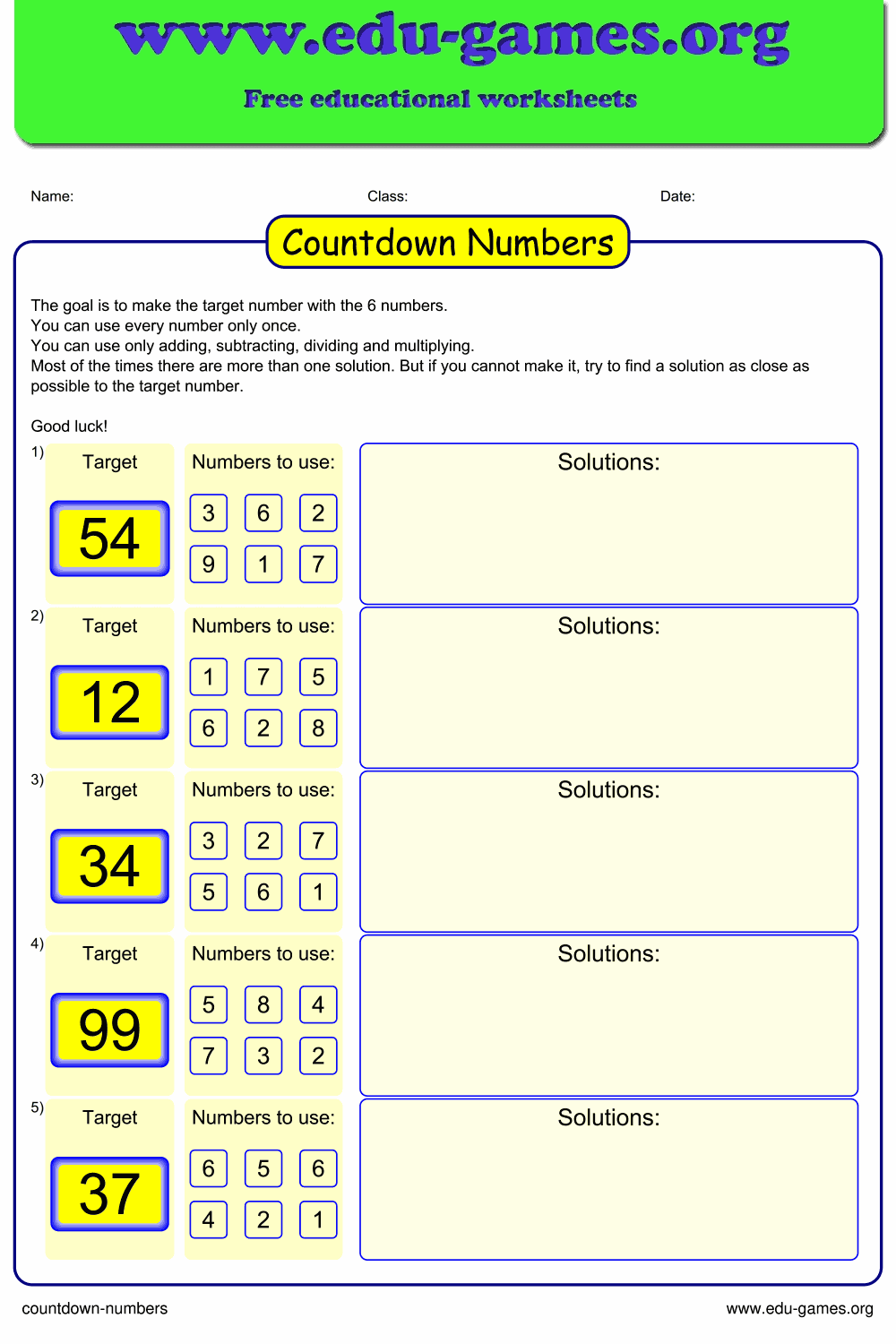
Generate custom printable Countdown Numbers worksheets in seconds. Students use six random numbers and the four operations to reach a target number — perfect for mental maths puzzles, number target challenges, and problem-solving activities in any classroom.
Six numbers. One target. Every operation allowed — but each number only once. That's the whole rule, and it's enough to keep a class genuinely stuck. Countdown Numbers is a logic and arithmetic challenge where students combine addition, subtraction, multiplication, and division to hit a target exactly — or land as close as possible when exact isn't achievable. The thinking it demands is deeper than any fill-in-the-blank drill.
This free generator creates a fresh, unique puzzle with every click. Set your own targets to control the difficulty, or randomise everything for instant variety. The solution toggle lets you download a student sheet and an answer key from the same puzzle — no second file, no extra prep.
Create your Countdown Numbers worksheet
What is the Countdown Numbers Game?
Countdown Numbers is a mental arithmetic puzzle that originated on Countdown, a British TV game show that first broadcast in 1982 and is still running. In the TV version, contestants choose from a pool of small numbers (1–10) and large numbers (25, 50, 75, 100) and are given a random three-digit target. The challenge: reach the target using any combination of the chosen numbers and the four operations, with each number used at most once.
This worksheet generator adapts the format for classroom use. Each puzzle gives students six numbers from 1–9 and a target you control, so the difficulty is entirely in your hands. Teachers use it as a countdown maths game, a mental maths puzzle, or a number target challenge depending on the lesson context.
The Rules
- You are given six numbers and a target number.
- Use any of the six numbers at most once. You do not have to use all of them.
- You may use addition, subtraction, multiplication, and division only.
- Every intermediate result must be a positive whole number — no fractions or negatives during the calculation.
- If no exact solution exists, the aim is to get as close to the target as possible.
A Quick Example
Target: 71. Numbers: 9, 8, 1, 8, 6, 9.
A clean solution: 9 × 8 − 1 = 71. Only three numbers used, two operations — achievable for most students once they recognise the near-multiple of 9 × 8 = 72.
A longer route to the same answer: 8 + (9 × (1 + 6)) = 71. Mathematically valid, but four numbers and three operations make it harder to spot. This is exactly why the game rewards systematic thinking over lucky guessing.
How to Use Countdown Numbers in the Classroom
Countdown Numbers builds number sense and flexible thinking. Unlike a drill, there is no single method — students must experiment with the four operations to find a path to the target.
Warm-Up Activity
Project the canvas on the board and give the class two minutes to solve the Countdown numbers challenge before revealing the answer. The shared number target puzzle generates discussion about different calculation routes — one student may use multiplication, another may add their way there. Both are correct, and comparing methods is the real learning.
Early Finisher Task
Print a stack in advance with different target values. Students who finish early have an open-ended challenge that requires no further instruction and no marking — the solution toggle provides instant feedback.
Differentiated Practice
Use targets below 100 for younger or less confident students, and targets above 100 for those ready for a greater challenge — both from the same generator, in the same lesson.
Homework
The worksheet is fully self-contained. The instruction text is customisable before printing, so you can add context or a specific note for your class without opening any other application.
Grade-Level Guidance
Grades 3–4 (Ages 8–9): Set targets between 10 and 50. Two-step solutions are common — for example, 3 × 8 = 24. Focus on multiplication and addition facts students already know.
Grades 5–6 (Ages 10–11): Targets between 50 and 100 typically require three steps. Introduce the strategy of working backwards: if the target is 63, ask "what multiplications give something near 63?" before trying combinations forward.
Grades 7–8 (Ages 12–13): Targets between 100 and 300 push students to use four or more numbers. Ask students to write out their working in full to practise notation and reinforce order of operations.
Enrichment / High School: Targets between 100 and 500 with a requirement to find two different routes. Compare routes by number of steps, numbers used, and elegance — this builds algebraic thinking and prepares students for proof and justification tasks.
What Skills Does Countdown Numbers Teach?
Countdown Numbers is not a test of memorised procedures — it is a thinking activity. These are the skills students actively practise every time they work through a puzzle:
- Mental arithmetic fluency. Rapid recall of times tables and number bonds directly speeds up the search for a solution. Students are motivated to practise facts because they can see them being useful immediately, not in the abstract.
- Order of operations. Brackets appear naturally as students build multi-step expressions. Students learn by doing that (9 × 8) − 1 and 9 × (8 − 1) give different results — a concrete, memorable lesson that no worksheet drill delivers as effectively.
- Systematic problem-solving. Effective solvers work methodically: identify multiplications near the target, then subtract or add to adjust. This "search and refine" strategy transfers directly to algebra, science, and logical reasoning tasks.
- Resilience and estimation. When no exact solution exists, students practise getting as close as possible and explaining why they cannot reach the exact target. This is genuine mathematical reasoning, not just arithmetic.
- Mathematical communication. Writing out each step in a readable chain of operations forces students to use correct notation and structure their working — habits that pay off at every stage of formal assessment.
Open-ended arithmetic challenges — problem-solving maths activities with multiple valid approaches — are consistently identified by numeracy researchers as more effective than single-answer drills for building flexible number sense and positive attitudes towards mathematics. The Countdown Numbers game is precisely this kind of task.