Third Grade Math: Skills & Curriculum Guide
What third graders need to know in math — and why it matters. Covers the key skills: multiplication and division facts, fractions, place value up to 10,000, geometry, measurement, and data.
1.7M+ worksheets downloaded · Instant PDF download · No account required
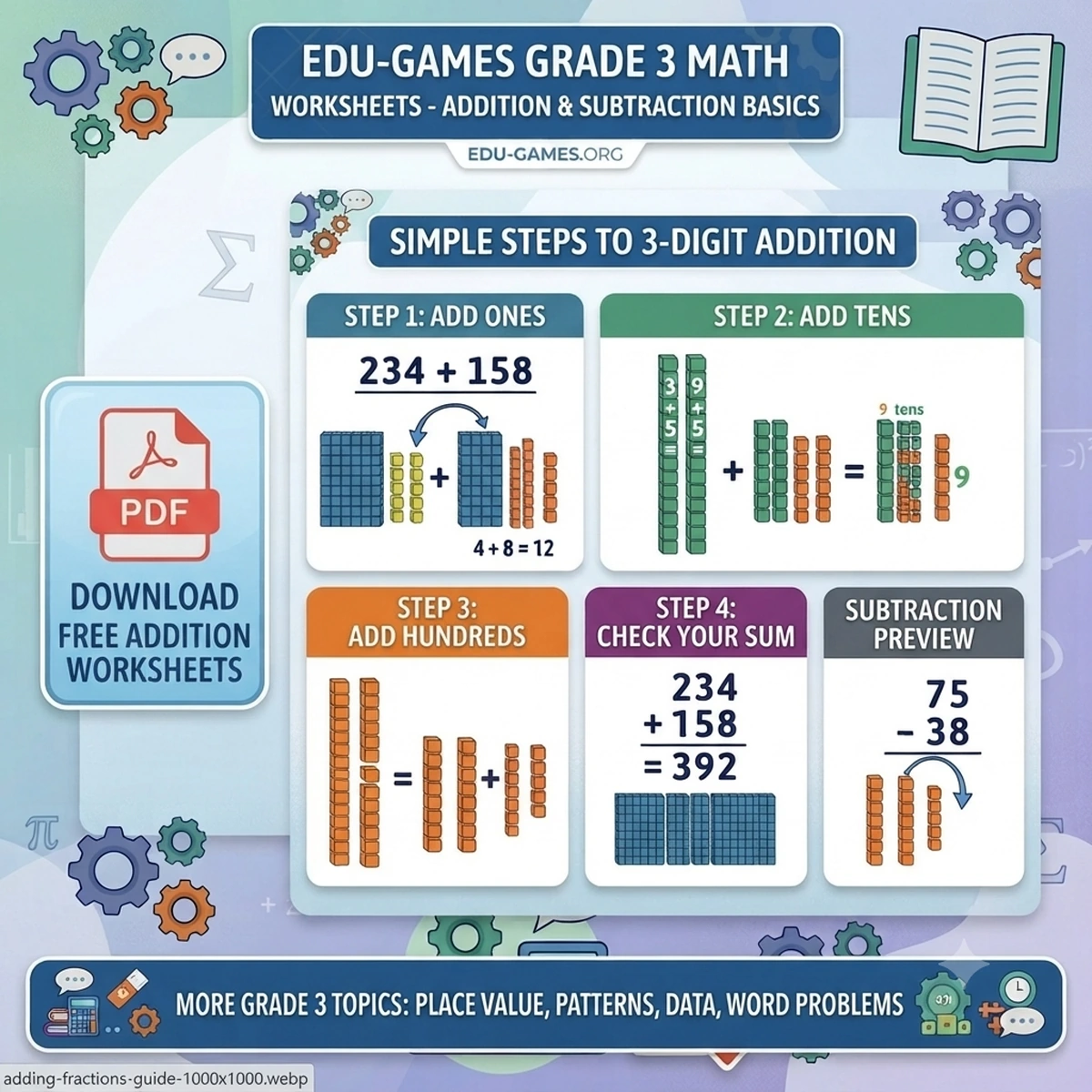
This is the curriculum guide, not the worksheet library. If you need printable sheets to download right now, go to browse all third grade math worksheets. If you want to understand what children should be able to do by the end of third grade, how those skills build on second grade, or which resources to use for a specific topic — read on.
Free Third Grade Math Resources
- Grade 3 Arithmetic Worksheets — multiplication, division, and mixed-operation drills with adjustable number ranges and table selection.
- Grade 3 Fraction Worksheets — representing, comparing, ordering, and finding equivalent fractions.
- Grade 3 Time Worksheets — clock reading to the nearest minute on analogue and digital formats.
- Grade 3 Printable Math Games — maze, bingo, and logic puzzle formats; ideal for learning centres and early finishers.
- Browse all third grade math worksheets — a broad collection covering every third grade topic in one place, including geometry, word problems, and data.
Third Grade Math Learning Goals
By the end of third grade, students are expected to have mastered these core skills:
- Multiplication & Division – Know multiplication facts up to 10×10; understand division as the inverse of multiplication; solve related word problems.
- Fractions – Identify, compare, and represent simple fractions (halves, thirds, quarters, sixths, eighths); understand fraction equivalence.
- Number Sense – Work confidently with numbers up to 10,000; understand place value; round to the nearest 10 or 100.
- Geometry – Recognise and describe shapes; understand symmetry; measure perimeter and area; identify angles.
- Measurement & Data – Tell time to the nearest minute; measure length, mass, and volume; interpret bar graphs, pictographs, and tables.
- Problem Solving – Apply math skills to solve multi-step word problems involving all four operations.
Where to Start — A Quick Decision Guide
Not sure which resource to use? Here is a short guide based on where your child or student currently stands:
- Just starting third grade / consolidating second grade — Begin with ×2, ×5, and ×10 multiplication facts in the Arithmetic Worksheets. These are already known as skip-counts and formalising them as multiplication facts builds confidence quickly.
- Mid-year, on track — Work through the remaining multiplication tables (×3, ×4, ×6, ×7, ×8, ×9) alongside the Fraction Worksheets. Use Math Games to keep engagement high while drilling facts.
- Ready for a challenge — Move into multi-step word problems, fraction comparison and equivalence, and perimeter and area. The broad Grade 3 Worksheets collection covers all of these.
- Bridging to fourth grade — Ensure multiplication facts up to 10×10 are automatic, confirm fraction equivalence is secure, and practise clock reading to the nearest minute. These are the specific skills fourth grade assumes students already have.
Why Third Grade Math Is a Pivotal Year
Third grade is the year multiplication moves to the centre of the curriculum. Until now, students have worked almost entirely with addition and subtraction. The introduction of multiplication as a new operation — not just repeated addition, but a distinct and powerful relationship between numbers — represents the largest conceptual shift since first grade. Students who leave third grade without fluent recall of their times tables carry that gap through every subsequent year of math.
Fractions appear for the first time as a major topic in third grade. Unlike whole-number arithmetic, fractions require students to understand a quantity that is smaller than one — a genuinely new idea that many children find counterintuitive. Early fraction work (halves, thirds, quarters) builds the mental models that make equivalent fractions, fraction addition, and eventually algebra far more accessible in later grades.
Multi-step word problems also become a serious expectation in third grade. Students must not only compute correctly but choose which operations to apply and in what order — a reasoning skill that games and puzzle activities develop particularly well. A mix of drill (for fact fluency) and puzzle-based practice (for applied reasoning) gives students both the speed and the flexibility they need to succeed in Grade 4 and beyond.