Free Printable Reading Thermometer Worksheets — Celsius & Fahrenheit
Generate and download free printable thermometer reading worksheets — choose Celsius, Fahrenheit, or both scales, pick a temperature range and increment, and download a PDF for classroom or home use. No account needed.
Used by thousands of teachers · Instant PDF download · No account required
Create your Reading Thermometer Worksheet
Include solution page
Paper format:
How to Use the Thermometer Worksheet Generator
- Select the scale your students will practice: Celsius, Fahrenheit, or celsius & fahrenheit (both scales on the same thermometer).
- Choose a temperature range. Each option has a fixed increment — 1° increments are easiest to read, 5° increments require interpolation and are more challenging.
- Optionally type lesson instructions in the Instructions field. Your text prints at the top of the worksheet.
- Click Create new Thermometers to generate a new set of thermometers with randomized temperature readings and see a live preview.
- Click Show Solution to verify all answers in the preview before printing.
- Select A4 or Letter paper size, then click Download the thermometer worksheet in PDF to save the file.
Why Use These Thermometer Worksheets?
- Scale flexibility: Practice Celsius, Fahrenheit, or both together — ideal for cross-curricular math and science lessons or for classes that need both systems.
- Adjustable difficulty: Narrower ranges with 1° increments suit grades 1–2; wider ranges with 5° increments challenge grade 3 and above.
- Real-world context: Reading a thermometer is a practical measurement skill used in weather, cooking, and science, making classroom practice immediately meaningful.
- Sub-zero reading: The −50 to 50 °C range introduces negative numbers in a concrete context, supporting understanding of number lines and signed values.
- Unlimited unique worksheets: Every click of "Create new Thermometers" generates a fresh set of temperature readings — no two worksheets are alike.
FAQ — Reading Thermometer Worksheets
Can I choose whether the worksheet uses Celsius, Fahrenheit, or both?
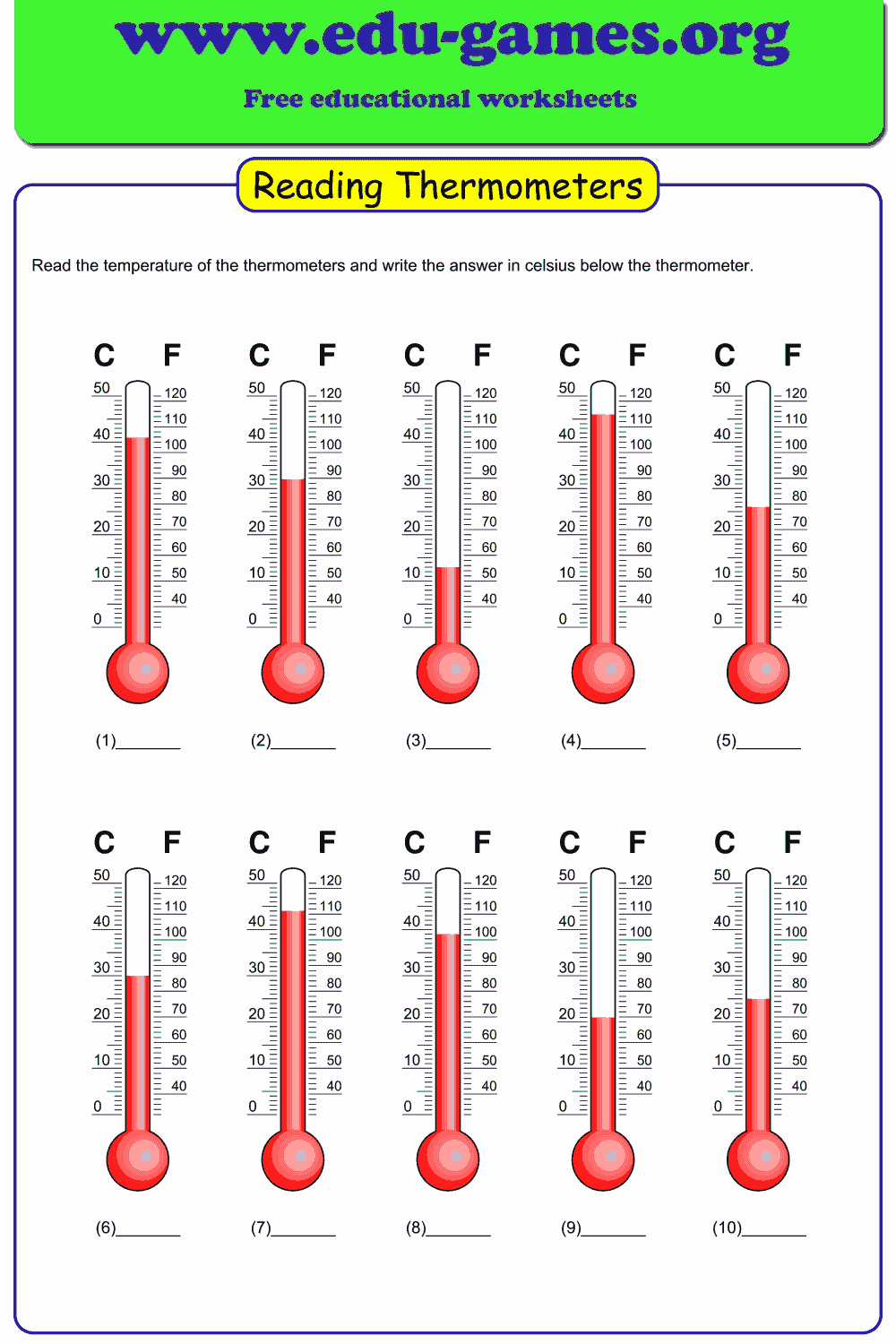
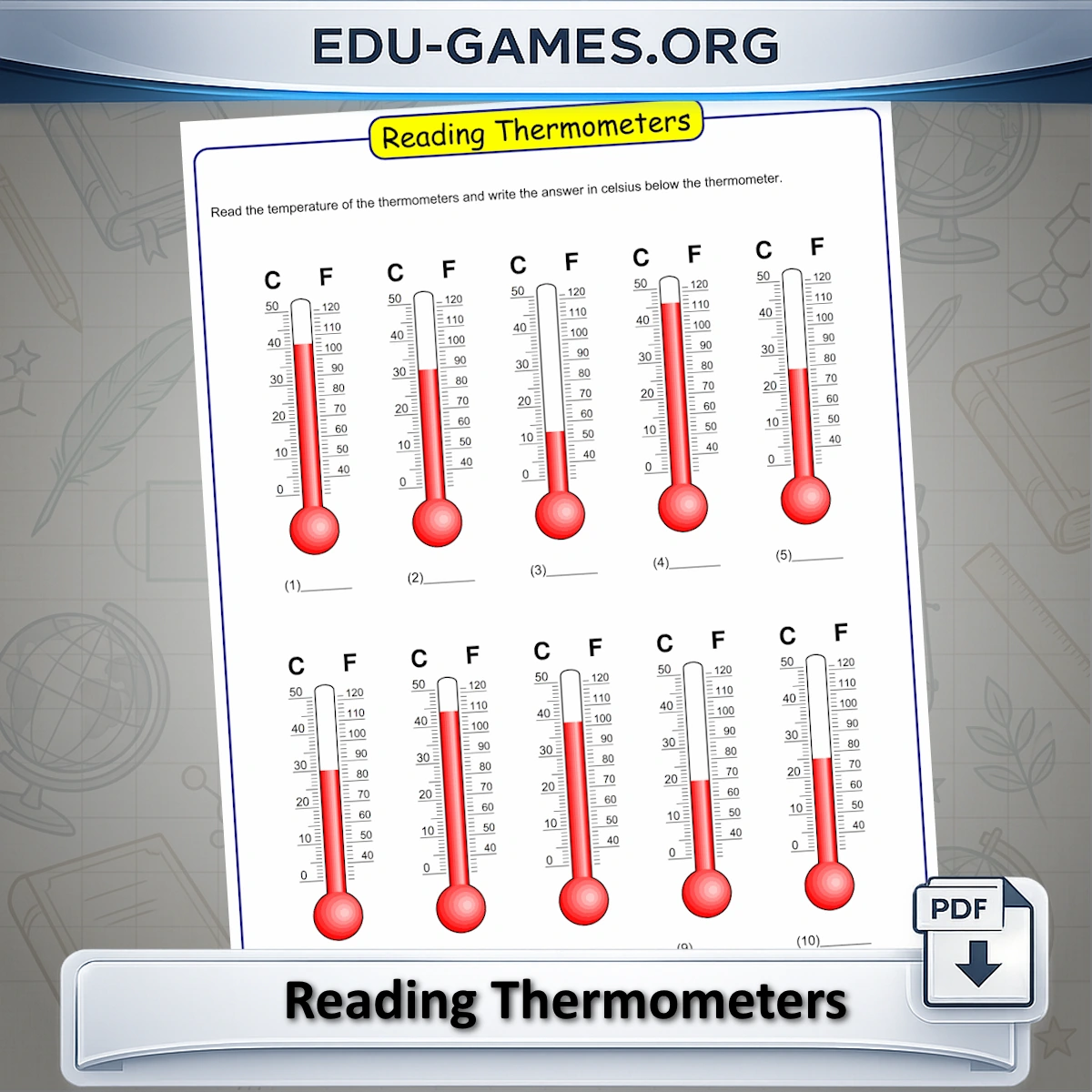
Yes. Select Celsius, Fahrenheit, or "celsius & fahrenheit" using the scale radio buttons. In "both" mode, each thermometer displays both scales side by side on the same diagram, which is ideal for conversion practice or introducing the relationship between the two scales.How do the temperature ranges and increments work?
Each range option is paired with a fixed increment. For example, the Celsius 0–50 option uses 1° increments (dense marks, easier to read), while 0–100 uses 2° increments, and −50 to 50 uses 5° increments (fewer marks, more challenge). A larger increment requires students to estimate between marks, increasing difficulty.Why are the Fahrenheit ranges in "celsius & fahrenheit" mode different from "Fahrenheit only" mode?
In combined mode the Fahrenheit range is chosen to align precisely with the paired Celsius range — for example, 50–104 °F matches 10–40 °C so both scales line up correctly on the same thermometer. In Fahrenheit-only mode there is no need to match a Celsius counterpart, so a different set of ranges is offered.What grade levels are these worksheets most suitable for?
The Celsius 0–50 (1° increments) and Fahrenheit 50–100 options are appropriate for grades 1–2. The wider ranges with 2° increments suit grade 2–3, while the −50 to 50 °C range (5° increments) can challenge grade 3 and above, especially as an introduction to sub-zero temperatures.Can I add custom instructions to the printed worksheet?
Yes. Type any text in the Instructions field before clicking "Create new Thermometers". Your text will appear at the top of the printed page — useful for writing the lesson context, telling students whether to round to the nearest degree, or giving a hint about the scale.Can I print the worksheets in A4 or Letter format?
Yes. Select either A4 or Letter paper size using the format selector in the download options. The thermometer layout adjusts automatically so the content fits the chosen paper dimensions.Why are some thermometers harder to read than others?
Thermometers with a wider temperature range use coarser increments — for instance, 5° per mark. Fewer lines on the scale mean students cannot count every tick and must interpolate position, which is a useful differentiation tool for more advanced learners.What is the Celsius −50 to 50 range useful for?
This range straddles zero, so students must read both positive and negative temperatures on the same thermometer. It works well for introducing sub-zero readings and connects math to real-world science contexts such as winter weather, food storage, or laboratory experiments.Does switching the scale radio button immediately reset the range options?
Yes. When you switch between Celsius, Fahrenheit, and "celsius & fahrenheit", the range selector updates to show only the options that are valid for that scale. Always confirm your temperature range selection after changing the scale, as the previous choice may no longer be visible.Share these thermometer worksheets with your friends