Free Time Resources
- Time Worksheets — draw the clock hands, read analog and digital clocks, and calculate elapsed time. Set the time interval and difficulty, download a unique PDF with an optional answer key.
- Time Game Worksheets — bingo cards and domino sets that embed clock-reading skills in an activity format. Ideal for math centers, partner work, and whole-class games.
How to Use the Time Generators
Choose the format that matches your teaching goal. Use drill worksheets when the priority is building accurate, reliable clock-reading — they deliver focused practice at a defined time interval and are easy to use for warm-ups or timed sessions. Use game worksheets when motivation is the limiting factor — the same time skills appear in a bingo or domino format that gives students a goal beyond simply completing a grid, generating more practice repetitions per session.
The time interval setting is the key control to adjust across the school year. Start with hours and half-hours for early Grade 1, move to five-minute intervals by Grade 2, and progress to any-minute reading and elapsed time calculations for Grades 3–4. Because every sheet is generated fresh, you can produce differentiated versions at different difficulty levels for mixed-ability groups in the same session.
The Three Stages of Learning Time
Mastering time is a gradual process that moves from concrete, real-world concepts to abstract mathematical understanding. For elementary students, learning typically progresses through three stages.
Stage 1 — Foundational Time Awareness (Grades 1–2)
The earliest stage focuses on daily routines and fundamental units. Use physical, manipulable clocks at this stage.
- Sequencing Events: Terms like "before," "after," "morning," and "yesterday" establish time order.
- Introduction to the Clock: Learning the purpose of the hour and minute hands; counting by 5s around the face.
- Key Times: "O'clock" and "half past" before moving to "quarter past" and "quarter to."
Stage 2 — Precision and Conversions (Grades 2–3)
Students begin reading time to the nearest minute and understanding relationships between units.
- Analog to Digital: Fluently converting time between analog and digital formats.
- Unit Equivalents: 60 seconds = 1 minute; 60 minutes = 1 hour.
- Time Lines: Visualising the passage of time as a linear distance, preparing students for elapsed time.
Stage 3 — Advanced Time Calculation (Grades 3–4)
The final stage involves complex problem-solving and real-life scenarios.
- Elapsed Time: Calculating the duration between a start and end time, including problems that cross the hour or noon.
- 24-Hour Clock: Introducing the 24-hour format and converting between 12-hour and 24-hour time.
Effective Strategies for Teaching Elapsed Time
Elapsed time — calculating the duration between a start and end time — is the most demanding time skill in the primary curriculum. Two strategies have the strongest track record in the classroom.
Strategy 1: The T-Chart Method
Ideal for organised, step-by-step thinking, especially when crossing the hour mark.
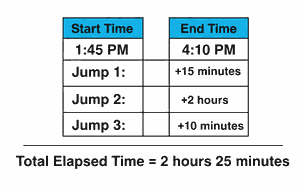
- List the start time and end time.
- Break the duration into "jumps" (e.g., jump to the next hour, then count remaining minutes).
- Sum the jumps to find the total elapsed time.
Example: 1:45 PM → 4:10 PM = 15 min + 2 h + 10 min = 2 h 25 min.
Strategy 2: The Time Number Line
A powerful visual tool that connects time to linear measurement.
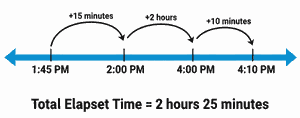
- Draw a line and mark the start time.
- Make large jumps to the nearest hour or half-hour.
- Make smaller jumps until you reach the end time.
- Label and sum the jumps.
Especially intuitive for time that crosses noon or midnight.
Time Worksheets & Games — Frequently Asked Questions
What grades and ages are these time worksheets suitable for?
The resources cover Grades 1 through 4 (ages 6–10). Worksheets at the hour and half-hour level suit Grade 1. Five-minute interval reading fits Grade 2–3. Elapsed time calculations and 24-hour clock materials are designed for Grade 3–4.What time topics are covered across the worksheets and games?
Resources cover: reading analog and digital clocks; "o'clock," "half past," "quarter to," and "quarter past" vocabulary; converting seconds, minutes, hours, and days; calculating elapsed time and duration; and an introduction to the 24-hour clock.When should students move from reading "o'clock" to reading to the nearest minute?
Most curricula introduce o'clock and half past in Grade 1, quarter past and quarter to in Grade 2, and reading to the nearest 5 minutes by mid-Grade 2. Reading to the nearest minute is typically a Grade 3 target. Moving too early, before students can reliably count by fives around the clock face, tends to generate guessing rather than real understanding.What are the main stages of learning time for elementary students?
- Foundational Time Awareness (Grades 1–2): Daily routines, sequencing events, and introducing the clock hands (o'clock, half past).
- Precision and Conversions (Grades 2–3): Reading to the nearest minute, converting units (60 seconds = 1 minute), and using number lines.
- Advanced Time Calculation (Grades 3–4): Elapsed time word problems, durations that cross the hour, and the 24-hour clock.
What is the best way to teach elapsed time?
Two methods work best in the classroom:
- The T-Chart Method: Break the duration into organised "jumps" (e.g., jump to the next hour, then count remaining minutes). Students track each jump in a table and sum them at the end.
- The Time Number Line: Draw a line, mark the start time, and make sequential jumps to landmark times until reaching the end. This visual method is especially clear when time crosses noon or midnight.