Choose a generator below to create a custom printable time worksheet as an instant PDF. Each generator lets you set the time interval, clock type, and an optional answer key before downloading. All worksheets are free and work for classroom practice, homework, math centers, and homeschooling — no account or subscription needed.
Time Worksheet Generators
Add Subtract Time
Grades 4, 5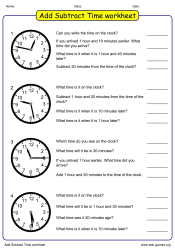
How much time has passed? Students read four analog clocks and use them to solve addition and subtraction problems with time. A real-world math skill that connects telling time to practical calculation — perfect for building the kind of number sense students use every day.
Draw Hands on the Clock
Grades 1, 2, 3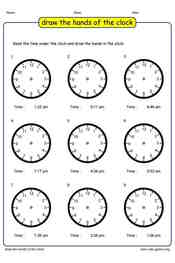
Reading a clock is one thing — drawing the hands correctly is another! Students see the time written in words or digits and must draw the hour and minute hands in the right position. A hands-on worksheet activity that turns time-telling into a truly active skill.
Telling Time
Grades 1, 2, 3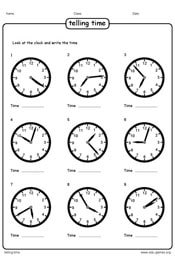
Generate customizable analog clock worksheets in seconds! Choose how many clocks to include, set the difficulty from full hours to exact minutes, and create the perfect practice sheet for your students. An essential skill made simple and fun to learn.
How to Use the Time Worksheet Generators
Start by choosing the format that matches your teaching goal. Use draw-the-hands worksheets when you want students to actively produce the answer — drawing is more demanding than reading and leads to stronger retention of the hand positions. Use tell-the-time worksheets when you want students to read a clock and write the time, building fluency in the recognition direction. Use elapsed time worksheets when students are ready for calculation — these require both accurate reading and arithmetic.
The time interval is the key setting to adjust across the school year. Start with whole hours and half-hours for Grade 1, move to 5-minute intervals by Grade 2, and narrow to any-minute precision for Grade 3–4. Because every sheet is generated fresh, you can produce a harder and an easier version in the same session for mixed-ability groups without any extra preparation.
Why Varied Time Practice Builds Stronger Clock-Reading Skills
Clock-reading is not one skill but a sequence of them — counting by fives, understanding the dual role of each hand, interpreting the relationship between the two hands simultaneously, and then adding the precision of minute-level reading on top. Students who practise only one format tend to develop a narrow procedural habit rather than a flexible understanding.
Drawing worksheets and reading worksheets target opposite directions of the same skill: drawing forces students to recall hand positions from memory, while reading builds recognition speed. Alternating between both formats produces more durable learning than repeating the same type. Adding elapsed time worksheets later creates a third layer — requiring students to apply their clock-reading skill inside a calculation, which is the most demanding and curriculum-relevant use of the skill.
Also check out the Time Games page for bingo and domino formats — game-style layouts generate more practice repetitions per session because students are working toward a goal that maintains engagement through a higher volume of problems.