Edu-Games.org
By Teachers, for Teachers

Free Printable Telling Time Worksheets — PDF Generator

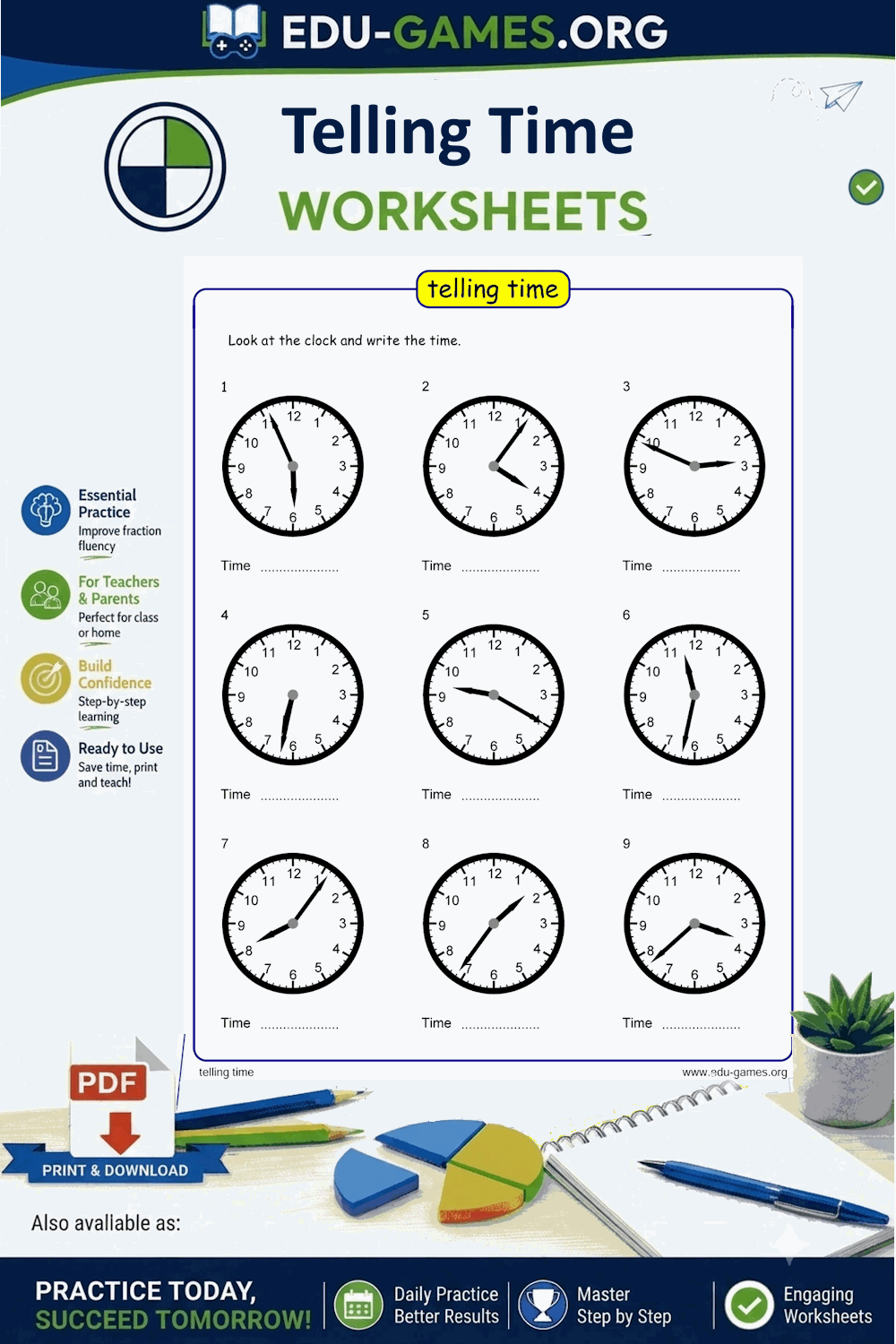
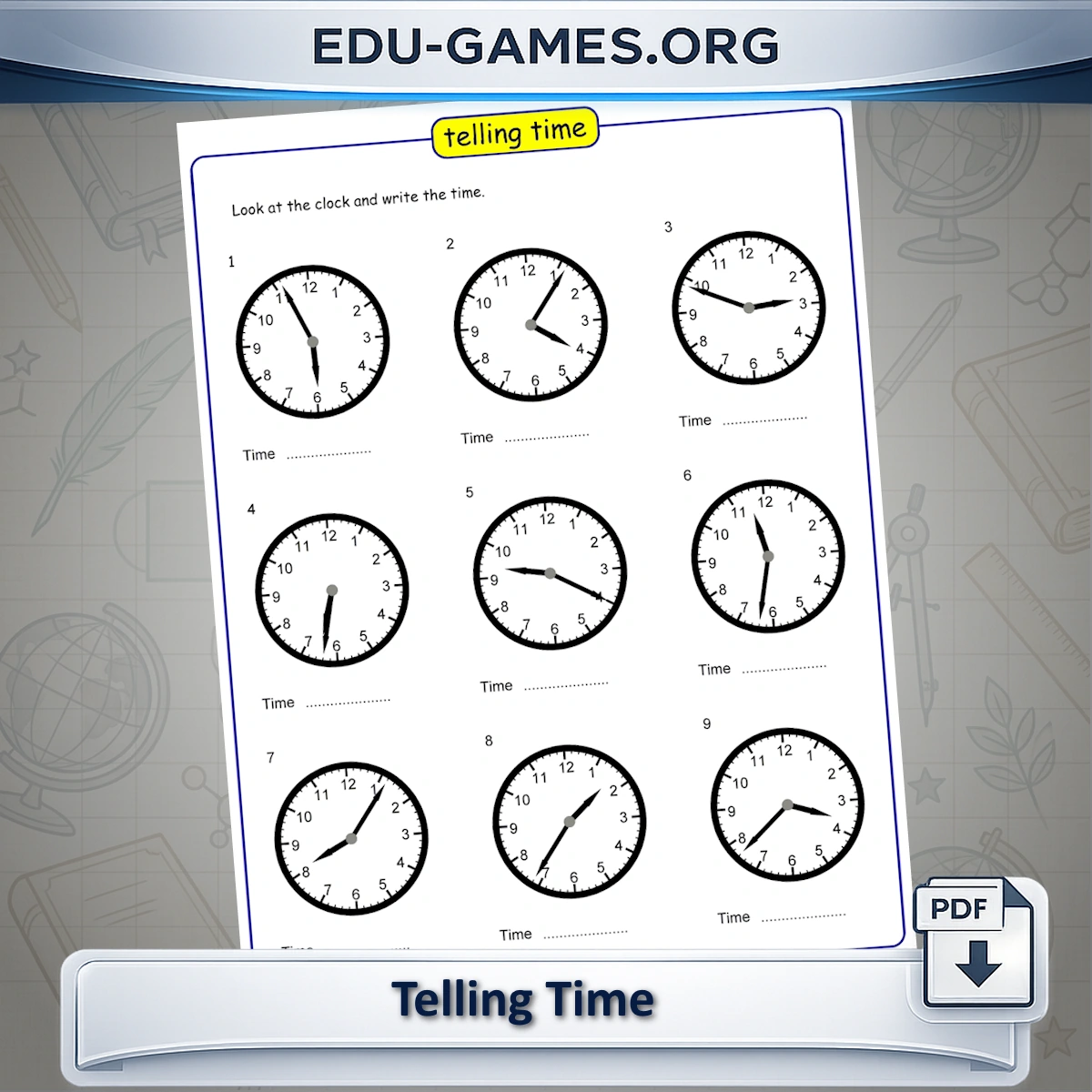
Generate free printable telling-time worksheets with 9 analog clocks. Choose which numbers appear on the clock face and the time interval — from whole hours down to the nearest minute — then download a PDF with an optional answer key in seconds. No account needed.

Used by teachers worldwide  ·  Instant PDF download  ·  No account required

Free printable telling time worksheet generator

Generate a telling-time worksheet with 9 analog clocks showing random times. Control which numbers appear on the clock face and set the time interval — from whole hours down to the nearest minute. Each worksheet is unique and downloads as a PDF with an optional answer key. Create an unlimited number of worksheets, free.

Create Your Telling Time Worksheet

Numbers in the clock:
Time intervals:
Instructions:
Include solution page
Paper format:

How to Use This Telling Time Worksheet Generator

  1. Choose clock numbers — "Hours" shows all 12 numbers and is the easiest setting. "Quarters" shows only 12, 3, 6, and 9, removing the intermediate guides. "None" shows a blank face and is the most challenging.
  2. Set the time interval — start with "hour" or "half hour" for Grade 1. Move to "quarterly" and "5 minutes" for Grade 2–3. Use "1 minute" for Grade 3–4 where any-minute precision is the curriculum target.
  3. Click "Create new Clocks" — 9 analog clocks appear in the preview, each showing a randomly generated time within the interval you chose.
  4. Download the PDF — the worksheet includes space for students to write the time shown on each clock. Tick "Solution" before downloading if you want an answer key on a second page.
  5. Generate again for a new worksheet — each click produces a different set of 9 random times, so you can create as many unique versions as you need in one session.

Why Use Telling Time Worksheets?

Reading a clock is a composite skill: students must understand the function of each hand separately, remember the counting-by-five structure of the minute hand, and then combine both readings simultaneously into a single time. A dedicated reading worksheet isolates and rehearses the recognition direction of that skill — seeing a clock face and producing the correct written time.

  • Focused repetition — 9 clocks per sheet gives a concentrated set of practice items without excessive length, making it suitable for timed warm-ups or short independent sessions.
  • Adjustable precision — the interval setting means one generator covers the entire telling-time curriculum from Grade 1 to Grade 4 without needing different resources at each level.
  • Self-checking — the optional answer key lets students or parents verify answers immediately, reducing the marking load on the teacher.
  • Complements draw-the-hands practice — telling-time worksheets train the recognition direction (clock → written time). Pairing them with draw-the-hands worksheets, which train the production direction (written time → clock hands), produces stronger retention than either format alone.

Telling Time Worksheets — Frequently Asked Questions

What does the "time interval" setting control?

The time interval determines the precision of the times shown on each clock. Hourly produces times on the hour only. Half-hour, quarter-hour, 10-minute, and 5-minute options include those intermediate times. Setting it to 1 minute allows any minute to appear. Start with hourly or half-hourly for Grade 1, move to 5-minute for Grade 2–3, and use 1-minute for Grade 3–4.

What do the clock number settings change?

"Hours" shows all 12 numbers on each clock face — the easiest setting, as students can count directly to the minute hand. "Quarters" shows only 12, 3, 6, and 9 — students must use the quarter-hour markers as reference points. "None" shows a blank clock face — the most demanding option, requiring students to estimate hand positions without any number guides.

What grades are these telling-time worksheets designed for?

The generator covers the full primary telling-time progression. Hourly and half-hourly intervals suit Grade 1 (Common Core 1.MD.B.3; UK KS1). Quarter-hour and 5-minute intervals fit Grade 2–3 (CC 2.MD.C.7, 3.MD.A.1). Any-minute reading at 1-minute precision is a Grade 3–4 target. The interval and clock-numbers settings together let you target any point in that range.

How does this worksheet differ from the draw-the-hands worksheet?

On a telling-time worksheet students read a clock face and write the time — the recognition direction. On a draw-the-hands worksheet students read a written time and draw the hands — the production direction. Both target the same skill but from opposite angles. Reading is generally mastered first; drawing requires recalling exact hand positions from memory, which is more demanding. Using both types across the school year produces stronger retention than either alone.

How many different worksheets can I generate?

There is no limit. The generator picks times randomly each time you click "Create new Clocks", so every worksheet is unique. Generate as many versions as you need for different sessions, different groups, or retesting — without any two worksheets being identical.

Can I use different settings to differentiate within one class?

Yes. Generate one worksheet with a wide interval and "Hours" numbers for students still building the skill, then change to a narrower interval and fewer clock numbers for students who are ready for a harder challenge. Both download as separate PDFs from the same page in the same session.