Edu-Games.org
By Teachers, for Teachers

Time Dominoes — Free Printable Telling Time Worksheets

Generate free printable time domino worksheets — choose the domino set size, clock type, time interval, and notation style, then download a PDF in seconds. Perfect for math centers, partner work, and whole-class games. No account needed.

1.7M+ worksheets downloaded  ·  Instant PDF download  ·  No account required

Free printable time dominoes worksheet generator

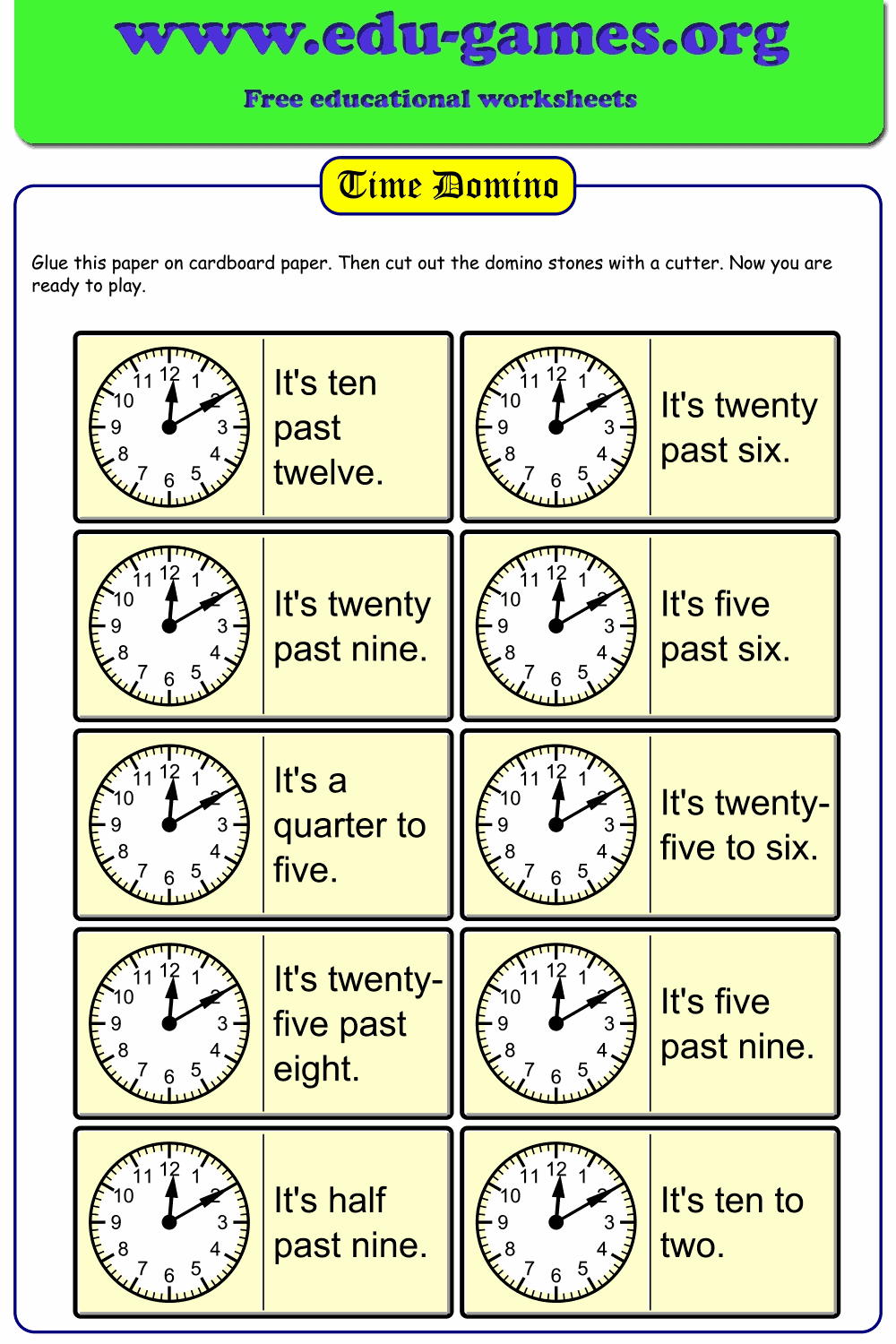
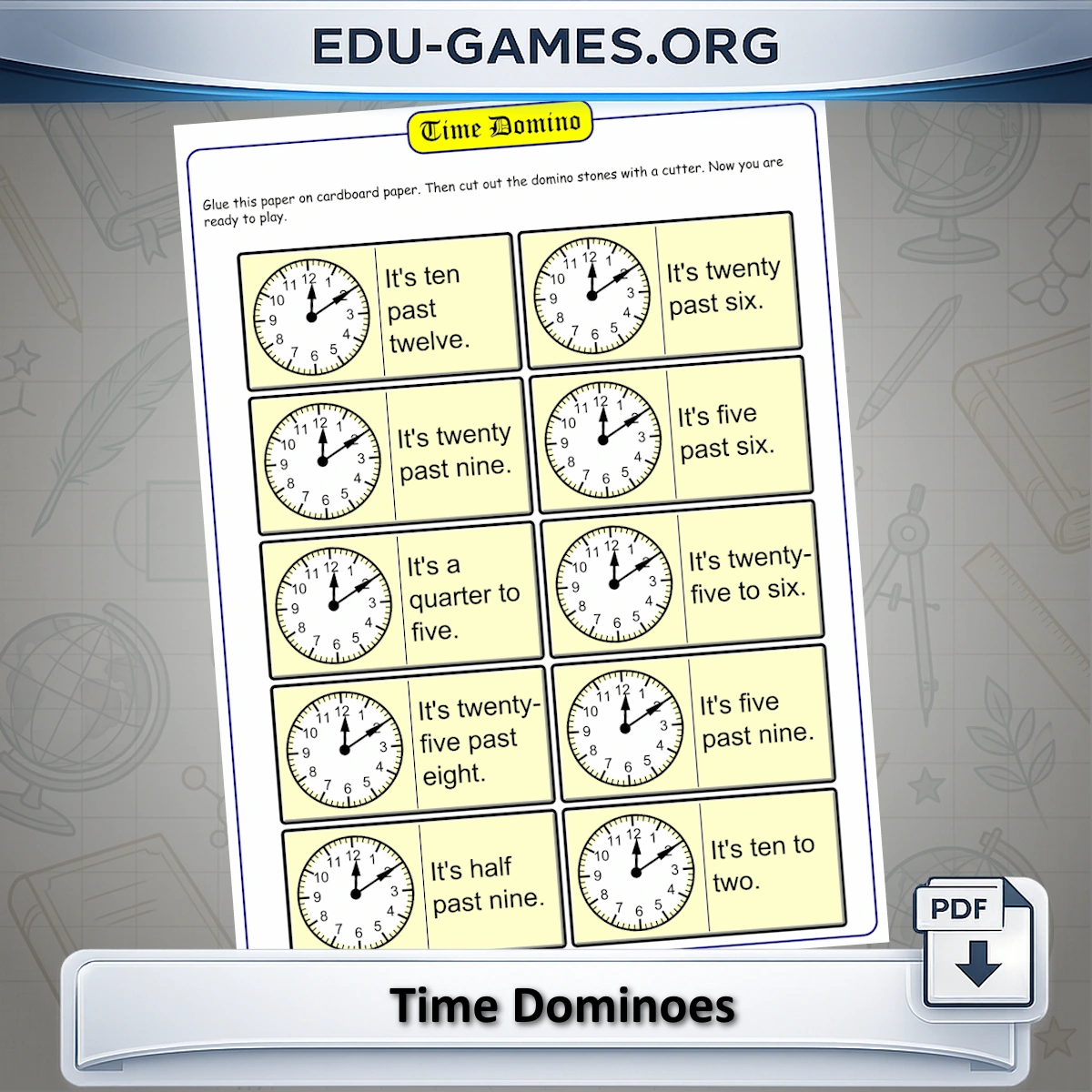
Time dominoes are an educational variation of classic dominoes designed for primary and elementary math. Each tile pairs an analog clock face with a matching written or digital time. Students connect tiles with equivalent times — the same rules as traditional dominoes, but with clock-reading as the matching skill.

Create Your Time Domino Worksheet

Size of the domino set:
Numbers in the clock:
Time intervals:
12/24 hours:
Time notation:
Paper format:

How to Use This Time Dominoes Generator

  1. Choose the domino set size — 28 tiles (double-six) for pairs or small groups; 55 tiles (double-nine) for larger groups or longer sessions.
  2. Set the clock numbers — show all 12 hour numbers for beginners, only quarter-hour markers (12, 3, 6, 9), or none at all for the most demanding version.
  3. Set the time interval — hourly for Grade 1, half-hourly or quarterly for Grade 2, 5-minute intervals for Grade 3.
  4. Choose the clock format — 12-hour, 12-hour with AM/PM, or 24-hour.
  5. Choose the time notation — spoken (e.g. "ten past nine") or digital (e.g. "9:10").
  6. Click "Create new Time Dominoes" — preview the domino set, then download the PDF. Print on card stock for durability and have students cut out the tiles.

Why Use Time Dominoes?

Game-format activities produce more clock-reading repetitions per session than a static worksheet, because students stay engaged through a goal — placing all their tiles — rather than working through a fixed list of problems. Each tile placement requires reading a clock or matching a time, which means the practice is embedded in every move of the game rather than isolated in rows of exercises.

  • Peer feedback — an incorrect match is immediately visible to the other player, generating discussion and self-correction without teacher intervention.
  • Flexible difficulty — the same tile format scales from whole-hour reading (Grade 1) to 5-minute precision and spoken notation (Grade 3) without changing the game rules.
  • Reusable — laminated sets can be used repeatedly across multiple sessions; generating a fresh set with different settings takes seconds.
  • Curriculum-aligned — telling time to the nearest 5 minutes is a Grade 2–3 standard across major curricula (Common Core 2.MD.C.7, 3.MD.A.1; UK KS2 Maths).

Time Dominoes — Frequently Asked Questions

What are time dominoes and how do they work?

Time dominoes are an educational variation of classic dominoes. Instead of dots, each tile shows an analog clock on one half and a written or digital time on the other. Students connect tiles by matching equivalent times — the same rules as traditional dominoes, but with clock-reading as the matching skill.

How do students play time dominoes?

Students take turns placing a tile so that one of its halves matches the exposed end of the chain. A clock face matches a tile showing the equivalent digital or spoken time (and vice versa). The first player to place all their tiles wins. Scoring is optional — many teachers focus on accurate matching and group discussion rather than points.

What domino set sizes are available and which should I choose?

Two sizes are available: 28 tiles (double-six set, using 7 different times) and 55 tiles (double-nine set, using 10 different times). The 28-tile set works well for pairs or small groups with a 20–30 minute session. The 55-tile set suits larger groups or longer practice periods — it also creates a longer matching chain, which adds an extra strategic element.

What time intervals and formats can I set?

You can set the time interval to hourly, half-hourly, quarterly (15 minutes), 10 minutes, or 5 minutes. Clock format options are 12-hour, 12-hour with AM/PM, or 24-hour. Time notation can be spoken (e.g. "ten past nine") or digital (e.g. "9:10"). Any combination of these settings produces a valid, printable domino set.

What age and grade are time dominoes suitable for?

The game is designed for primary and elementary students, typically Grades 1–3 (ages 6–9). Use hourly or half-hourly intervals with all clock numbers visible for Grade 1. Move to quarter-hour and 5-minute intervals and reduce clock numbers for Grade 2–3.

Can I adjust difficulty for different skill levels in the same class?

Yes. Generate one set at a wide interval (e.g. hourly, all numbers on the clock) for lower-ability students and a second set with a narrower interval (e.g. 5 minutes, no clock numbers) for more advanced students. Both print as separate PDFs from the same generator without any other tools needed.