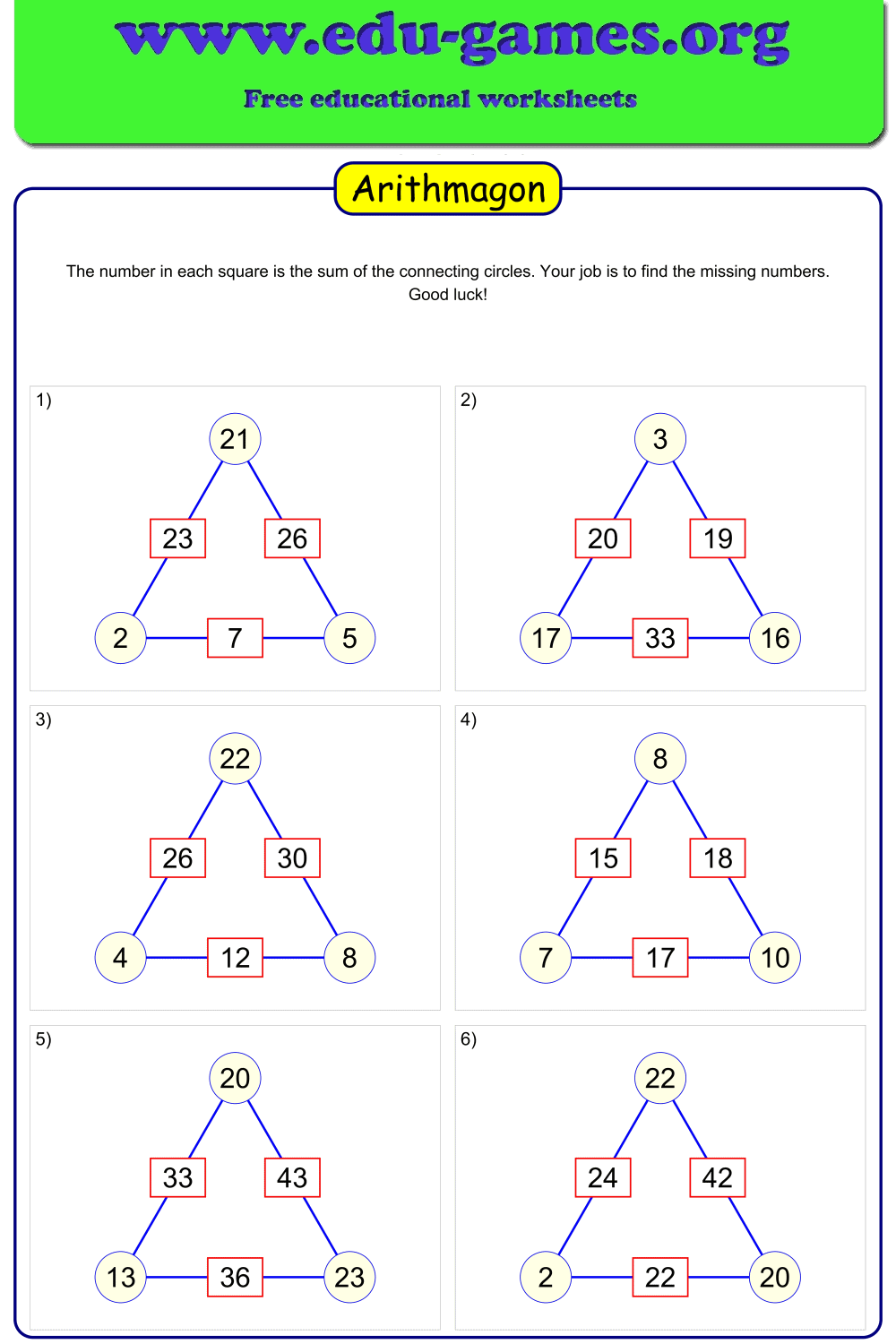
An arithmagon, also known as a number triangle puzzle, is a math puzzle where the numbers on the sides are created by adding the corner numbers.
Create printable addition arithmagon puzzles
What are Addition Arithmagons?
An addition arithmagon is a triangle puzzle with operands at its vertices and their sums written on the edges between them. There are three types of puzzle:
- Operands given. The easiest type. The numbers at the vertices are shown — add any two to find the sum on the connecting edge.
- Sums given. The most challenging type. The sums on the edges are given and you must work backwards to find the operands at the vertices.
- Mixed. A middle-ground challenge: two sums on the edges and one operand at a vertex are revealed. Find the rest.
How to Solve an Arithmagon Puzzle
The Arithmagon
A triangle with operands on the corners and sums on the sides.
1. All Sums Given
Given: ab, bc, ca
Find: a, b, c
- Add all three sums.
- Divide by 2 to get total of a + b + c.
- Find each value:
2. All Operands Given
Given: a, b, c
Find: ab, bc, ca
- Add adjacent operands.
- Repeat for all sides.
3. Mixed Information
Given: Some values
- Fill values step-by-step.
- Use completed sides to solve others.
- Check consistency.
How to Use Arithmagons in the Classroom
Use as a warm-up: Start your lesson with a quick arithmagon to activate mental math skills. “Operands given” works best for fast starters.
Differentiate difficulty:
- Operands given: You add the corner numbers to find the edge values.
- Sums given: You work backwards from the edge values to find the corner numbers.
Choose the right level:
- Beginners: Operands given
- Intermediate: Mixed
- Advanced: Sums given
Encourage problem-solving: Ask students to explain their steps, especially for “Sums given” puzzles where reasoning matters more than calculation.
Use for independent or group work: Students can solve individually, compare answers in pairs, or explain strategies to the class.
Provide immediate feedback: You can include a solution page in the worksheet to allow quick checking and self-correction.
Share this free printable addition arithmagon worksheets with your friends