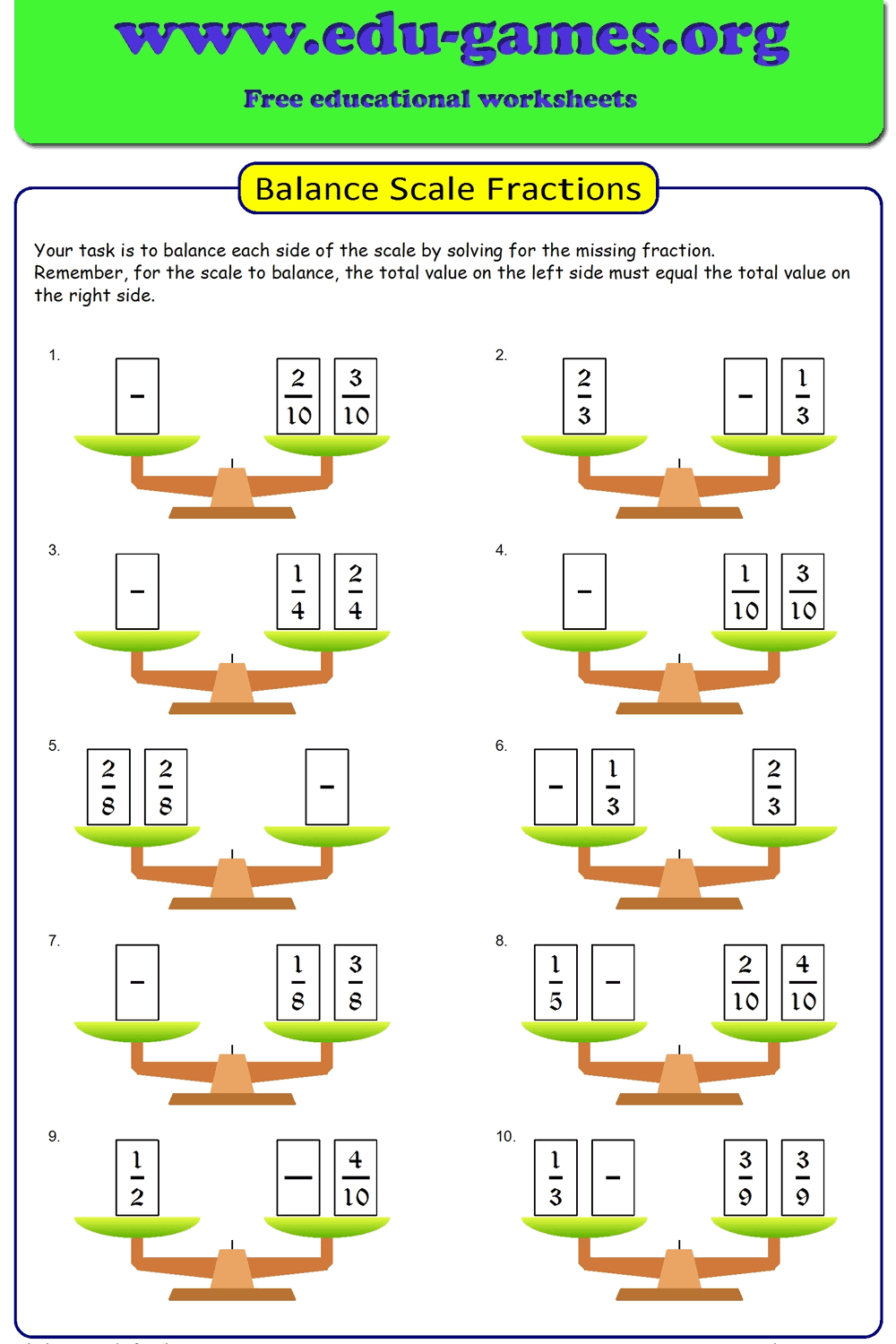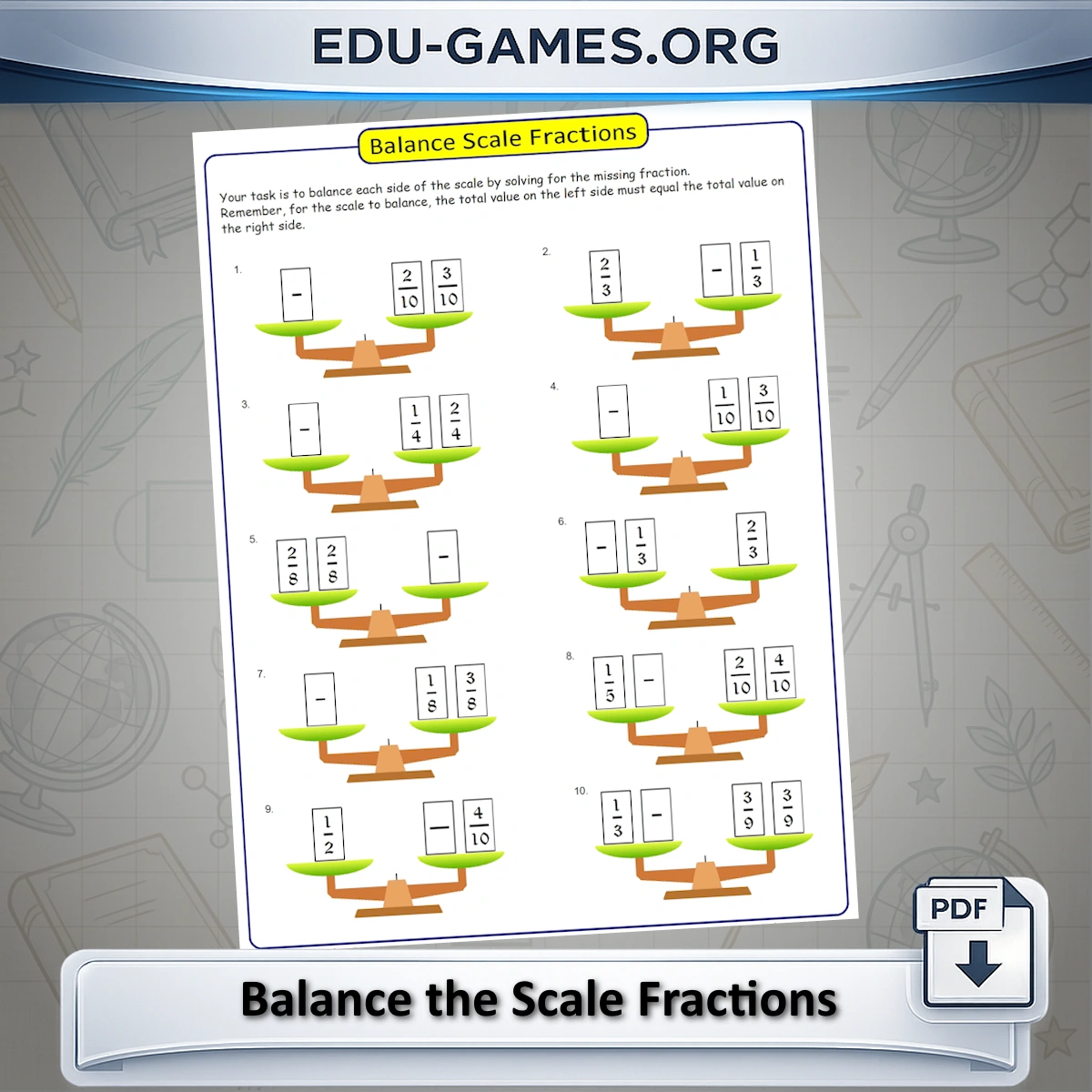
Each worksheet presents a set of balance scales showing fraction equations. One fraction is missing on each scale — students must use their knowledge of fraction operations to find the value that makes both sides equal. The scale model makes the concept of equation equality concrete and visual: if the values don't match, the scale tips. Each worksheet downloads as a PDF with an optional solution page.
Create Your Balance Scale Fraction Worksheet
How to Use This Balance Scale Fraction Generator
- Click "Create new balancing scales" — the preview shows a fresh set of balance scale fraction equations, each with one missing value.
- Edit the instructions (optional) — update the instructions field to add a student name line, a specific prompt, or a reminder about the method you want students to use.
- Download the PDF — the worksheet prints on a standard A4 or letter page. Enable the "Solution" option before downloading if you want a completed answer page included.
- Generate again for a new set — each click creates a different set of fraction equations, so you can produce a unique worksheet for every session without repeating the same problems.
Why Use Balance Scale Fraction Worksheets?
Most fraction worksheets ask students to calculate a result. Balance scale worksheets flip the question: students are given the result (one side of the scale) and must work backwards to find the missing value. That reversal is significant — it is exactly the reasoning required in algebraic equations, making these worksheets one of the most efficient bridges between fraction arithmetic and pre-algebra.
- Equation thinking, not just calculation — the scale makes the equality constraint visible, so students engage with the idea that both sides must stay balanced, not just that a calculation must be performed.
- Inverse operation practice — finding a missing addend or factor requires applying the inverse operation, reinforcing the relationship between operations that is central to solving equations at every level.
- All four operations — addition, subtraction, multiplication, and division of fractions are all covered, making it possible to target the specific operation a class is currently practising or to mix them for revision.
- Visual support for abstract concepts — the balance scale image is particularly helpful for students who struggle to see why they must apply the same operation to both sides of an equation. The image makes that rule physically intuitive.
Share this free balance scale fractions worksheet