Edu-Games.org
By Teachers, for Teachers

Free Printable Fraction Domino Game Worksheet Maker

Generate free printable fraction domino tiles — students match graphic and numerical fractions to build the chain. Choose a 28-stone or 55-stone set and download a PDF in seconds. No account needed.

1.7M+ worksheets downloaded  ·  Instant PDF download  ·  No account required

Free printable fraction domino game worksheet maker

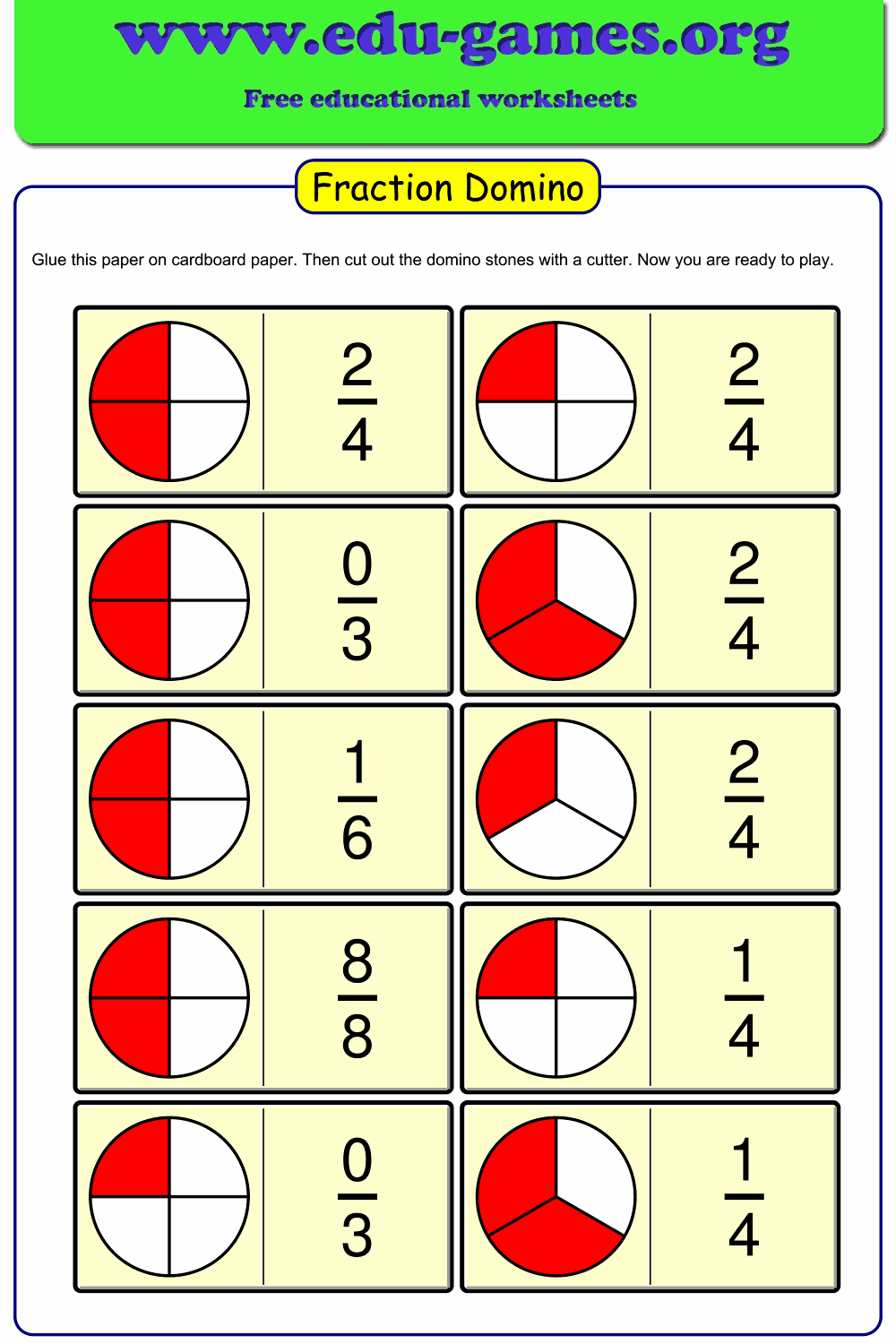
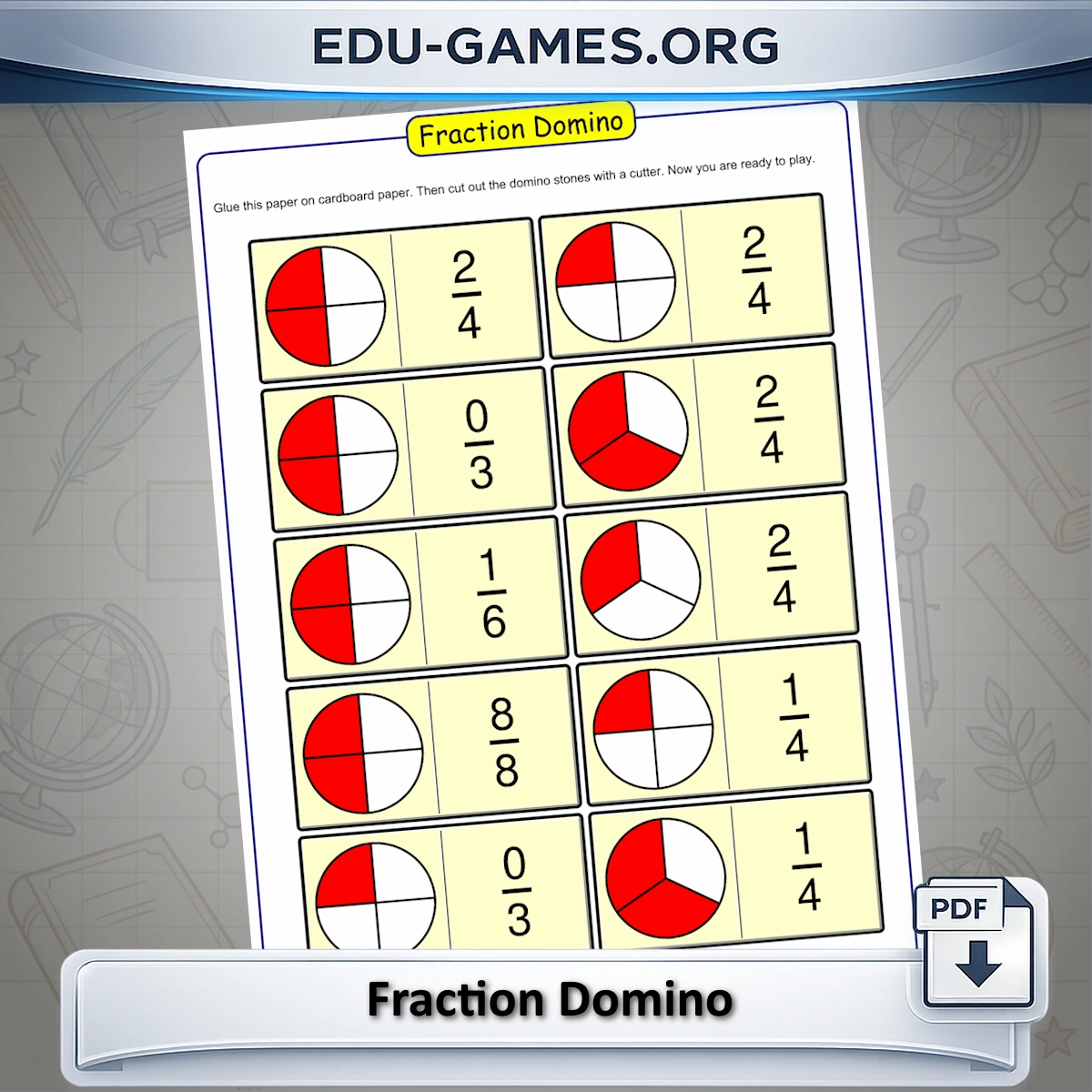
Fraction domino is a printable version of classic domino with a math twist. Each tile has two halves — one showing a fraction as a shaded graphic, the other in numerical notation. Students connect tiles by matching equivalent fractions, using the same chain-building rules as traditional domino. The game is easy to learn, effective for fraction practice, and reusable across many sessions.

Create Your Fraction Domino Worksheet

Size of the domino set:

Include solution page
Paper format:

How to Use This Fraction Domino Generator

  1. Choose the set size — 28 stones (double-six) uses 7 different fractions and suits pairs or groups of 2–3. 55 stones (double-nine) uses 10 different fractions and works for larger groups or longer sessions. You can print multiple sets and combine them to extend the game further.
  2. Click "Create new Fraction Dominoes" — the tile set appears in the preview.
  3. Download the PDF — print on cardstock, or print on regular paper and glue to thick card. Cut out the tiles with scissors or a craft knife. Laminating before cutting makes the set reusable across many sessions.
  4. Deal and play — deal tiles equally among players. The first player places a tile. Each subsequent player adds a tile to either open end of the chain by matching one half to the exposed fraction — graphic must match numerical, or numerical must match graphic, showing the same fraction value. The first player to place all tiles wins.

Why Use Fraction Domino?

One of the most persistent gaps in fraction understanding is the disconnect between how a fraction looks as a graphic (a shaded shape or number line segment) and how it looks as a numerical expression (numerator over denominator). Students who can read ¾ but cannot identify it on a shaded circle — or who can shade a circle but cannot write the fraction — have a representation gap that interferes with all further fraction work.

Fraction domino targets this gap directly. Every tile placement requires a student to confirm that a shaded graphic and a numerical fraction show the same value. Over the course of a game, each student makes this connection many times across a varied set of fractions — more repetitions than a static worksheet typically produces, because the matching constraint applies to both ends of the chain simultaneously and creates a genuine puzzle that sustains engagement.

  • Representation bridging — the game specifically practises the graphic ↔ numerical connection, which standard drill worksheets rarely address in isolation.
  • Social learning — incorrect matches are immediately visible to other players, generating natural peer correction and discussion without teacher intervention.
  • Reusable — laminated sets last for years; regenerating a fresh set with a different fraction range takes seconds.

Fraction Domino Game — Frequently Asked Questions

What is a fraction domino and how is it different from regular domino?

A fraction domino tile has two halves, just like a regular domino — but instead of dots, each half shows a fraction. One half shows the fraction as a graphic (a shaded shape), the other shows it in numerical notation. Students connect tiles by matching equivalent fractions, one graphic to one numerical, following the same chain-building rules as traditional domino.

How do students play fraction domino?

Deal the tiles among players. The first player places a tile. On each subsequent turn, a player adds a tile to either open end of the chain by matching one of its halves to the exposed end — a graphic fraction must match a numerical fraction showing the same value, and vice versa. The first player to place all their tiles wins. Scoring is optional: some teachers ask students to add the fractions remaining in their hand at the end, which adds a calculation element to the game.

What are the 28-stone and 55-stone sets, and which should I choose?

The 28-stone set (double-six) uses 7 different fractions and works well for pairs or small groups of 2–3 students in a 20–30 minute session. The 55-stone set (double-nine) uses 10 different fractions and suits larger groups or longer sessions — it also creates a longer chain, which adds a strategic element. You can also print two or more sets and combine them to accommodate more players or extend the game.

What fraction skills does this game develop?

The game builds the connection between graphic and numerical fraction representations — a skill that many students find difficult because they can read a numerical fraction but struggle to recognize it as a shaded shape, or vice versa. Every tile placement requires a student to confirm that two representations show the same value, which reinforces fraction equivalence and visual recognition across many repetitions per session.

What grades is fraction domino suitable for?

The game suits Grades 2–5 (ages 7–11). For Grade 2–3, it builds initial fraction recognition using simple fractions (halves, thirds, quarters). For Grade 4–5, it reinforces the connection between representations alongside more complex fraction work. The matching rule is simple enough that younger students can play independently after one demonstration.

What preparation is needed after printing?

Print the PDF, then glue the sheets onto thick card or print on cardstock for durability. Cut out the individual tiles with scissors or a craft knife. This takes around 10–15 minutes per set. Laminating the tiles before cutting makes them reusable across many sessions and extends the life of each set significantly.