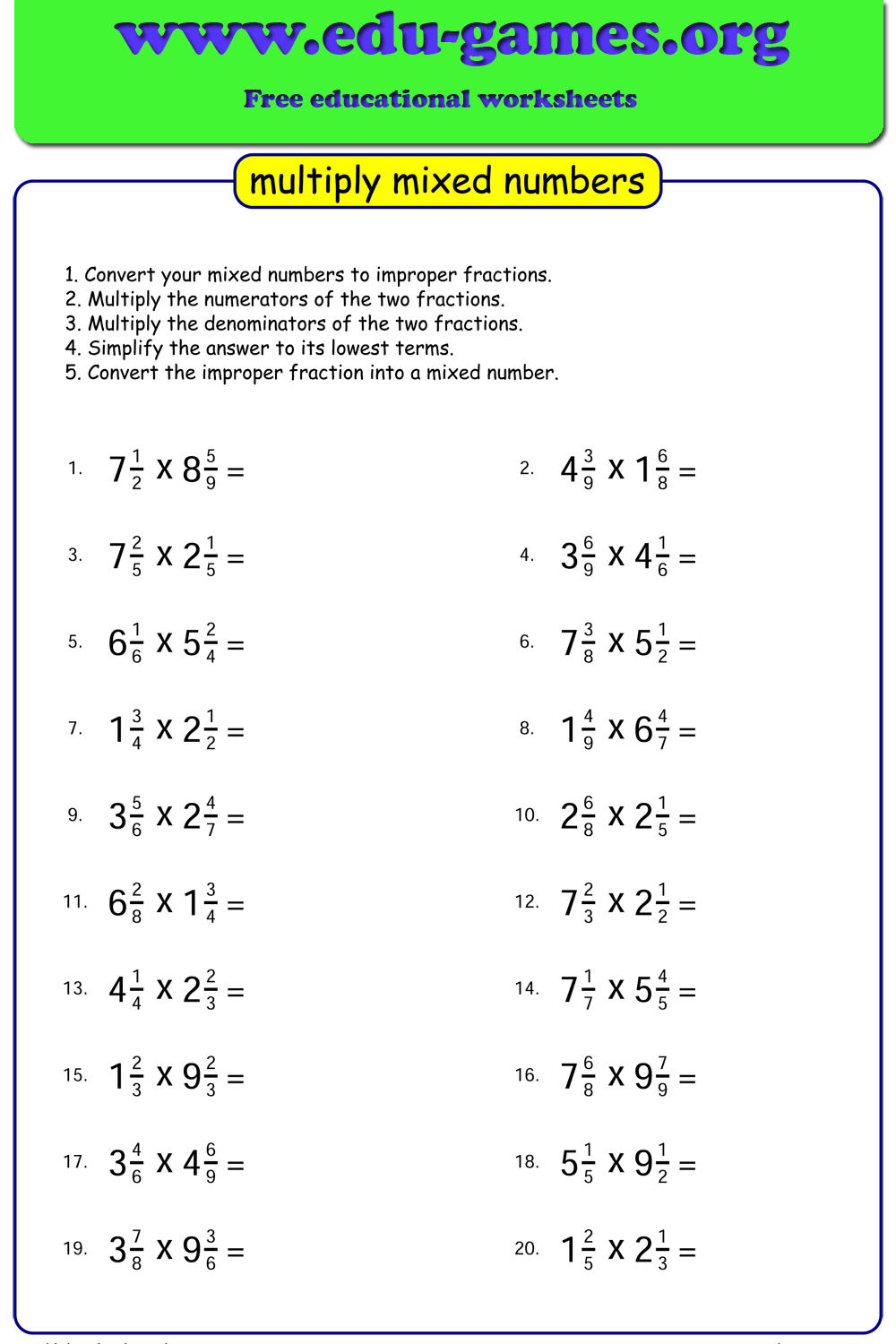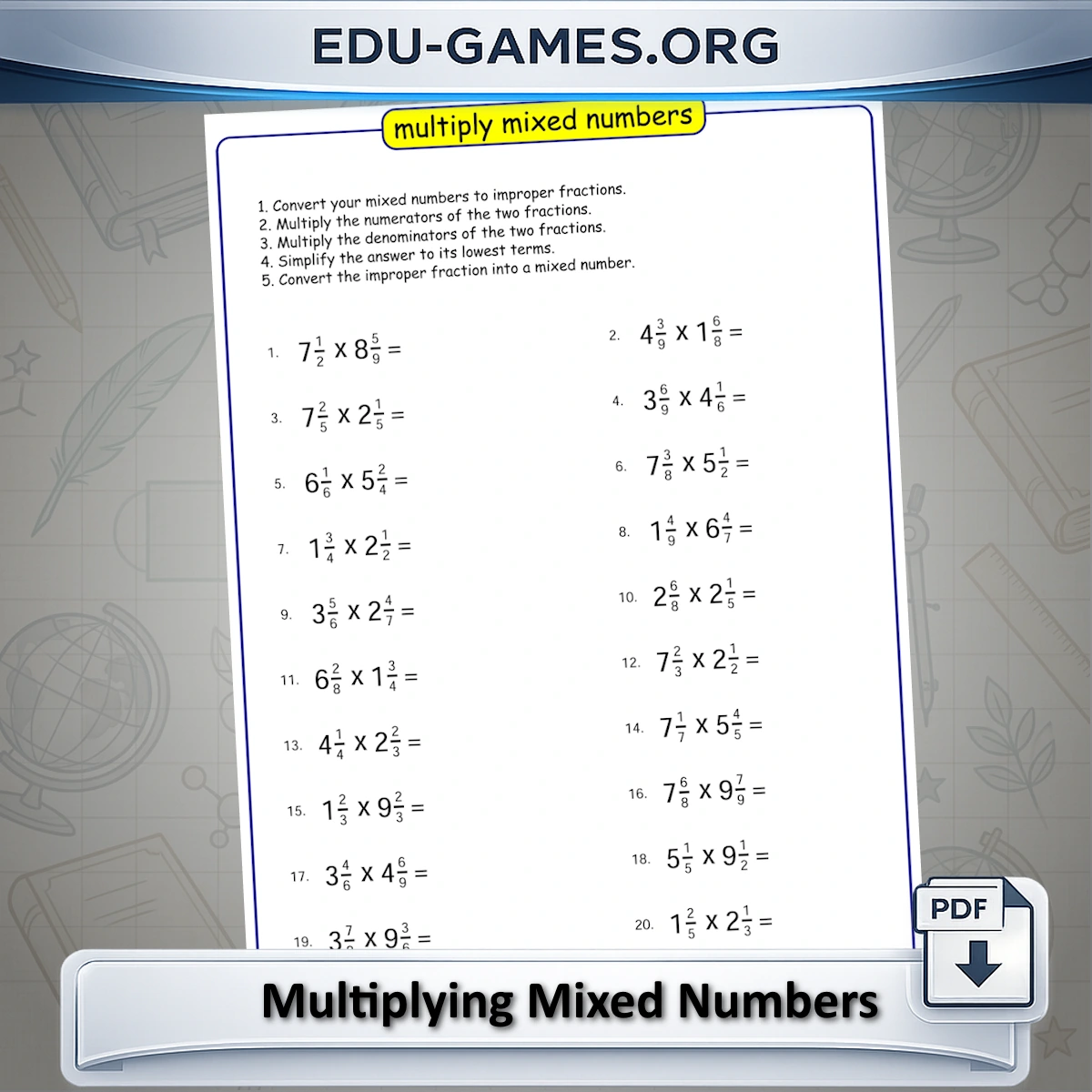
What Are Multiplying Mixed Numbers Worksheets?
These free printable worksheets give students structured practice multiplying two mixed numbers together. Each problem requires converting the mixed numbers to improper fractions, multiplying straight across, simplifying the result, and converting back — building mastery of every step in the process.
With the generator above you can set the denominator range and the whole-number range independently, so you can create easy problems for Grade 5 beginners or more demanding problems for Grade 6 students who need an extra challenge.
How to Use the Worksheet Generator
- Set your ranges: Use the range controls to set the denominator and whole-number values. Smaller ranges produce simpler problems; larger ranges give students a greater challenge.
- Choose the number of problems: Select 16 or 20 problems per page to match your lesson time.
- Customize the instructions: Edit the instruction text to match your lesson phrasing or leave the default steps in place.
- Generate and download: Click "Create new Fractions Products" to generate a random worksheet, then download it as a PDF. Include an answer key with one click.
- Repeat for variety: Click the create button again to get a completely different set of problems — useful for classwork, homework, and re-test practice.
Why Use This Worksheet Generator?
- Targets every step of the process: Students practise the full procedure — converting, multiplying, simplifying, and converting back — not just a single step.
- Adjustable difficulty: Narrow the ranges for younger or struggling learners; widen them to challenge advanced Grade 6 students.
- Unlimited unique worksheets: Every click produces a fresh random set, so you never run out of practice material for classwork, homework, or re-tests.
- Clean, printable PDF: The PDF fits standard A4 and US letter paper with no formatting adjustments needed.
- Completely free: No account, no subscription, no limits.
Multiplying Mixed Numbers — Frequently Asked Questions
How do you multiply mixed numbers?
First convert each mixed number to an improper fraction: multiply the whole number by the denominator and add the numerator. Then multiply the two improper fractions straight across — numerator × numerator and denominator × denominator. Simplify the result and convert back to a mixed number if needed. Example: 2 1/3 × 1 2/5 = 7/3 × 7/5 = 49/15 = 3 4/15.Why do you convert to improper fractions before multiplying?
Mixed numbers have a whole part and a fractional part, which makes direct multiplication complicated. Converting to an improper fraction merges both parts into a single value, so you can apply the standard rule: multiply numerator × numerator and denominator × denominator.How do you convert a mixed number to an improper fraction?
Multiply the whole number by the denominator, then add the numerator. Place the result over the original denominator. For example, 3 2/5 becomes (3 × 5 + 2) / 5 = 17/5.What grade level covers multiplying mixed numbers?
Multiplying mixed numbers is typically introduced in Grade 5 and practised through Grade 6. Students should already be comfortable multiplying simple fractions and converting between mixed numbers and improper fractions before starting this topic.How do you simplify the answer after multiplying mixed numbers?
Find the greatest common factor (GCF) of the numerator and denominator and divide both by it. If the result is still an improper fraction, divide the numerator by the denominator to get the whole-number part and keep the remainder as the new numerator.Can I multiply a mixed number by a whole number?
Yes. Write the whole number as a fraction over 1 — for example, 4 becomes 4/1. Convert the mixed number to an improper fraction, then multiply as usual. For example, 2 1/2 × 4 = 5/2 × 4/1 = 20/2 = 10.Share these free multiplying mixed numbers worksheets with your friends