Free Printable Subtracting Fractions Worksheets
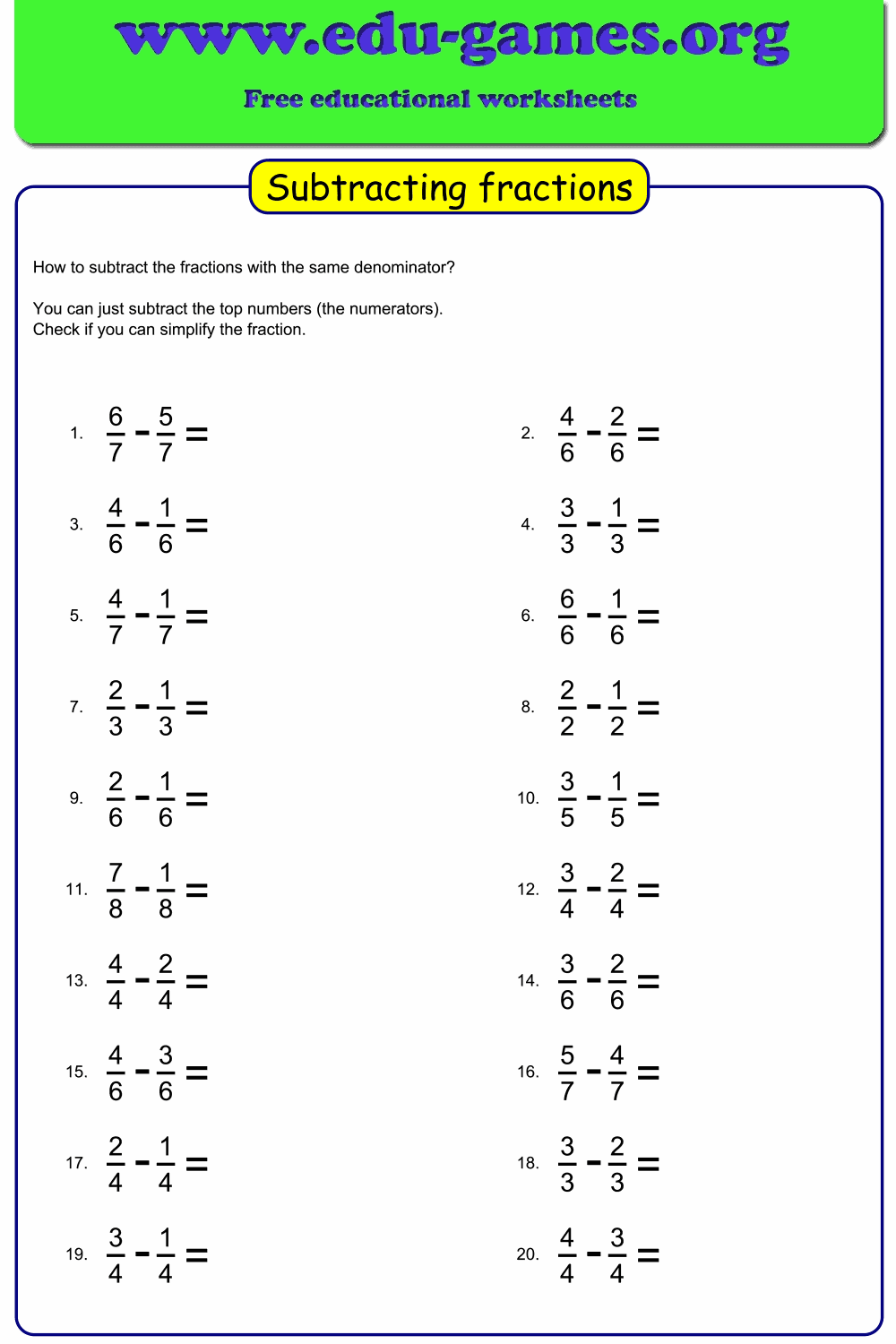
Generate free printable subtracting fractions worksheets for grades 3–6. Choose like or unlike denominators, subtract 2 or 3 fractions per problem, set a custom denominator range, and download a ready-to-print PDF in seconds. No account needed.
Used by teachers worldwide · Instant PDF download · No account required
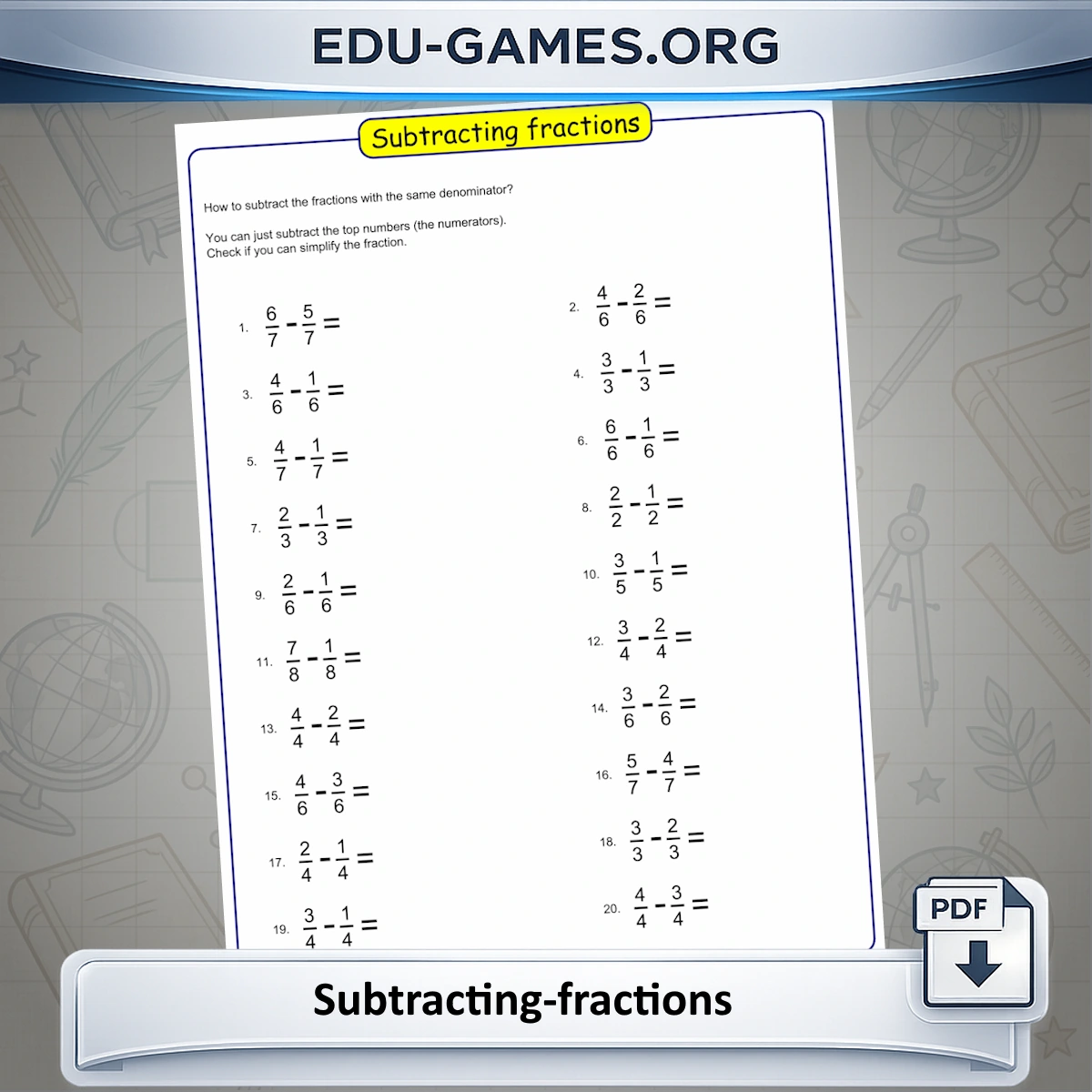
The Subtracting Fractions Worksheet Generator creates unique, printable fraction subtraction worksheets for grades 3–6. Choose like or unlike denominators, subtract 2 or 3 fractions per problem, set a custom denominator range, and download a clean PDF — ready to hand out the same day.
Create your subtracting fractions worksheet
How to Use the Subtracting Fractions Worksheet Generator
- Set the denominator range — Type a range like 2-8 in the denominator field, or click Easy, Medium, or Hard to auto-fill a preset range suited to your grade level.
- Choose the number of fractions — Select 2 or 3 fractions per problem. Three fractions with unlike denominators is the most demanding setting.
- Pick like or unlike denominators — Like denominators let students subtract numerators directly. Unlike denominators require finding a common denominator first.
- Choose problems per page — Select 16, 20, or 24 problems depending on the available class time.
- Add custom instructions — Optionally type your own directions in the instructions box — they appear at the top of the worksheet.
- Download — Click the download button to save a ready-to-print PDF worksheet.
Why Use This Subtracting Fractions Worksheet Generator
Unlike static worksheet packs, this generator creates a unique worksheet every time. That means you can reuse it week after week without repetition.
- Targeted practice — Control the exact difficulty by setting the denominator range, fraction count, and denominator type independently.
- Curriculum-aligned — Covers subtracting fractions skills taught in grades 3–6, from simple like-denominator problems up to three unlike-denominator fractions.
- Print-ready PDFs — Every worksheet downloads as a clean, A4-formatted PDF ready to hand out immediately.
- No setup required — No registration, no login, no software to install. Just choose your settings and download.
FAQ for the Subtracting Fractions Worksheet Generator
What grade levels are these subtracting fractions worksheets suitable for?
The generator is designed for students in grades 3 through 6. Grade 3 students can begin with like denominators at an easy range; grades 5–6 students can work with unlike denominators and three-fraction problems.What is the difference between like and unlike denominators in subtraction?
With like denominators, both fractions share the same bottom number so students simply subtract the numerators. With unlike denominators, students must first find a common denominator — the key skill for grades 4–6.Can I create worksheets where students subtract 3 fractions in one problem?
Yes. Use the Nr fractions per question selector to switch between 2 and 3 fractions per problem. Subtracting 3 fractions with unlike denominators is the most challenging combination the generator offers.How do the Easy, Medium, and Hard shortcuts affect the problems?
The shortcuts set a preset denominator range: Easy uses 2, 4, 6, 8 (small even numbers); Medium uses 2–9; Hard uses 10–25 (larger denominators that are harder to simplify). You can also type a custom range directly.What is a common mistake students make when subtracting fractions with unlike denominators?
The most frequent error is subtracting both numerators and both denominators separately — for example, writing 3/4 − 1/2 = 2/2. Stress that only the numerators are subtracted once a common denominator has been found, and that the denominator itself never changes during the subtraction step.Share this free subtracting fractions worksheet