Math Search Worksheet Generator
Students search a number grid to find hidden arithmetic equations — just like a word search, but for math. Choose your operators, set the difficulty, and download a unique math search worksheet PDF for Grades 2–6. No login required.
Trusted by thousands of teachers · Instant PDF download · No account required
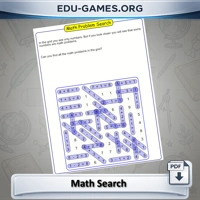
Create your Math Search Worksheet
What Is a Math Search Worksheet?
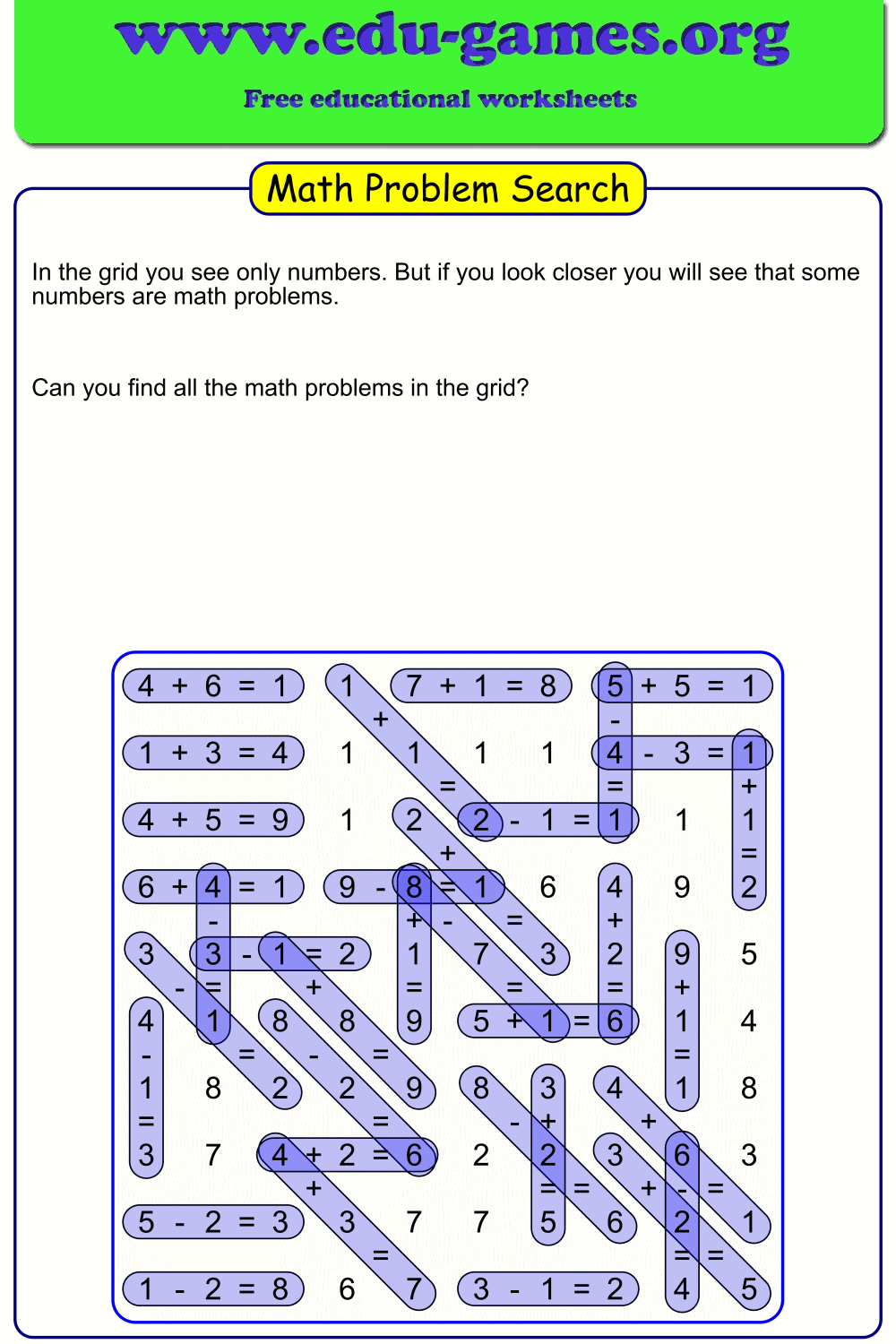
A math search worksheet is a number-grid puzzle modelled on the classic word search. A grid is filled with digits, and hidden within it are complete arithmetic equations — for example the sequence 6 + 3 = 9 might run horizontally, vertically, or diagonally through the grid. Students must scan the numbers to find and circle every hidden equation. Outside the US this activity is sometimes called a maths search or search maths puzzle — the format is identical.
Math search worksheets suit Grades 2–6. Use addition and subtraction with a small Max Result for Grades 2–3 to reinforce basic facts. Add multiplication and division with a larger Max Result for Grades 4–6. Enabling the diagonal direction and a larger grid size pushes the math search challenge toward Grade 5–6.
How to Use the Math Search Generator
- Choose the puzzle size (8–15). A larger grid holds more equations and is harder to search.
- Tick the operations you want: +, −, × and ÷ can all be combined on one sheet.
- Set Max Result to control the difficulty — lower values keep numbers small for younger students.
- Choose which search directions to use. Adding the diagonal direction makes the puzzle significantly harder.
- Set the print options — show one highlighted example problem and/or display the total equation count.
- Click Create the Math Search puzzle to preview, then Download to save the PDF.
Why Use Math Search Worksheets?
- Combines arithmetic fluency with visual scanning — students practise number facts while developing concentration and attention to detail
- Scales across grade levels — addition and subtraction for Grades 2–3, full four-operation puzzles for Grades 4–6
- Motivating puzzle format — the word-search structure makes arithmetic practice feel like a game
- Adjustable difficulty — control grid size, Max Result, operators, and search directions independently
- Unlimited unique puzzles — every generation produces a different grid
- Free and instant — print-ready PDF in seconds, no account needed
FAQ — Math Search Worksheet Generator
How many math equations are hidden in one puzzle?
The generator places up to 30 equations per puzzle. The exact number depends on the grid size, the selected directions, and the Max Result value — a larger grid with more directions and a higher Max Result gives the most room for equations.What does "Print 1 math problem" do?
One randomly selected equation is highlighted on the printed sheet as a worked example, showing students exactly what a hidden problem looks like before they begin searching. This is especially useful when introducing the puzzle format for the first time.What does "Max Result" control?
Max Result limits the largest answer that can appear in any equation. A lower value (e.g., 10) keeps the numbers small and accessible for Grades 2–3; a higher value (up to 99) increases difficulty for Grades 4–6.Can equations be hidden diagonally?
Yes. Three directions are available: Left to Right, Top to Bottom, and Top-Left to Bottom-Right diagonal. All three can be active at the same time. Using only Left to Right makes the puzzle easier to scan; adding the diagonal direction makes it significantly harder.What grade level is this worksheet suitable for?
The math search worksheet works across Grades 2–6. Use addition and subtraction with a low Max Result for Grade 2–3. Add multiplication and division with a higher Max Result for Grades 4–6. The diagonal direction and a larger grid size push the challenge toward Grade 5–6.Share the Math Search Maker with your friends
You Also Might Like:
- Operators are shown but the numbers are hidden — students must find the correct operands to complete each equation.
- Numbers are shown but the operators are hidden — students must identify the correct +, −, ×, or ÷ to complete each sum.
- Printable multiplication drill sheets and puzzle worksheets for Grades 2–6, from times tables to multi-digit practice.
- Browse all printable math puzzle worksheets — arithmetic mazes, number snakes, bingo cards, and more for Grades 1–6.