Missing Operators Worksheet Generator
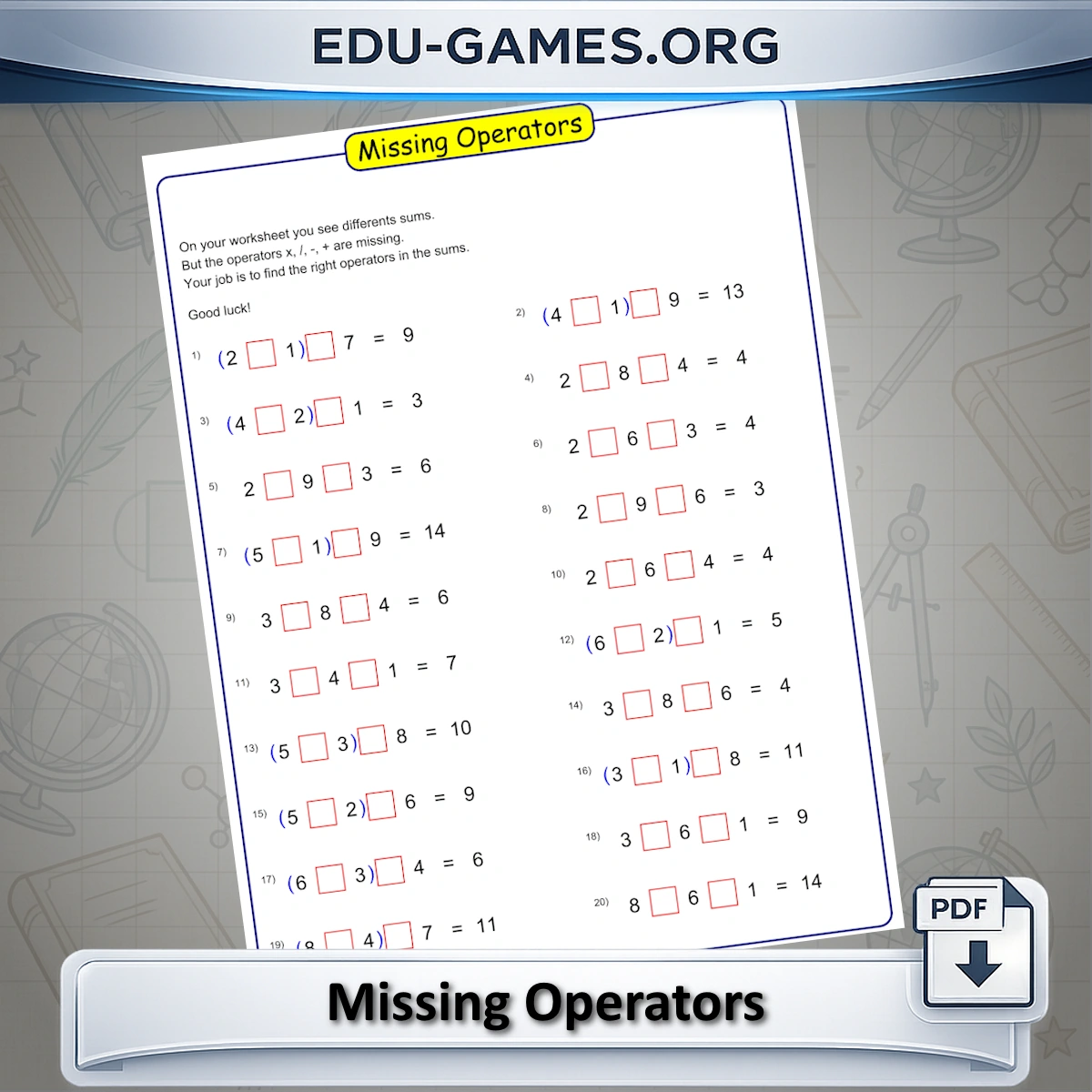
Students see the numbers and the result — but the operators are hidden. A flexible worksheet for Grades 3–6: use + and − for Grade 3, add × and ÷ for Grades 4–5, or enable parentheses for a Grade 5–6 PEMDAS challenge. Download a unique PDF every time — no login required.
Trusted by thousands of teachers · Instant PDF download · No account required
Create your Missing Operators Worksheet
What Is a Missing Operators Worksheet?
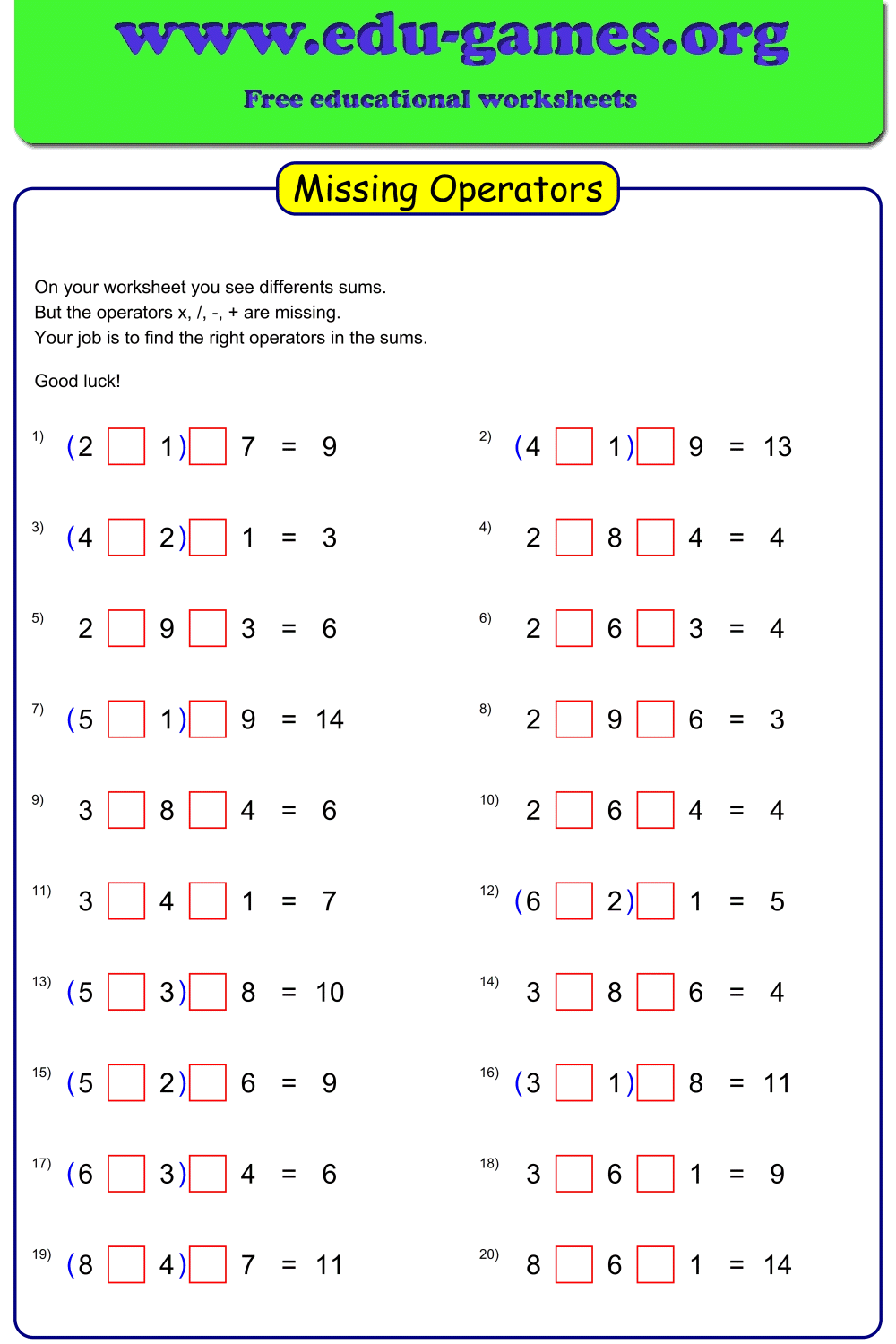
A missing operators worksheet shows arithmetic equations where the operators (+, −, ×, ÷) are hidden while the numbers and the result are fully visible. Students must determine which operation makes each equation true — a skill that sits at the heart of algebraic thinking. The format works across a wide range: Grade 3 students can work with addition and subtraction alone, Grades 4–5 bring in multiplication and division, and Grade 5–6 students tackle full order-of-operations reasoning with parentheses.
The parentheses mode adds the second layer of difficulty suited to Grades 5–6. When enabled, some equations use grouping that changes the result — for example (3 + 4) × 2 = 14 rather than 3 + 4 × 2 = 11. Hiding the parentheses on the printed sheet creates the hardest variant, requiring students to find the operators and determine the grouping simultaneously — a genuine PEMDAS challenge.
How to Use the Generator
- Set Problems with parentheses to Yes to include order-of-operations equations (Grades 5–6), or No for straightforward left-to-right sums (Grades 3–4).
- Set Print parentheses to No to hide the grouping on the printed sheet — the hardest setting, best for Grade 6.
- Choose the number of problems per page: 10, 20, or 30.
- Click Create the Missing Operators puzzle to preview your worksheet.
- Click Download the Missing Operators puzzle to save the PDF, with an optional solution page.
Why Use Missing Operators Worksheets?
- Builds operation recognition — students reason about which operator fits, not just how to apply one
- Scales across grade levels — + and − only for Grade 3, add × and ÷ for Grades 4–5, full PEMDAS with parentheses for Grade 5–6
- Introduces order of operations — the parentheses mode gives a concrete, hands-on introduction to PEMDAS for Grade 5–6
- Works across all four operations — addition, subtraction, multiplication and division all appear on the same sheet
- Unlimited unique worksheets — every generation produces a different set of equations
- Free and instant — print-ready PDF in seconds, no account needed
What Is PEMDAS — and Why Do Parentheses Change the Answer?
PEMDAS is the rule that tells you which operation to perform first when an equation contains more than one operator. The letters stand for: Parentheses, Exponents, Multiplication, Division, Addition, Subtraction. Outside the US the same rule is known as BODMAS (Brackets, Orders, Division, Multiplication, Addition, Subtraction) — the logic is identical.
The key practical rule for elementary students is this: multiplication and division are always calculated before addition and subtraction — unless parentheses say otherwise.
Examples without parentheses
In 3 + 4 × 2, multiplication comes first per PEMDAS:
3 + (4 × 2) = 3 + 8 = 11.
In 10 − 6 ÷ 2, division comes first:
10 − (6 ÷ 2) = 10 − 3 = 7.
Examples with parentheses
Parentheses override PEMDAS — whatever is inside them is calculated first, regardless of which operator it contains.
(3 + 4) × 2 — the addition is forced first:
7 × 2 = 14. Compare this with 3 + 4 × 2 = 11 above — the same numbers and operators, but a completely different answer.
6 ÷ (1 + 2) — the addition is forced first:
6 ÷ 3 = 2. Without parentheses, 6 ÷ 1 + 2 = 6 + 2 = 8.
How this connects to the worksheet
On a missing operators worksheet, students see the numbers, the result, and — depending on the settings — the parentheses. To find the correct operators they must apply PEMDAS in reverse: decide which operation would produce the given result, and check whether the parentheses change the evaluation order. Hiding the parentheses (the hardest setting) means students must also figure out where the grouping belongs — a genuine order-of-operations challenge.
FAQ — Missing Operators Worksheet Generator
What is the difference between "Problems with parentheses: Yes" and "No"?
With Yes, some equations include parentheses that change the result by altering operator priority — for example (3 + 4) × 2 = 14 rather than 3 + 4 × 2 = 11. With No, all equations read strictly left to right and grouping never affects the outcome.What does "Print parentheses: No" actually do?
The parentheses are hidden on the printed sheet even though the equations were generated with grouping. Students must find the missing operators AND figure out where the grouping applies — significantly harder than the default Yes setting.Can the same operator appear twice in one equation?
Yes. Both operator positions are chosen independently, so both can be identical — for example 3 + 4 + 2 = 9 or 6 × 2 × 3 = 36 are valid equations. The generator does not enforce that the two operators must be different.How does the generator ensure division always gives a whole-number result?
For division equations, the generator picks a divisor first and then finds a multiple to pair with it, so the quotient is always a whole number. An equation like 7 ÷ 3 will never appear on the worksheet.What grade level is this missing operators worksheet suitable for?
The worksheet scales across Grade 3 through Grade 6. Set the operators to + and − only for Grade 3 students who are building addition and subtraction fluency. Add × and ÷ for Grades 4–5 once students know their multiplication facts. Enable the parentheses option for Grade 5–6 to introduce order-of-operations (PEMDAS) reasoning. Hiding the printed parentheses creates the hardest variant, best suited to Grade 6.Share the Missing Operators Worksheet Maker with your friends
You Also Might Like:
- The reverse challenge — operators are shown but the numbers are hidden. Students must find the missing operands to complete each sum.
- Printable multiplication drill sheets and puzzle worksheets for Grades 2–6, from times tables to multi-digit practice.
- Printable division practice sheets with adjustable difficulty, from basic facts to long division for Grades 3–6.
- Browse all printable math puzzle worksheets — arithmetic mazes, number snakes, bingo cards, and more for Grades 1–6.