
Choose a generator below to create a custom printable division worksheet as an instant PDF. Each generator lets you set the divisor range, the number of problems, and an optional answer key before downloading. All worksheets are free and work for classroom practice, homework, math centers, and homeschooling — no account or subscription needed.
Division Drill Worksheet Generators
Balancing Equations
Grades 1, 2, 3, 4, 5, 6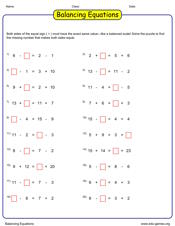
Help students master the true meaning of the equal sign with these engaging balancing equations worksheets! Designed to build early algebraic thinking, these activities guide learners through solving missing values on both sides of an equation (ranging from simple single-digit addition to advanced multiplication factor puzzles). Perfect for strengthening number sense, logical reasoning, and operational fluency in elementary classrooms or at home.
Division Wheels
Grades 3, 4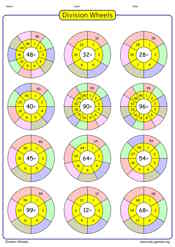
Make division practice something students look forward to! These circular wheel worksheets use visual repetition and patterns to build division fact fluency in a fresh, engaging format. A proven approach that turns what can feel like a chore into a genuinely satisfying activity.
Long Division 2 Digit Divisors
Grades 4, 5, 6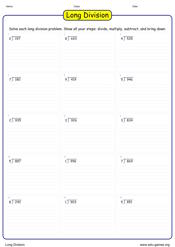
Long division with two-digit divisors, the step where estimating gets hard. Choose the divisor and dividend range, allow remainders or keep it exact, and generate a new set of problems every time. Answer key included.
Long Division 3 Digit Divisors
Grades 6, 7
Dividing by numbers like 248 or 671 is long division at full size. Each step means a real estimate and a real multiplication, and one slip early on throws off the whole column. Students who have the 2-digit version down use this to make the last jump.
Long Division with decimals
Grades 5, 6, 7
The decimal point is where long division starts to feel like real math. Money, measurements, averages, split-the-bill problems, they all land here. These worksheets let students divide with decimals in the dividend, the divisor, or both, and get comfortable with the moment where the point slides over and the answer keeps going past the ones place. Set the number of decimal places, choose how many problems fill a page, and generate a new sheet as often as you like. Answer key with every one.
Long division with remainders
Grades 4, 5, 6
Here every problem leaves something over, which is where students have to slow down and think about what the remainder actually means. Once the basic steps are solid, this is the natural next step, and it prepares the ground for writing remainders as fractions or decimals later on. Choose the divisor and dividend size, set how many problems go on a page, and print a fresh sheet with its answer key whenever you need one.
Long division without remainders
Grades 3, 4, 5
Every problem on these worksheets divides evenly, so students can focus on the steps of long division without the extra hurdle of interpreting what's left over. It's a good place to start once the algorithm is introduced, and a good place to return to when someone needs a confidence run. Set the divisor and dividend size, choose how many problems go on a page, and generate a new sheet whenever you need one. Answer keys included.
Long Division Worksheets
Grades 3, 4, 5, 6
Generate free printable long division worksheets where every problem divides exactly. No remainders — ideal for building the core algorithm.
Missing operands
Grades 2, 3, 4, 5, 6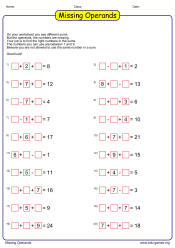
The operators are there — but the numbers have gone missing! Students must figure out which operands make each equation balance correctly. A clever reverse-engineering challenge that builds deep number sense and a genuine understanding of how addition and subtraction work.
Missing operators
Grades 2, 3, 4, 5, 6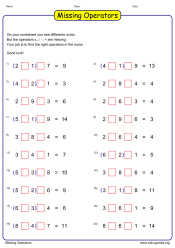
The numbers are there — but the +, −, ×, ÷ signs have vanished! Students must figure out which operators make each equation true, and then add brackets to show the correct order of operations. A uniquely challenging worksheet that deepens understanding of how math actually works.
How to Use the Division Worksheet Generators
Start by choosing the format that matches your teaching goal. Use division wheels when you want students to drill one specific divisor across many problems — set the center to the divisor they need to consolidate (e.g. ÷7 or ÷8) and every problem on the sheet targets that fact family. Use fact drills for mixed-divisor practice across a range, where students encounter different divisors on the same sheet.
For long division practice, set the digit count for the dividend and choose single- or two-digit divisors to match where your class is in the curriculum: 2-digit ÷ 1-digit for Grade 4, 3-digit ÷ 1-digit for Grade 5, or 4-digit ÷ 2-digit for Grades 5–6. Because every worksheet is generated fresh, you can produce a harder and an easier version in the same session for mixed-ability groups without any extra preparation.
Why Varied Division Practice Builds Stronger Fluency
Division fact fluency — the ability to produce quotients instantly without repeated subtraction or skip-counting — is essential before Grade 4 introduces long division. Every step of a long division calculation requires a division fact to be applied quickly; if those facts still require visible effort, the cognitive load of tracking the algorithm makes sustained, accurate work very difficult. Automatising facts first frees working memory for the procedural reasoning that long division actually tests.
Wheels and fact drills serve different purposes. A mixed fact drill tests whether a student has consolidated their division knowledge across all divisors. A wheel with a fixed center divisor isolates one fact family and delivers more repetitions of it per sheet than a mixed drill would. Using both formats in rotation gives students the breadth of a mixed drill and the depth of targeted fact-family practice — producing faster and more durable fluency than either format alone.
Also check out the Division Games page for maze, arithmagon, and bingo formats — game-style layouts generate more practice repetitions per session than a standard drill sheet because students are working toward a goal that keeps them engaged through the volume of problems that fluency actually requires.
Share these free division worksheet generators
