Free Printable Dice Climber Board Game
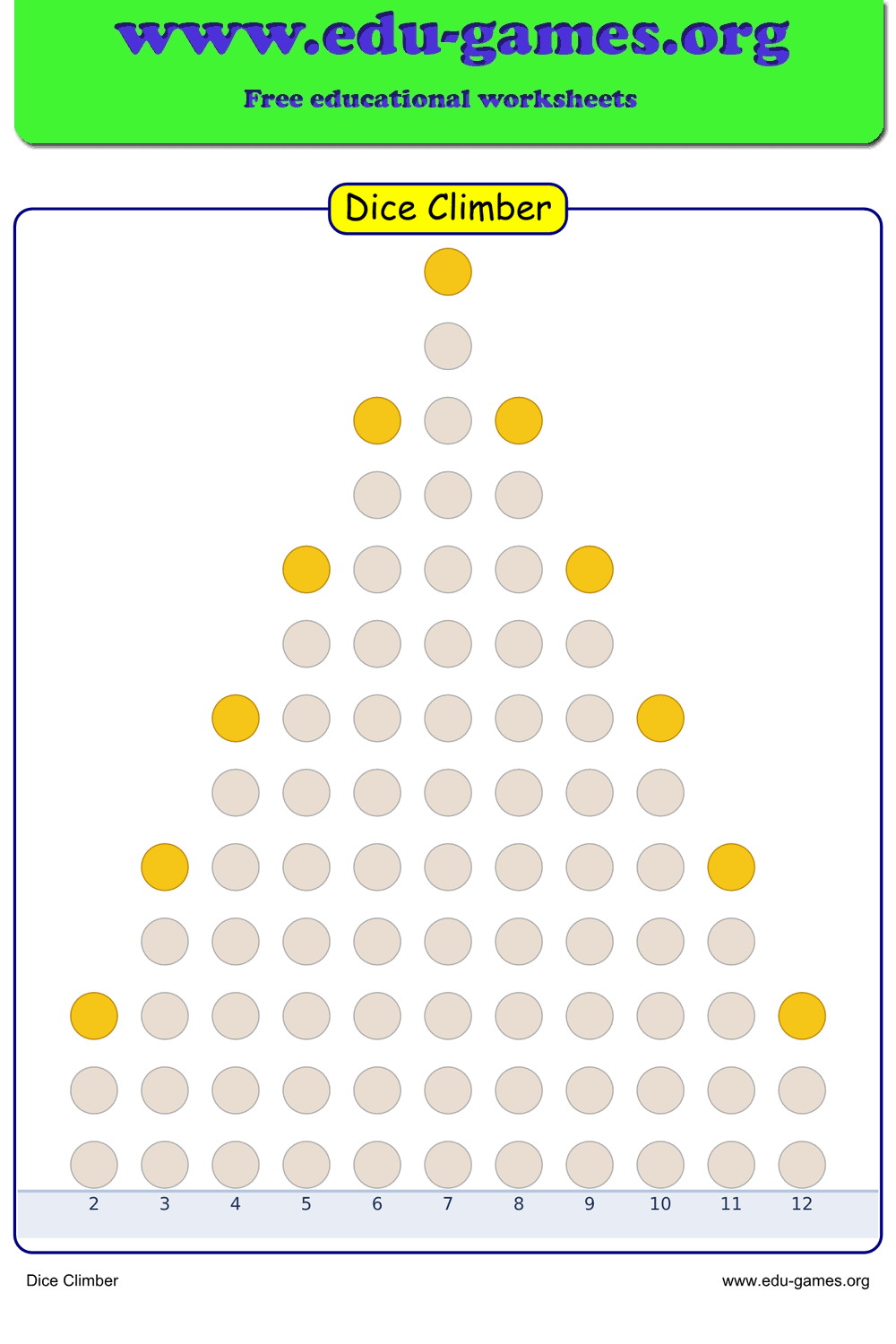
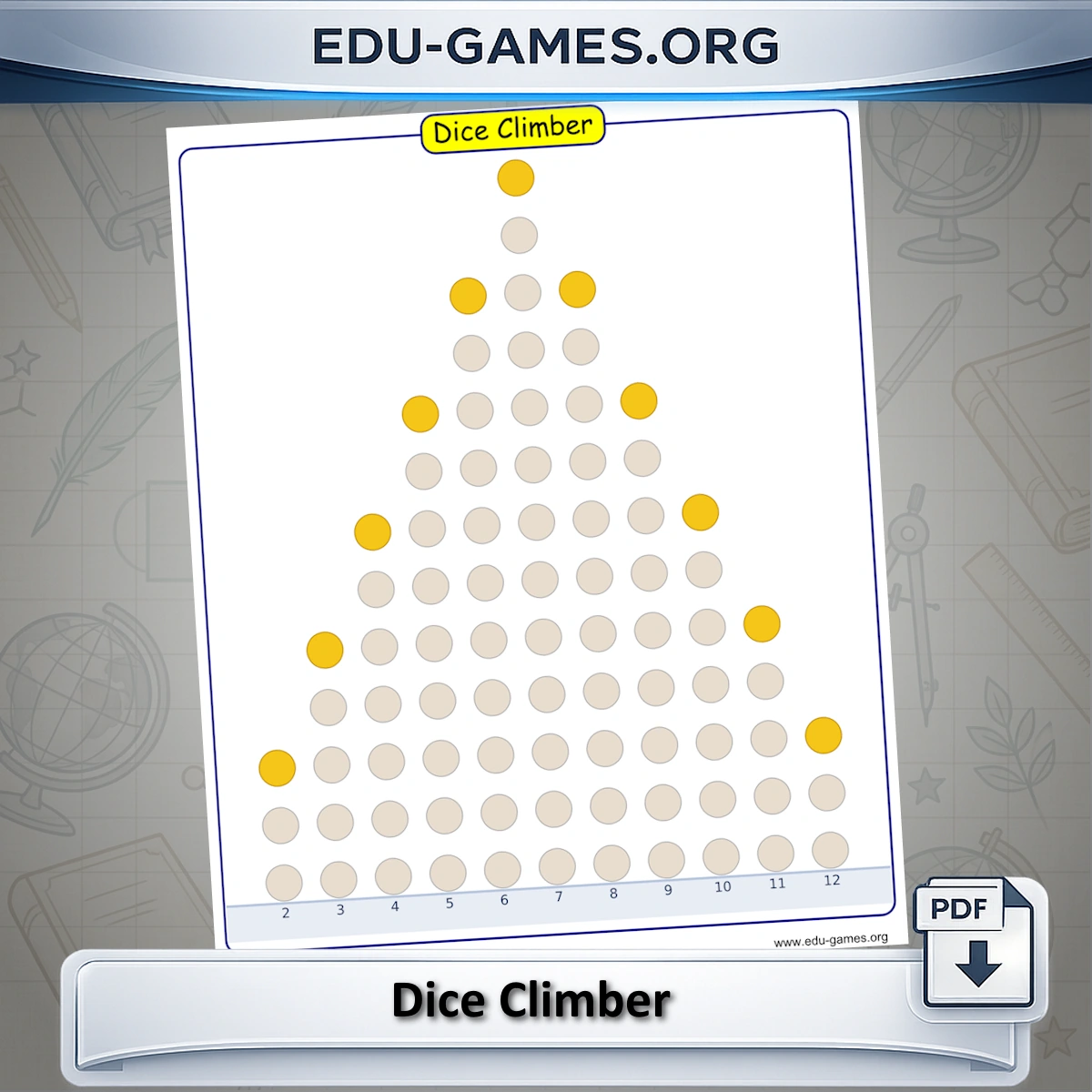
Generate a print-ready Dice Climber board in seconds. A push-your-luck dice game inspired by the classic board game Can't Stop. The full pyramid board — all 11 columns from 2 to 12 — is drawn automatically with the correct number of spaces per column. Choose the number of players and download the PDF.
Instant PDF download · No account required
Create your Dice Climber board
How to use the board generator
- Select the number of players using the dropdown on the left. This is printed on the board sheet.
- Download the PDF. The board is printed with all 11 columns in their correct heights. Cut out tokens or use coins as player markers and climbers.
Dice Climber — Game Rules
A push-your-luck dice game inspired by the classic board game Can't Stop. Be the first player to claim the top space of 3 columns.
Setup
- You need 4 standard six-sided dice to play.
- Each player chooses a colour and takes 11 matching coloured markers — one for each column on the board.
- Place 3 neutral white climber pieces in a shared pool.
- Put the printed board in the centre of the table.
If you do not have suitable markers, the PDF includes a second page with printable cut-outs — 3 white climbers and 11 circles per player. Cut them out and glue them onto a piece of cardboard before playing.
The three neutral markers enforce the rule that you can advance in at most three columns during a single turn. For example: you roll 5, 3, 4, 2 and pair them as 5+2=7 and 3+4=7 — you place one neutral marker in column 7 and move it 2 spaces. On a later roll you advance in columns 6 and 9. You now have neutral markers in columns 7, 6, and 9. On your next roll, if every possible pairing would require opening column 8, you cannot make that play — and if none of the three pairings stay within columns 6, 7, and 9, you bust.
On your turn
- Roll all 4 dice.
- Split the 4 dice into 2 pairs of your choosing. There are three possible ways to split them — you decide which to use.
- The sum of each pair determines which column you advance in. Move a white climber up one space in each matching column. If both pair sums are the same, advance two spaces in that column.
- You may advance in at most 3 different columns during your turn. Once you have started 3 columns, you may only continue advancing in those columns until you choose to stop or you bust.
- After advancing, choose: Stop and bank your progress, or Roll again at your own risk.
Busting
If none of the three possible pairings can be played without opening a fourth active column, you bust. Remove all white climbers from the board. Your coloured markers stay where they are — banked progress from earlier turns is safe.
Claiming a column
When a white climber reaches the top space of a column, that column is completed only if you end your turn successfully by choosing to stop. Replace the white climber with one of your coloured markers. No player may use that column again — it is permanently closed.
Winning
The first player whose coloured markers occupy the top space of 3 different columns wins.
In the classroom
Younger players (grade 2–3) use it as an addition game — pairing four dice and adding under pressure. From grade 4 up, the shape of the board starts doing the teaching: students notice that 7 lands far more often than 2 or 12, and that the longest column is the one you can climb fastest.
Frequently Asked Questions
Why is column 7 the longest on the Dice Climber board?
7 is the most likely sum of two standard dice — there are 6 ways to roll a 7 out of 36 possible outcomes. The column length reflects this probability: longer columns are harder to claim because they need more dice rolls to reach the top.How many spaces does each column have?
Columns 2 and 12 each have 3 spaces. Columns 3 and 11 have 5. Columns 4 and 10 have 7. Columns 5 and 9 have 9. Columns 6 and 8 have 11. Column 7 has 13 spaces.Why can a player only advance in three columns per turn?
The three neutral climbers enforce this rule — you can only place a neutral climber in a column you are advancing in. Once climbers are active in three different columns, every subsequent roll must produce a pairing that stays within those same three columns. You then choose to stop and bank your progress, or roll again.What happens when you bust?
If none of the three possible ways to pair your four dice can be played without opening a fourth active column, you bust. Remove all neutral climbers from the board. Your coloured markers stay where they are — progress banked in previous turns is safe.How do you win the game?
The first player to claim three columns wins. You claim a column by reaching its top space and ending your turn successfully by choosing to stop. If you bust after a neutral climber reached the top space, the column is not claimed — the climber is removed along with the rest.Share this free Dice Climber board generator