Edu-Games.org
By Teachers, for Teachers

Free Printable Dividing Fractions Worksheet Generator

Generate free printable dividing fractions worksheets — set the denominator range, choose the number of problems, edit the step-by-step instructions, and download a unique PDF with optional answer key. No account needed.

Used by teachers worldwide  ·  Instant PDF download  ·  No account required

Free printable dividing fractions worksheet generator

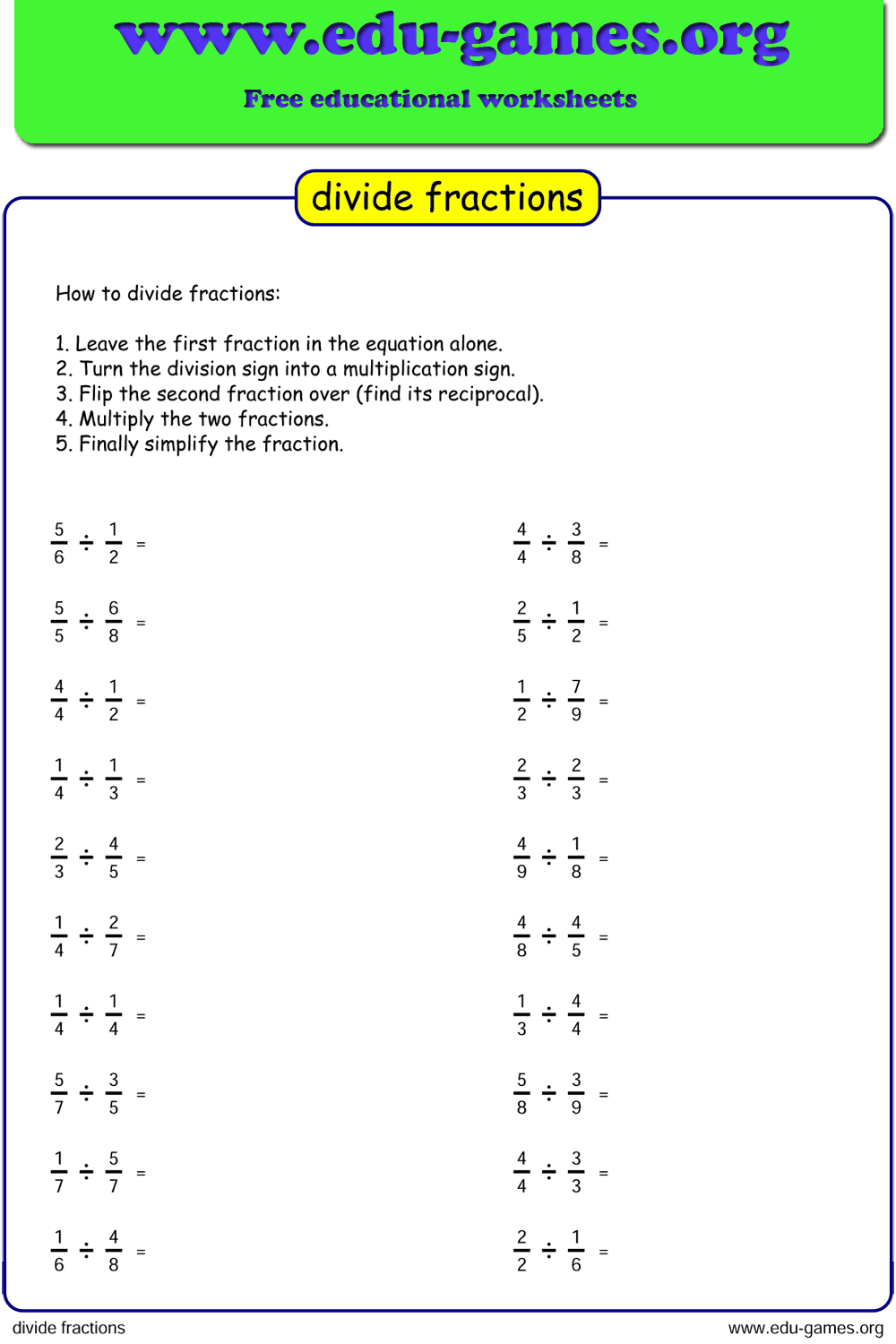
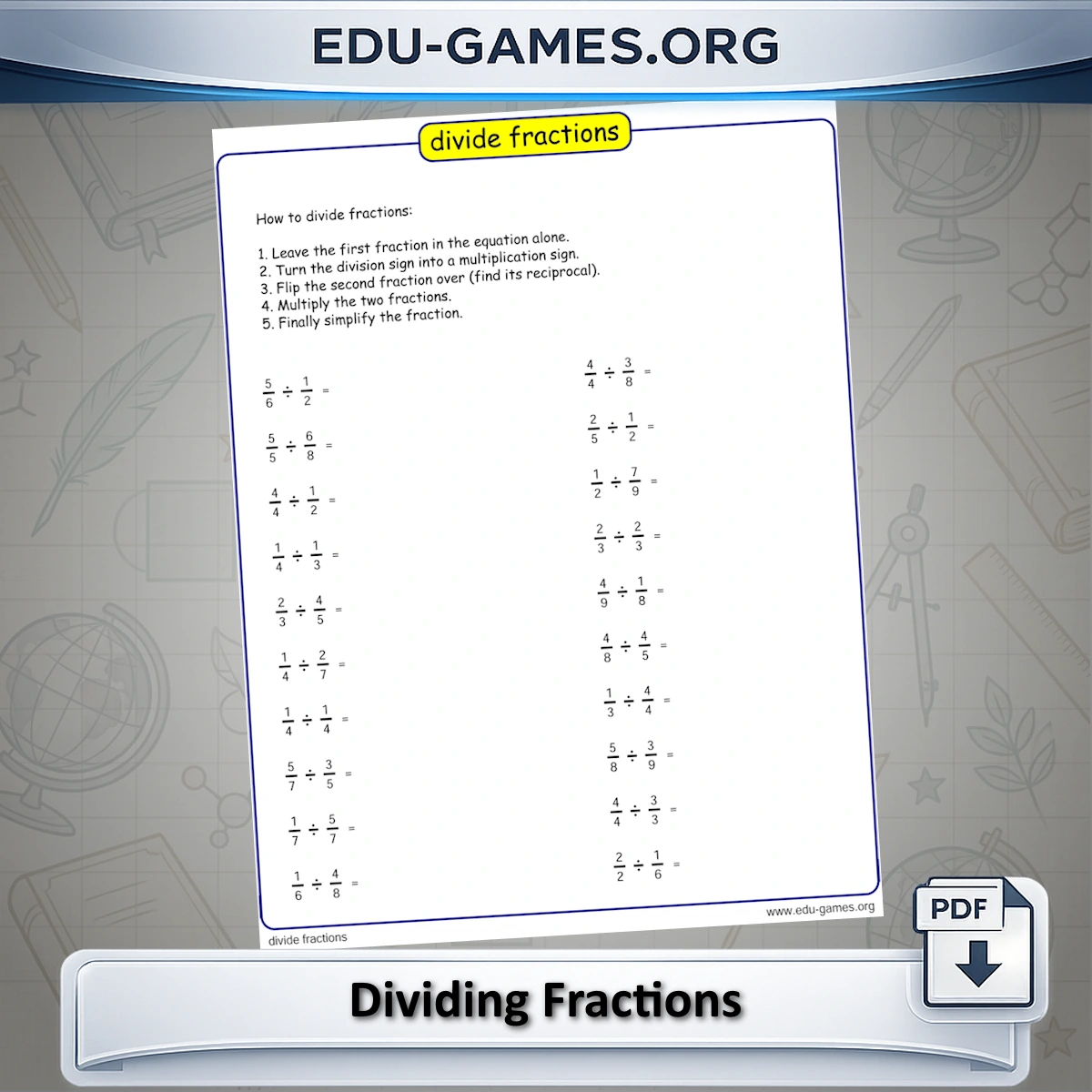
Each worksheet presents a set of fraction division problems. Students divide one fraction by another using the keep-change-flip method — keep the first fraction, change division to multiplication, flip the second fraction, then multiply and simplify. The denominator range setting controls difficulty, and the instructions field lets you customise the printed method guide on every worksheet. A new unique set of problems is generated on every click.

Create Your Dividing Fractions Worksheet

Denominators range:
?
By writing them with commas.
 Example: 2,5,8 → this means you only pick the numbers 2, 5, and 8.

By using a dash ( - ).
 Example: 2-5 → this means you pick all numbers from 2 up to 5 (2, 3, 4, 5).

👉 You can also mix both!
 Example: 1,3,5-7 → this means 1, 3, 5, 6, 7.
shortcuts for denominator range.
Problems per page:
Instructions:
Include solution page
Paper format:

How to Use This Dividing Fractions Worksheet Generator

  1. Set the denominator range — type a range (e.g. 2–9) or a comma-separated list of specific values. Use the easy and hard shortcut buttons to apply preset ranges matched to common curriculum levels.
  2. Set the number of problems per page — choose 10, 16, or 20 problems.
  3. Edit the instructions (optional) — the instructions text box contains the printed step-by-step method guide. Edit it to match the method phrasing your class uses, add a student name field, or simplify the language for younger students.
  4. Click "Create new Dividing Fractions" — a preview of the worksheet appears with a freshly generated set of problems.
  5. Download the PDF — enable the Solution option before downloading to include a completed answer page.

Why Use This Dividing Fractions Worksheet Generator?

Dividing fractions is one of the algorithm-heavy steps in the fraction curriculum — students need to apply keep-change-flip correctly, multiply across, and then simplify, all in sequence. Errors accumulate when any step is missed or applied in the wrong order. Repeated practice with varied problem sets is the most reliable way to build accurate, automatic execution of the full procedure.

  • Targeted difficulty — the denominator range setting lets you control exactly which fraction values appear. Keep denominators small for initial practice; expand the range once students are confident with the basic procedure to introduce more demanding simplification steps.
  • Editable instructions — the method guide prints on every worksheet, so students always have the procedure available as a reference during practice. Edit the wording to match how your class phrases each step.
  • Unlimited unique worksheets — every click generates a different set of problems, so you can produce a unique worksheet for every session, for retesting, or for each student in the group without any repetition.

Dividing Fractions Worksheets — Frequently Asked Questions

What does "keep, change, flip" mean when dividing fractions?

"Keep, change, flip" describes the three steps of fraction division. Keep the first fraction exactly as it is. Change the division sign to multiplication. Flip the second fraction — swap its numerator and denominator to form the reciprocal. You then multiply across: numerator × numerator and denominator × denominator. The method works because dividing by a number is mathematically identical to multiplying by its reciprocal, so the two operations cancel out correctly.

Why does multiplying by the reciprocal produce the same result as dividing?

Division asks: "how many times does the divisor fit into the dividend?" Multiplying by the reciprocal answers the same question algebraically. If you divide by 2/3, you are asking how many groups of 2/3 fit into the dividend. The reciprocal of 2/3 is 3/2, and multiplying by 3/2 scales the dividend by exactly the factor needed to give that answer. The two operations are inverses of each other — that relationship is what makes the reciprocal method valid, not just a trick.

How does the denominator range setting affect the difficulty of the worksheet?

The denominator range controls which values can appear as denominators in the generated fractions. A narrow low range (e.g. 2–4) produces simple fractions whose products are easy to simplify. A wider or higher range (e.g. 5–9 or beyond) produces fractions with larger numerators and denominators after multiplication, making simplification harder and requiring students to find larger common factors. The shortcut buttons — easy and hard — apply preset ranges matched to typical curriculum levels.

What grade levels are dividing fractions worksheets suitable for?

Dividing a fraction by a fraction is typically introduced in Grade 5–6. Grade 5 students usually begin with dividing unit fractions by whole numbers and whole numbers by unit fractions before moving to fraction ÷ fraction. Grade 6 applies the full algorithm including mixed numbers. The denominator range setting lets you calibrate difficulty within those grades — keeping denominators in the 2–5 range for Grade 5 and expanding to 6–9 or beyond for Grade 6 and above.

What is the difference between dividing a fraction by a fraction versus dividing a fraction by a whole number?

Dividing by a whole number is a simpler special case: a whole number n has the reciprocal 1/n, so dividing by n is the same as multiplying by 1/n. Students usually learn this case first because the flip step is straightforward and the resulting denominator is predictable. Dividing by a fraction generalises the rule — both numerator and denominator change after the flip, so the result is less predictable and simplification is more often required. The same keep-change-flip procedure applies to both cases.

Why does the result fraction sometimes need to be simplified, and how should students decide when to simplify?

After multiplying numerator × numerator and denominator × denominator, the result often shares a common factor between the two numbers. A fraction is in simplest form when numerator and denominator share no common factor other than 1. Students should check by finding the greatest common factor (GCF) of the result and dividing both numbers by it. A faster method is to cross-cancel before multiplying — identify common factors between any numerator and any denominator diagonally before performing the multiplication, which keeps the numbers smaller throughout.