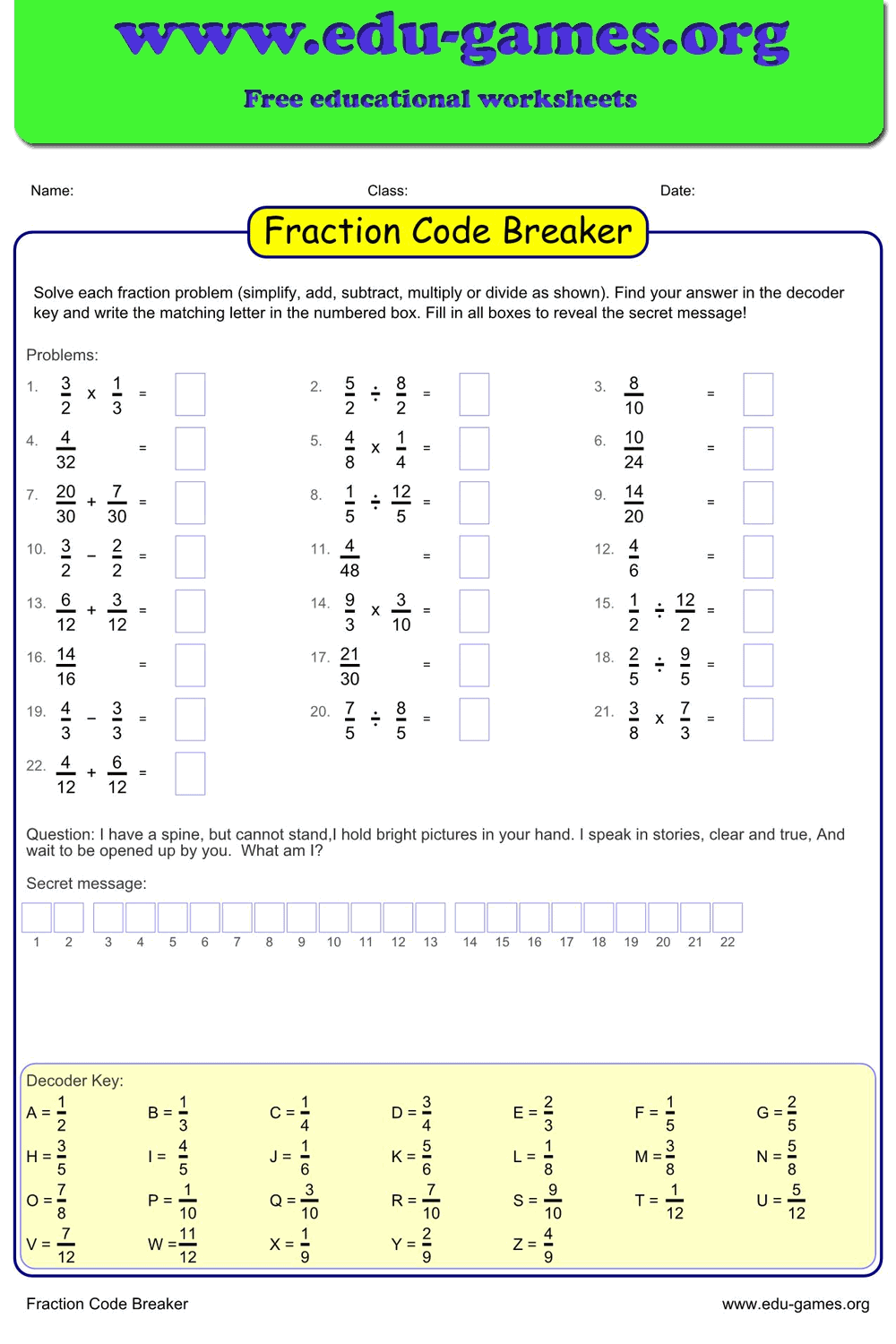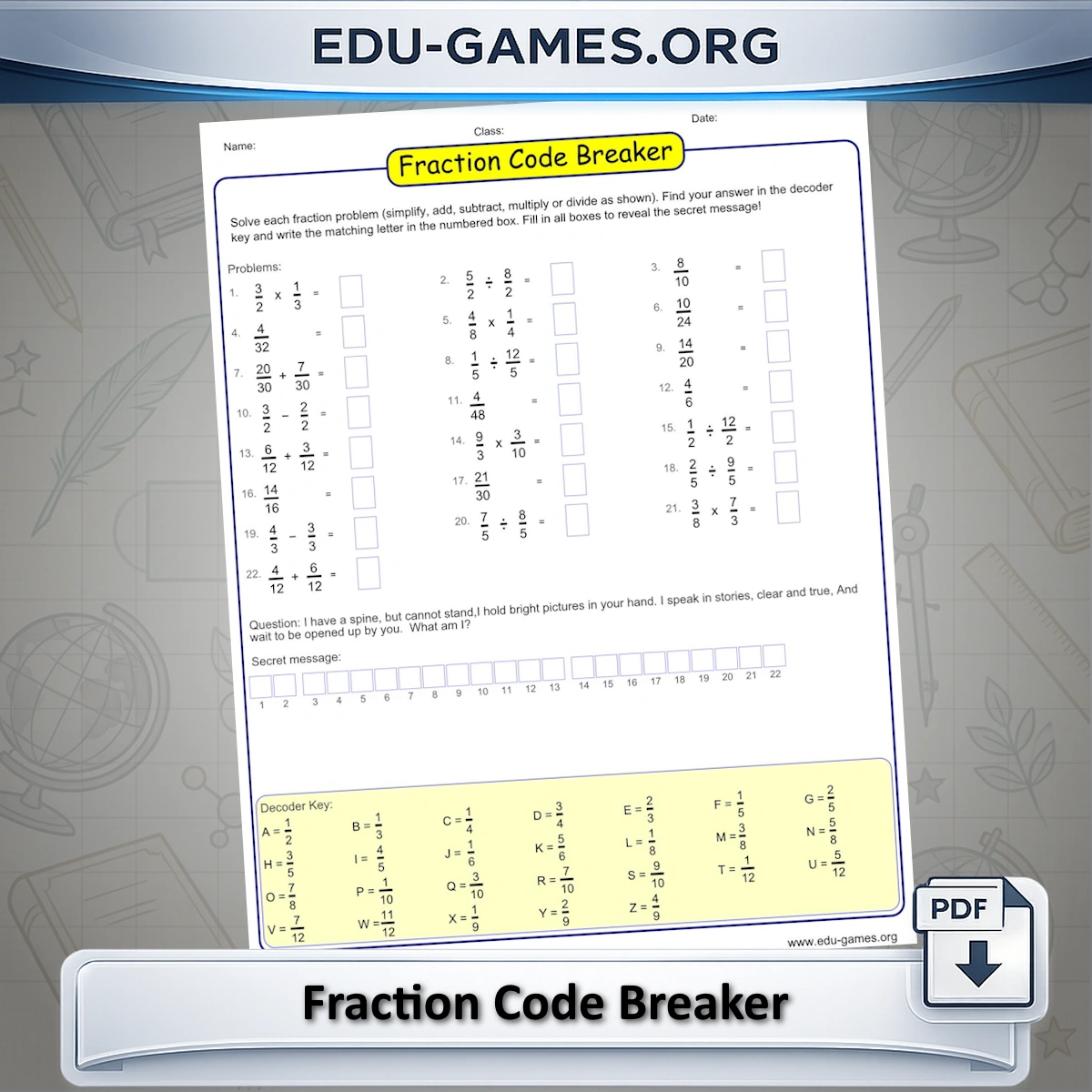
Each worksheet presents a set of fraction problems — adding, subtracting, multiplying, dividing, and/or simplifying, depending on which operations you select. Solve each one, then use the decoder key to find the letter that matches your answer. Write the letters in the numbered boxes to reveal the punchline to a math riddle. If a letter combination spells gibberish, it means a calculation error — students can self-correct immediately without waiting for teacher feedback.
Create Your Fraction Code Breaker Worksheet
How to Use This Fraction Code Breaker Generator
- Select your operations — tick one or more of: Simplify, Adding, Subtracting, Multiplying, Dividing. The worksheet will only include problem types you have checked.
- Click "Create new code breaker" — the preview shows a fresh set of fraction problems and a decoder key, together spelling a secret math joke.
- Edit the instructions (optional) — update the instructions field to add a student name line or a specific prompt.
- Download the PDF — the worksheet prints on a standard A4 or letter page. Enable the "Solution" option before downloading if you want the decoded message included on the answer page.
- Generate again for a new set — each click creates a fresh worksheet with different problems, so you can produce a unique activity for every session.
Why Use Fraction Code Breaker Worksheets?
Standard fraction drills give students problems to solve and then move on. Code-breaker worksheets add a layer of purpose: every answer is a step toward revealing a hidden message, which keeps students engaged through the full set of problems rather than rushing or skipping the harder ones.
- All five operations — choose to include adding, subtracting, multiplying, dividing, and/or simplifying fractions. Use a single operation for a focused drill or combine several for a mixed review.
- Built-in self-checking — a wrong answer produces a nonsense letter that breaks the message, giving students immediate, unambiguous feedback without needing a teacher to mark each problem.
- Wide grade range — select the operations that match your class: simplifying fits Grades 3–4, adding and subtracting with unlike denominators fits Grades 4–5, and multiplying and dividing fits Grades 5–6.
- High engagement — the cryptogram format is inherently motivating; students are solving a puzzle rather than completing a drill, which increases the number of practice repetitions per session.
- Flexible use — works as a warm-up, a math center activity, early-finisher work, or a homework task, with no preparation beyond printing.
Share this free fraction code-breaker worksheet