What Are Subtracting Fraction Circles Worksheets?
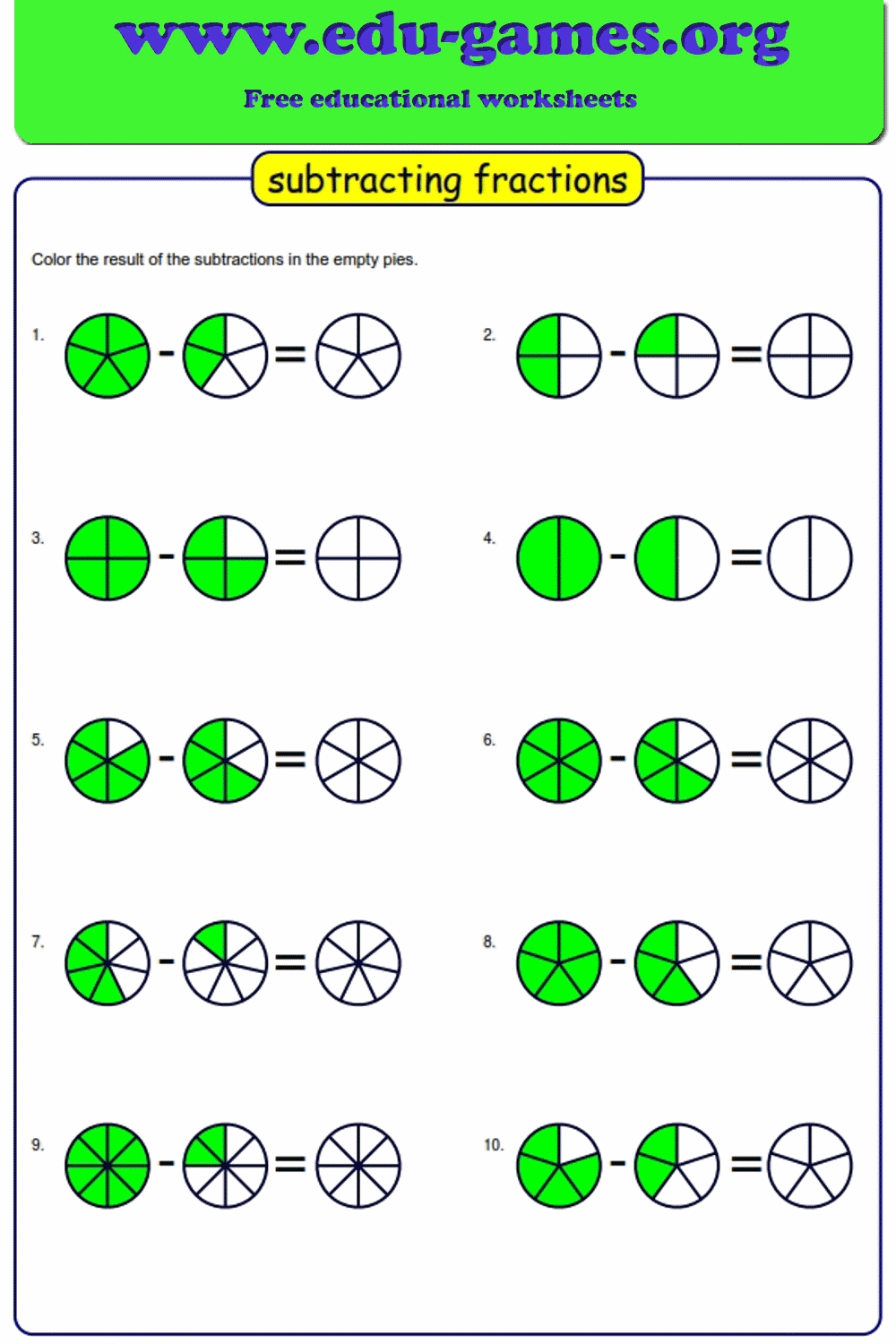
Fraction circle worksheets replace abstract notation with a pie-chart model. Each problem shows the first fraction already colored in a circle. Students subtract the second fraction by uncoloring (or crossing out) the matching number of slices, then color the remaining slices in an empty circle to show the result. This physical action of removing slices makes the subtraction operation visible and memorable.
The generator lets you choose the number of problems per page — 10, 16, or 20 — so you can match the volume of practice to the age group and lesson length. Every click creates a completely new random set of problems, so the same worksheet is never repeated.
How to Use the Worksheet Generator
- Choose the number of problems: Select 10 for younger students who need more space, or 16–20 for faster paced practice.
- Customize the instructions: Edit the instruction text to match your lesson language or leave the default prompt in place.
- Generate the worksheet: Click "Create Circle Fractions" to generate a new random set of problems. The preview updates immediately.
- Download the PDF: Click the download button to save a print-ready PDF. You can optionally include a solution page that shows the completed circles.
- Repeat for variety: Generate as many different worksheets as you need — there is no limit and no account required.
Why Use Fraction Circle Worksheets for Subtraction?
- Makes subtraction concrete: Removing colored slices from a circle is a physical action students can see. This prevents the most common error of subtracting both numerator and denominator separately.
- Reveals why common denominators matter: When denominators differ, the slice sizes do not match and students can see immediately that they cannot remove one type of slice from another — the model teaches the rule without memorization.
- Builds conceptual understanding first: Students who understand the visual model transition far more easily to the written symbolic method in later grades.
- Ideal for Grades 3–5: Younger learners in Grade 3 start with like denominators; Grades 4–5 move toward unlike denominators using the same familiar circle model.
- Unlimited and free: Generate a different worksheet every lesson with no registration, no subscription, and no cost.
Subtracting Fraction Circles — Frequently Asked Questions
What are fraction circles and how do they help with subtraction?
Fraction circles are pie-chart models where the circle is divided into equal slices, each representing one part of the denominator. To subtract, students start with the first fraction colored in, then remove (uncolor) the number of slices shown by the second fraction. Seeing the pieces disappear makes the subtraction concrete rather than abstract.What grade levels use fraction circle worksheets?
Fraction circle worksheets for subtraction are best suited for Grades 3 to 5. Grade 3 students typically start with like denominators (same-size slices). Grades 4 and 5 move toward unlike denominators, where students must first find equivalent fractions before they can subtract.How do fraction circles show subtracting fractions with unlike denominators?
When denominators differ, the slice sizes are different and you cannot remove one type of slice from another. The circle model makes this mismatch visible — students can see that the slices do not line up. This reveals exactly why a common denominator is needed: you must split both circles into equal-sized pieces before subtracting.Why do students need a common denominator to subtract fractions?
A fraction's denominator tells you the size of each part. You can only subtract parts that are the same size, just as you can only take away apples from a group of apples. A common denominator converts both fractions into equal-sized parts so the subtraction makes sense. The fraction circle model makes this rule visible without memorization.What is a common mistake students make when subtracting fractions?
The most common mistake is subtracting both the numerators and the denominators separately — for example, writing 3/4 − 1/2 = 2/2 = 1. Fraction circles prevent this by showing that the denominator represents the total number of equal slices in the whole circle, which does not change when you remove slices.Can fraction circles be used to subtract mixed numbers?
Fraction circles work best for proper fractions (values less than one whole circle). For mixed numbers, students would need more than one circle to represent the whole-number part, which makes the model harder to read. It is better to build fluency with proper fractions using circles first, then move to the written method for mixed numbers.Share these free subtracting fraction circles worksheets