Free Printable Adding Fractions with Fraction Circles Worksheets
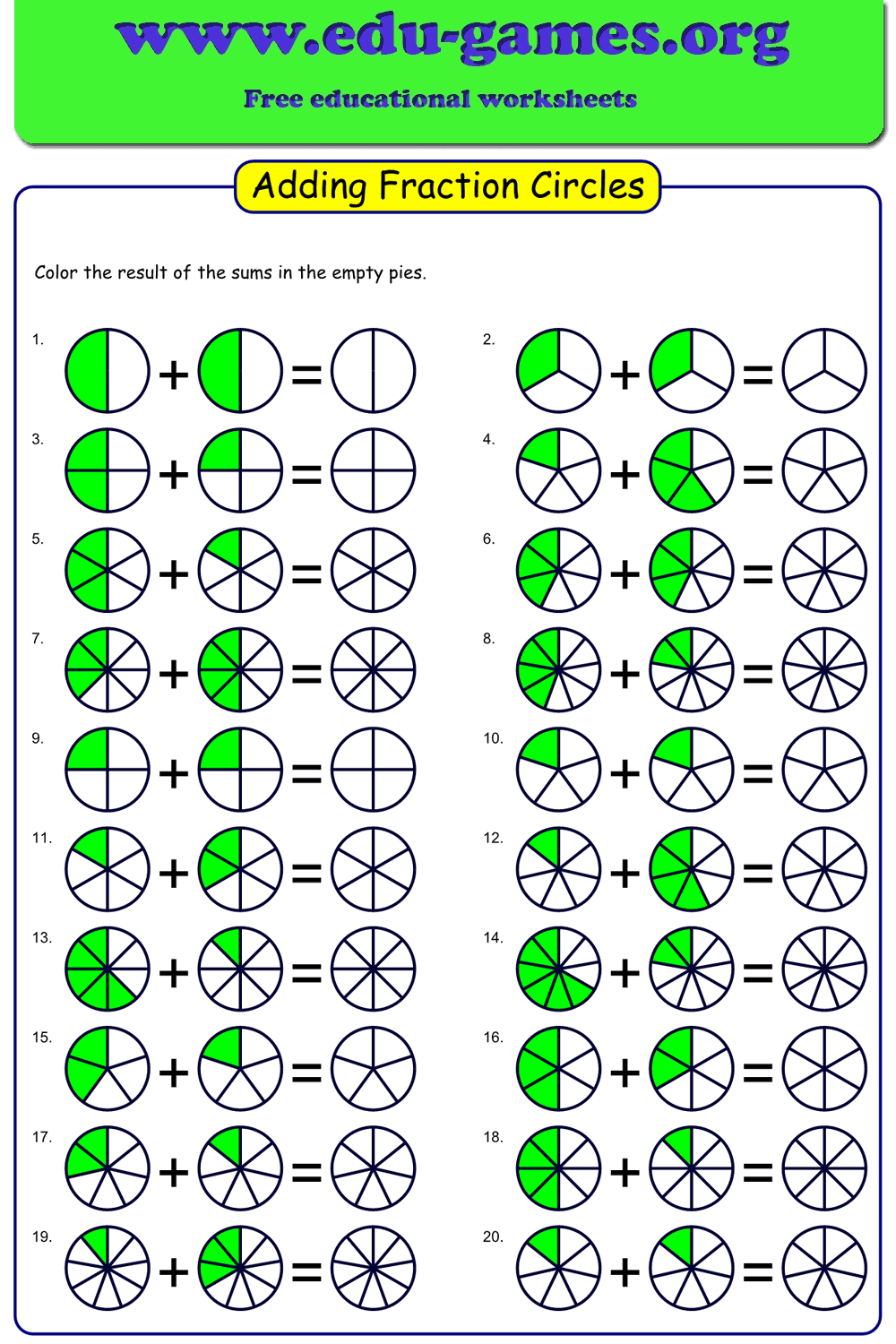
Help your students or children understand how fractions work with our printable fraction circle worksheets. These hands-on visuals make adding fractions easier to grasp and more engaging to teach.
Perfect for classroom lessons or home practice — just print and start learning!
Used by teachers worldwide · Instant PDF download · No account required
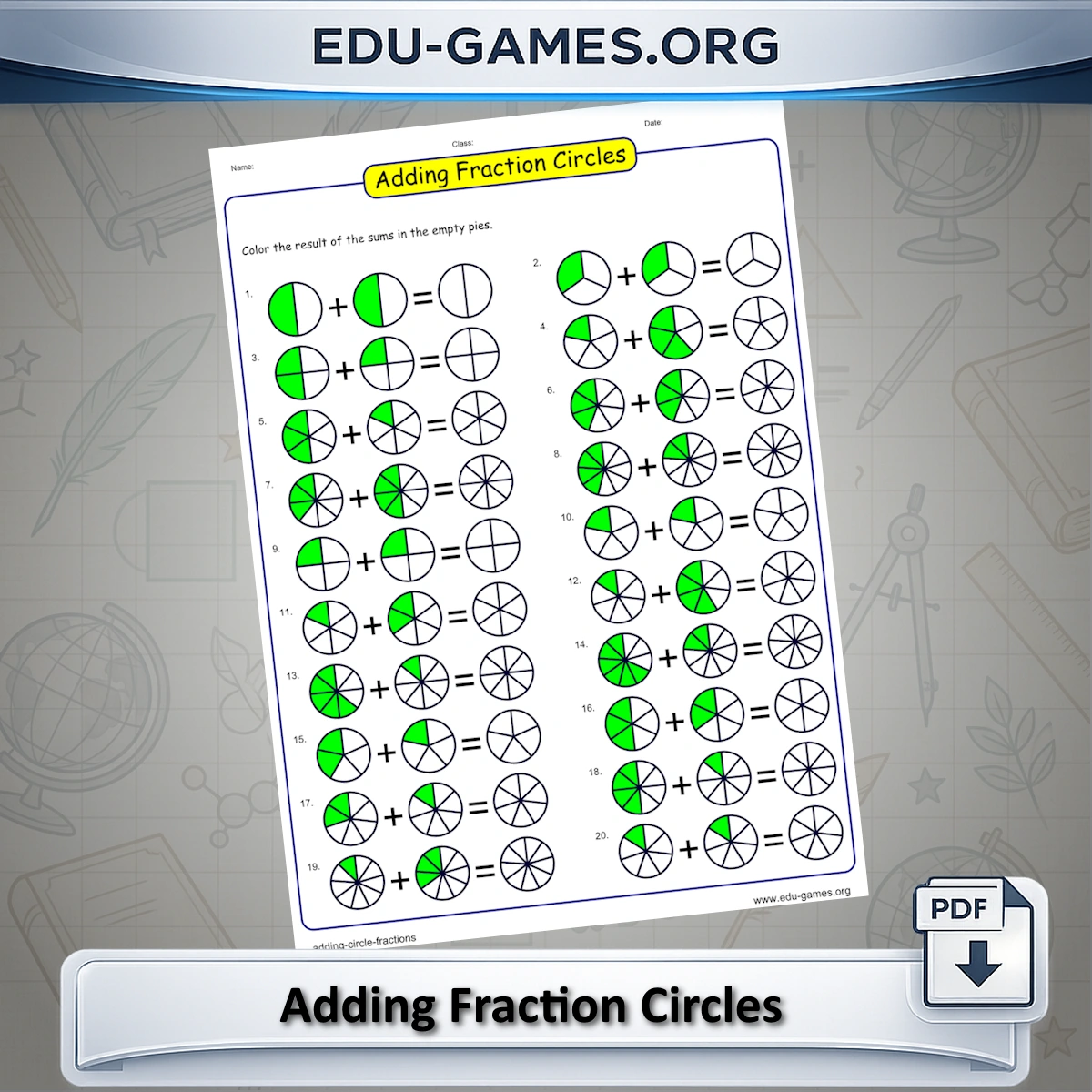
Create your fraction circles worksheet
How to use the fraction circles worksheet generator
- Choose the number of problems. Select 10, 16, or 20 problems per page. Fewer problems give larger circles — useful for younger students or whole-class projection.
- Edit the instructions if needed. The default text tells students to color the result in the empty pie. Change it to match your lesson or leave it as is.
- Click "Create Circle Fractions" to generate a new set of problems and see the preview on the canvas.
- Check the solution. Click the solution button to see the completed worksheet before printing.
- Download the PDF and print directly for classroom use or homework.
Why use fraction circles for adding fractions?
Fraction circles connect the abstract notation — 1/4 + 2/4 = 3/4 — to a visual that students already understand: slicing a pie. When students shade the result circle themselves, they are not just computing; they are building a mental image of what a fraction actually represents.
That visual anchor makes the move to abstract addition far easier. Students who can picture how two quarter-circles combine into a half-circle rarely make the classic mistake of adding denominators. The model also introduces mixed numbers naturally: when the result spills over into a second circle, students see why the answer is expressed as a whole number plus a fraction.
These worksheets are most effective at grades 3 to 5, when fraction notation is new and the concrete-to-abstract progression is most important.
Frequently Asked Questions
What does the empty circle on the right of each problem represent?
The empty circle is where students shade in the result. After working out the sum of the two fractions shown on the left, they color the matching number of sections in the result circle to make the answer visible.Why do all three circles in each problem have the same number of sections?
Using matching denominators means the two addend circles and the result circle are all divided into the same number of equal parts. This makes it visually clear that the numerators simply add together without any conversion.Can the result of an addition fill more than one circle?
Yes. When the combined numerators exceed the denominator — for example 3/4 + 3/4 — the result is an improper fraction. The worksheet shows this as a fully shaded circle plus a partially shaded one, introducing mixed numbers visually.How many problems can I put on one worksheet?
The generator offers three options: 10, 16, or 20 problems per page. Fewer problems give larger circles — useful for younger students or those new to the visual model.Share this free adding fractions worksheet