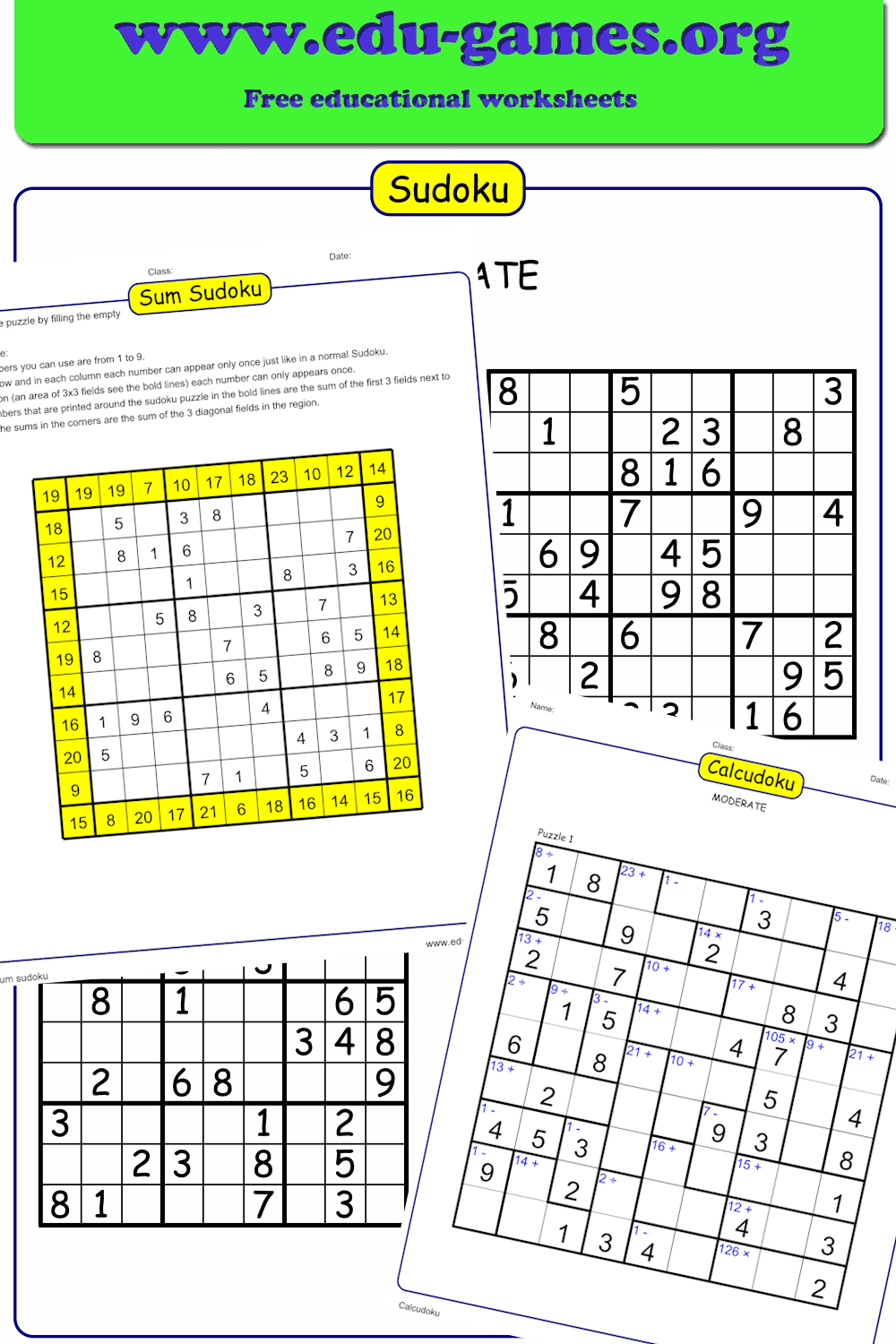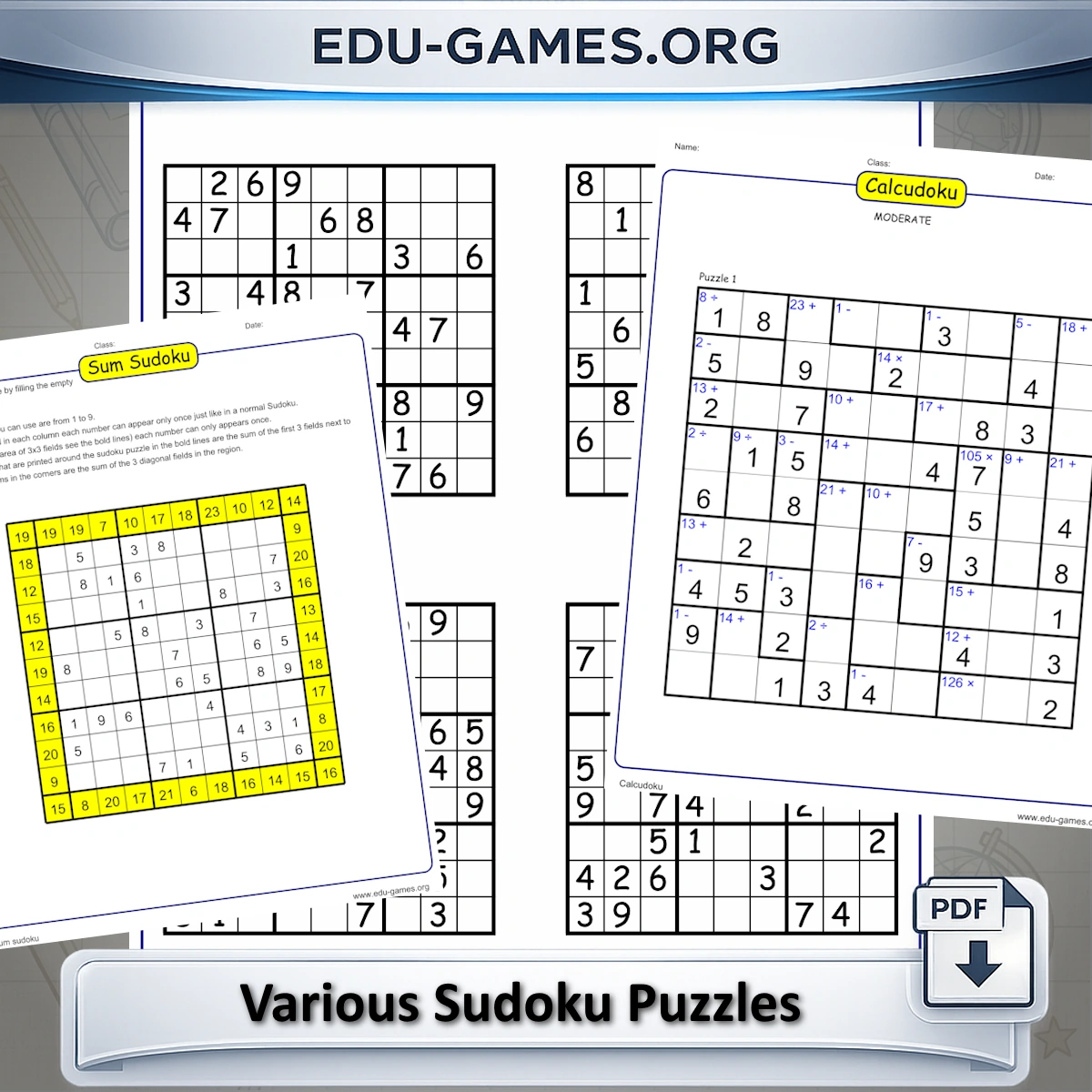
Sudoku puzzles are among the most effective logic exercises available — they require no prior knowledge beyond the rules, and a solver of any age can sit down with a fresh puzzle and experience the satisfaction of completing it through pure deduction. This collection brings together four printable sudoku variants, each with its own generator so you get a unique puzzle every time you click Create.
All Printable Sudoku Puzzle Generators
Calcudoku
Grades 3, 4, 5, 6
Sudoku meets arithmetic in this brain-bending puzzle! Fill the grid using Sudoku rules, but use the arithmetic clues inside each "cage" to figure out which numbers belong where. Every puzzle is a unique challenge that sharpens both logic and calculation skills simultaneously.
Divider sudoku
Grades 3, 4, 5, 6
A clever twist on the classic Sudoku! Division problems are printed inside certain cells, and solving them reveals the key numbers you need to crack the entire puzzle. Perfect for students who are ready to take their Sudoku skills — and their division — to the next level.
Sudoku
Grades 3, 4, 5, 6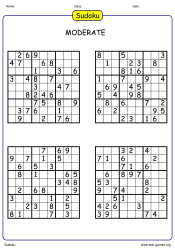
The world's most popular logic puzzle — now with an instant worksheet maker! Select your difficulty level and generate four unique Sudoku puzzles per sheet, complete with a full answer key. Perfect for fast finishers, homework, or a quiet classroom challenge.
Sum sudoku
Grades 3, 4, 5, 6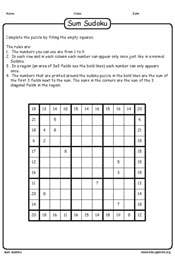
Think you know Sudoku? Think again! In Sum Sudoku, the totals of every group of three cells are printed around the puzzle, giving you just enough clues to crack the code. A fresh, rewarding challenge that combines addition with pure logic thinking.
The Four Sudoku Variants Explained
Classic Sudoku
The standard 9×9 grid divided into nine 3×3 boxes. Fill every row, column, and box with the digits 1–9, each appearing exactly once. No arithmetic — pure logical deduction from the starting clues. Five difficulty levels control how many clues are given, from Very Easy (51–53 clues) to Very Hard (20–26 clues).
Calcudoku
Calcudoku — also sold under the brand names KenKen and Mathdoku — keeps the row-and-column rule but replaces the 3×3 boxes with irregular cages. Each cage shows a target number and an arithmetic operation (+ − × ÷). The digits inside the cage must produce that target when the operation is applied. Available in 6×6 (digits 1–6) and 9×9 (digits 1–9) grids.
Sum Sudoku
A hybrid of sudoku and arithmetic. The standard row/column/box rules apply, and clue numbers printed along the borders of each 3×3 region tell you the sum of the three neighbouring digits. This extra constraint opens a different solving path — working from the border inward.
Divide Sudoku
Division clues appear between horizontally or vertically adjacent cells, showing the ratio of the larger digit to the smaller. These clues add targeted constraints that dramatically narrow the candidate list in specific cells, making Divide Sudoku a compact but demanding logical challenge.
Why Use Sudoku in the Classroom?
Sudoku builds the kind of thinking that underpins almost every academic subject: systematic elimination, pattern recognition, and logical reasoning. Working through even a Moderate puzzle requires sustained concentration, hypothesis testing, and the ability to hold multiple constraints in mind simultaneously.
Because classic sudoku involves no arithmetic at all, it is equally accessible to students who struggle with computation and those who excel at it — making it an unusually effective whole-class or mixed-ability activity. The arithmetic variants (Calcudoku, Sum Sudoku, Divide Sudoku) add a second layer: students must simultaneously apply number knowledge and logical deduction. A wrong arithmetic step makes the puzzle unsolvable, which creates immediate, self-evident feedback without a teacher needing to intervene.
- Early finisher tasks — a Very Easy or Easy puzzle keeps fast workers productively engaged without requiring teacher input.
- Warm-ups — a 6×6 Calcudoku takes 5–10 minutes and primes students for focused thinking before a lesson.
- Homework — self-contained, no materials needed beyond a pencil, and the optional answer key lets students self-check.
- Logic enrichment — Hard and Very Hard puzzles challenge gifted learners without requiring advanced curriculum knowledge.
Choosing the Right Difficulty Level
| Level | Who it suits | Solving technique needed |
|---|---|---|
| Very Easy | First-time solvers, Grade 3+ | Naked singles only |
| Easy | Casual players, Grades 4–5 | Naked singles + scanning |
| Moderate | Regular solvers, Grade 6+ | Hidden singles + cross-hatching |
| Hard | Experienced players, gifted learners | All three basic techniques in combination |
| Very Hard | Expert solvers, logic clubs | Advanced techniques (pairs, triples, X-wings) |
Share these free printable sudoku generators with your friends