Grade 3 is when students encounter fractions as a formal number system for the first time. The curriculum does not ask third graders to add, subtract, or multiply fractions — instead, it focuses entirely on what a fraction means: how to read and write one, how to represent it visually, and how to decide which of two fractions is larger. These free printable fraction worksheet generators target those foundational skills. Choose a generator, click Generate, and a print-ready PDF appears instantly — complete with an answer key on a separate page. No sign-up, no account, no limit on how many times you generate.
Free Printable Fractions Worksheets for Grade 3
Compare Fraction Circles
Grades 2, 3, 4, 5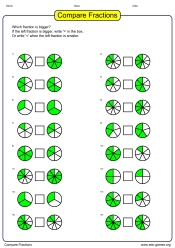
Comparing fractions becomes instantly visual with colourful fraction circle diagrams! Students can literally see which fraction is larger by looking at the pie slices. A powerful visual tool that makes the abstract concept of fraction comparison concrete and accessible.
Compare Fractions
Grades 3, 4, 5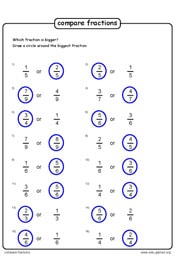
Which fraction is bigger — can your students tell? With options for same numerators, same denominators, mixed fractions, and even negative values, this fully customizable worksheet generator creates a fresh challenge every time. Every worksheet is uniquely generated, guaranteed.
Connect Four Fractions
Grades 1, 2, 3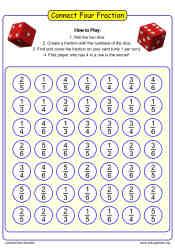
Roll two dice, create a fraction, and race to cover it on your card before anyone else does! First player to get four in a row wins. A fast-paced, competitive group game that builds fraction recognition naturally through play — no textbook required.
Fraction Battle
Grades 3, 4, 5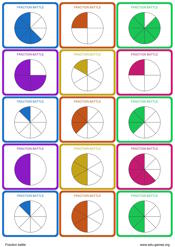
Get ready for an exciting test of math skills with Fraction Battle (also known as Fraction War)! This fast-paced, engaging card game is designed to help students master comparing fractions while having fun.
Fraction Bingo
Grades 3, 4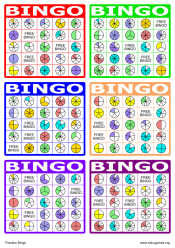
A wonderfully playful introduction to fractions! Instead of numbers, fraction pie diagrams fill the bingo cards — students match the fraction called to the correct pie on their card. An ideal icebreaker for a fractions unit that gets the whole class engaged from the very first call.
Fraction Domino
Grades 2, 3, 4, 5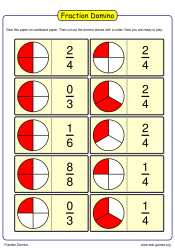
A brilliant hands-on game that makes fractions fun! Play using the same rules as classic domino, but match equivalent or related fractions instead of dots. A fantastic group activity that builds fraction recognition naturally through play — no drilling required.
Order fractions
Grades 3, 4, 5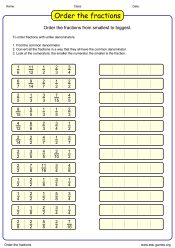
Arrange fractions from smallest to largest — easier said than done! This highly flexible worksheet maker lets you control the maximum denominator, the number of fractions per problem, and whether denominators are alike or different. The perfect tool for building fraction ordering confidence at any level.
How to Use the Grade 3 Fraction Generators
The generators on this page each target one of the three Grade 3 fraction skills, because understanding fractions as numbers, visualising them using area models and diagrams, and comparing them are distinct tasks that benefit from separate practice. Start with the concept your students are currently working on in class.
The key setting in most generators is the denominator. Grade 3 works with halves, thirds, fourths, sixths, and eighths — all denominators in the Grade 3 standards. Start with halves and fourths, where the visual intuition is strongest, before moving to sixths and eighths, where students must rely more on reasoning and less on a picture.
For the comparing-fractions generators, problems are built around one of two strategies: same denominator (which fraction has more equal parts?) or same numerator (which fraction has bigger equal parts?). Students should be able to state the reasoning, not just circle the larger fraction — the answer key includes the correct symbol, but classroom use should prompt students to explain why.
Why Grade 3 Fraction Foundations Matter
Fractions are the single most common source of persistent math anxiety from Grade 4 onward. The most frequent root cause is not that students can't do fraction arithmetic — it's that they never built a clear mental model of what a fraction is. A student who thinks of 3/4 as "three and four" rather than "three out of four equal parts" will make errors in every fraction operation they encounter in later grades, regardless of how many times they practise the procedure.
Grade 3 is the one year in the curriculum where the entire focus is on that mental model. There is no computation to distract from it. These generators reinforce the specific reasoning Grade 3 students need: that the denominator tells you the size of each part, that the numerator tells you how many parts you have, and that a fraction represents a specific quantity that can be shown as an area model — not just a notation for "part of something."
Students who leave Grade 3 with that conceptual clarity find Grade 4 fractions significantly more manageable. The equivalent-fractions work in Grade 4, the unlike-denominator addition in Grade 5, and the ratio and proportion work in Grade 6 all rest directly on the foundations built here. Extra practice time invested at Grade 3 has an outsized return across the following three years.
About the Worksheets
All worksheet generators on edu-games.org are created by Johannes Verhoef, an educator and developer with hands-on classroom experience. Every tool is designed around a single principle: less teacher prep, more student engagement. The generators are free, require no account, and produce print-ready PDFs with answer keys included.
Share these free third grade fractions worksheets