Browse 6 free printable brain teaser worksheets for Grades 2–8. These puzzles don't drill a single procedure — they require students to observe carefully, reason systematically, and try different approaches before reaching a solution. Each generator creates a unique worksheet on every click, so you can produce a fresh puzzle for every session without repeating problems.
Why Use Brain Teasers in the Classroom?
Most math practice gives students a procedure to apply. Brain teasers do the opposite: they present a problem with no obvious method, forcing students to reason from first principles. That difference matters — students who regularly work through genuine puzzle challenges develop a tolerance for uncertainty and a habit of trying multiple approaches, both of which transfer directly to performance in unfamiliar exam questions.
Brain teasers also work across ability levels in a way that standard worksheets don't. A puzzle that is straightforward for one student can remain genuinely challenging for another, so a single worksheet can be used with a mixed-ability group without signalling different expectations. For early finishers and gifted students in particular, a well-chosen puzzle occupies productive independent thinking time without requiring any teacher preparation.
How to Use Brain Teasers Effectively
Brain teasers work best when students are given time to struggle productively before any hints are offered. A useful classroom rule: no help for the first 5 minutes — students should make at least one genuine attempt before asking. After that, a nudge toward a useful first step (rather than the answer) keeps the reasoning challenge intact.
For whole-class use, displaying the puzzle and discussing approaches afterward is often more valuable than the solving time itself. Students articulate their reasoning, compare strategies, and frequently discover that a classmate found a more elegant solution — which is a powerful model for mathematical thinking. For individual use, pair a brain teaser with an instruction to show all working, so students build the habit of recording their reasoning rather than just circling an answer.
Browse All Brain Teasers by Grade
Calcudoku
Grades 3, 4, 5, 6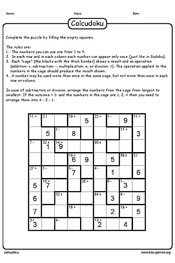
Sudoku meets arithmetic in this brain-bending puzzle! Fill the grid using Sudoku rules, but use the arithmetic clues inside each "cage" to figure out which numbers belong where. Every puzzle is a unique challenge that sharpens both logic and calculation skills simultaneously.
Divider sudoku
Grades 3, 4, 5, 6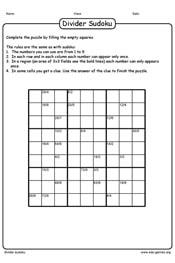
A clever twist on the classic Sudoku! Division problems are printed inside certain cells, and solving them reveals the key numbers you need to crack the entire puzzle. Perfect for students who are ready to take their Sudoku skills — and their division — to the next level.
How Many Squares
Grades 2, 3, 4, 5, 6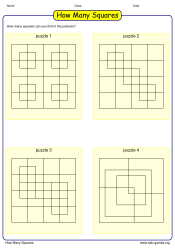
Count the squares — if you can! This deceptively tricky visual puzzle trips up most people on their first try, because squares come in all sizes. A brilliant critical thinking challenge that sparks great classroom discussion and proves that looking carefully really is a mathematical skill.
Rullo
Grades 2, 3, 4, 5, 6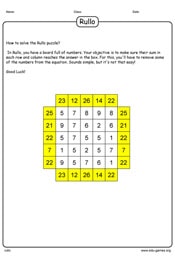
A board full of numbers — your job is to cross some out! Scratch off numbers in each row and column until the remaining ones add up to the target on the edge. Simple to understand, surprisingly difficult to master, and completely impossible to put down once you start.
Sudoku
Grades 3, 4, 5, 6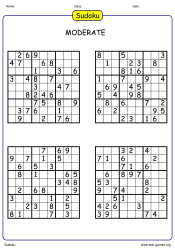
The world's most popular logic puzzle — now with an instant worksheet maker! Select your difficulty level and generate four unique Sudoku puzzles per sheet, complete with a full answer key. Perfect for fast finishers, homework, or a quiet classroom challenge.
Sum sudoku
Grades 3, 4, 5, 6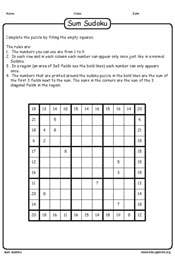
Think you know Sudoku? Think again! In Sum Sudoku, the totals of every group of three cells are printed around the puzzle, giving you just enough clues to crack the code. A fresh, rewarding challenge that combines addition with pure logic thinking.