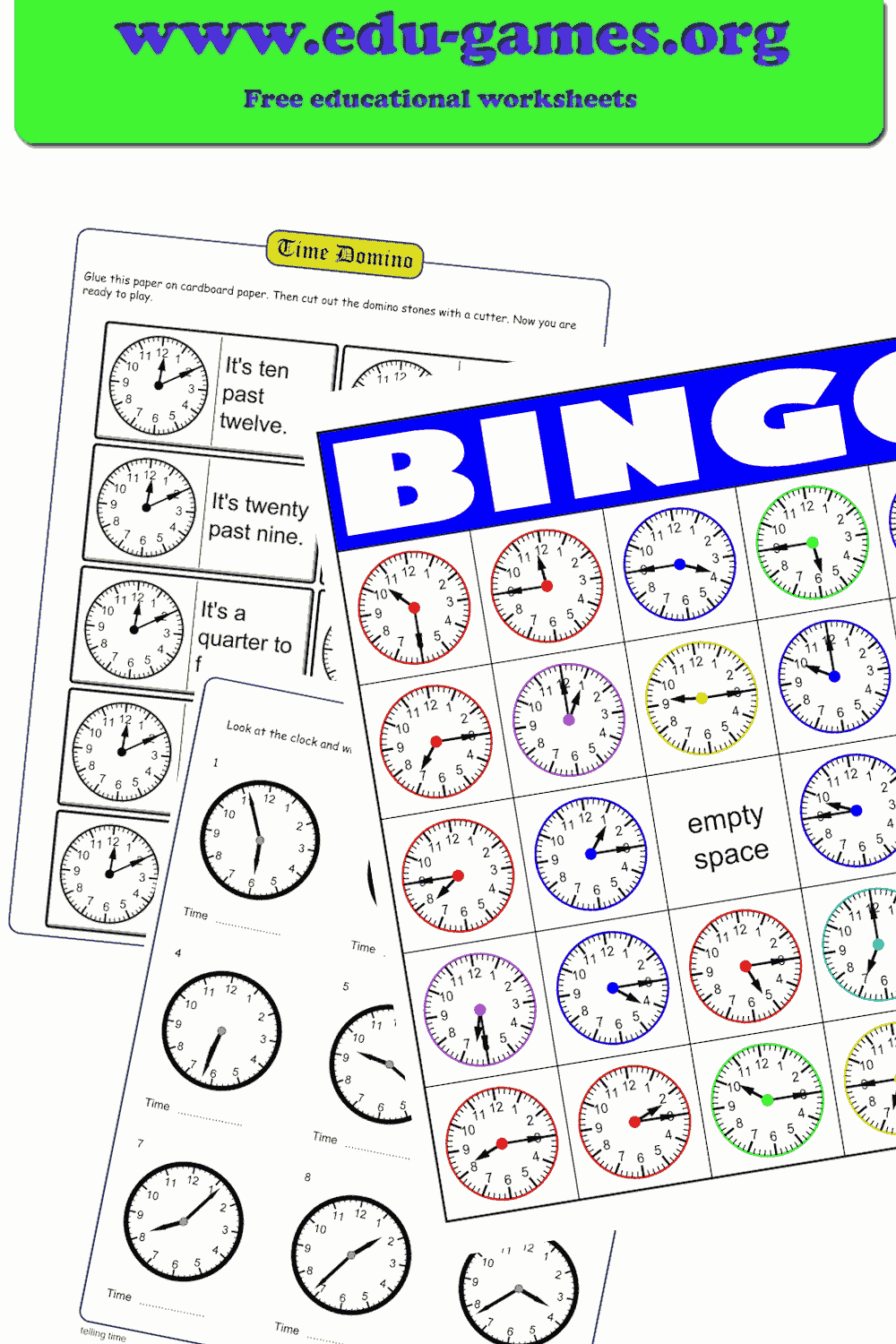
CCSS 1.MD.3 is the first formal clock-reading standard in the curriculum. It requires students to tell and write time in hours and half-hours using both analog and digital clocks — two minute-hand positions, reliably identified. These free printable time worksheet generators provide focused practice on exactly those two positions. Click Generate and a print-ready PDF appears instantly — complete with an answer key. No sign-up, no account, no limit on how many times you generate.
Free Printable Time Worksheets for Grade 1
Draw Hands on the Clock
Grades 1, 2, 3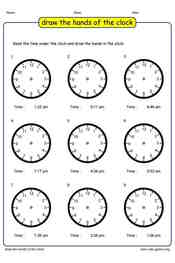
Reading a clock is one thing — drawing the hands correctly is another! Students see the time written in words or digits and must draw the hour and minute hands in the right position. A hands-on worksheet activity that turns time-telling into a truly active skill.
Telling Time
Grades 1, 2, 3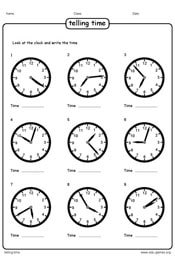
Generate customizable analog clock worksheets in seconds! Choose how many clocks to include, set the difficulty from full hours to exact minutes, and create the perfect practice sheet for your students. An essential skill made simple and fun to learn.
Time Bingo
Grades 1, 2, 3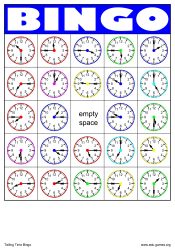
Bingo meets the clock in this wonderfully flexible time-telling game! Players match clocks on their cards to the times called out, with options for 4×4 or 5×5 cards and difficulty ranging from whole hours to exact minutes. A classroom favourite that makes telling time genuinely exciting.
Time Dominoes
Grades 1, 2, 3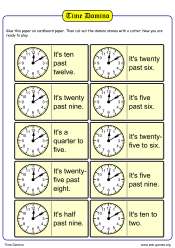
Domino with a twist — every tile shows a clock on one end and a time in words or digits on the other! Students match the clock face to the correct written time as they build the chain. Adjust the difficulty from hourly all the way down to 5-minute intervals for the perfect challenge level.
How to Use the Grade 1 Time Generators
The generators display an analog clock face and ask students to write the time. At Grade 1 there are exactly two valid minute-hand positions: pointing straight up (on the hour) and pointing straight down (half-hour). The most useful setting to vary is whether the worksheet mixes both positions or focuses on one at a time. Start with on-the-hour times only — students need to understand that "3 o'clock" means the minute hand is at the 12 and the hour hand is at the 3 before they can correctly interpret a half-hour position where the hour hand has moved past its numeral.
Once students are reliable on both positions separately, generate mixed worksheets. The half-hour is harder because the hour hand sits between two numerals, and students must identify which numeral it has passed, not which numeral it is nearest to. A sheet that mixes 3:00 and 3:30, 7:00 and 7:30, and similar pairs makes this distinction visible and gives students the repetition they need to stop reading the nearer numeral by mistake.
These worksheets work well as a 5-minute daily warm-up. Short, repeated exposure to the same two positions builds the automaticity that Grade 2's five-minute extension will depend on.
Several other generators in the grid — Telling Time, Time Bingo, and Time Dominoes — support minute-level precision for older students. For Grade 1 use, look for the difficulty or interval setting and select hour and half-hour only before generating, so the output stays within 1.MD.3 scope.
Why Hours and Half-Hours Are the Right Starting Point
Reading a clock to the hour and half-hour is harder than it looks for a six- or seven-year-old. The analog clock asks students to track two hands simultaneously, understand that a number on the face can represent both an hour value and a minute value (the 6 means "30 minutes" not "6 minutes"), and resolve the ambiguous position of the hour hand at the half-hour. Each of those cognitive demands is new at Grade 1.
The CCSS stops at half-hours at Grade 1 precisely because those demands are already significant. Five-minute intervals require skip-counting by fives around the clock face — a skill taught in Grade 2 (2.NBT.2). Individual minutes require reading any position of the minute hand with precision — a Grade 3 standard (3.MD.1). The progression is deliberate: each grade adds one layer of complexity after the previous layer has been consolidated. Students who leave Grade 1 with solid hour and half-hour reading have the foundation that each subsequent grade builds on.
The most common reason Grade 2 students struggle with five-minute times is not that five-minute reading is too hard — it is that their Grade 1 half-hour reading was never quite automatic. When the minute hand is at the 6 for 3:30, and also for 3:35 and 3:25, a student who is still uncertain about 3:30 itself has no firm reference point to count from. Extra practice time at Grade 1, applied before that layer closes, pays dividends across the next two years.
Share these free Grade 1 time worksheets