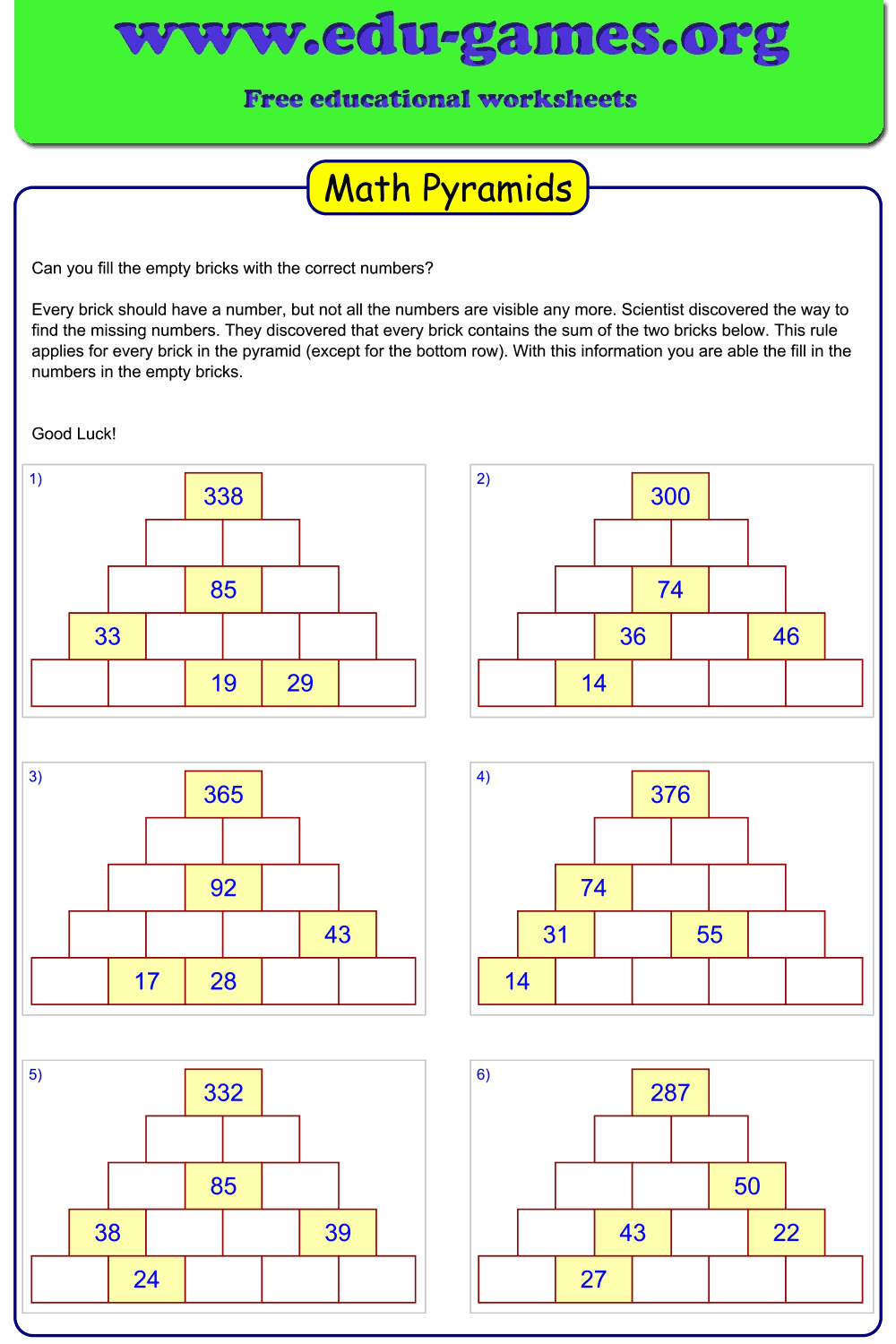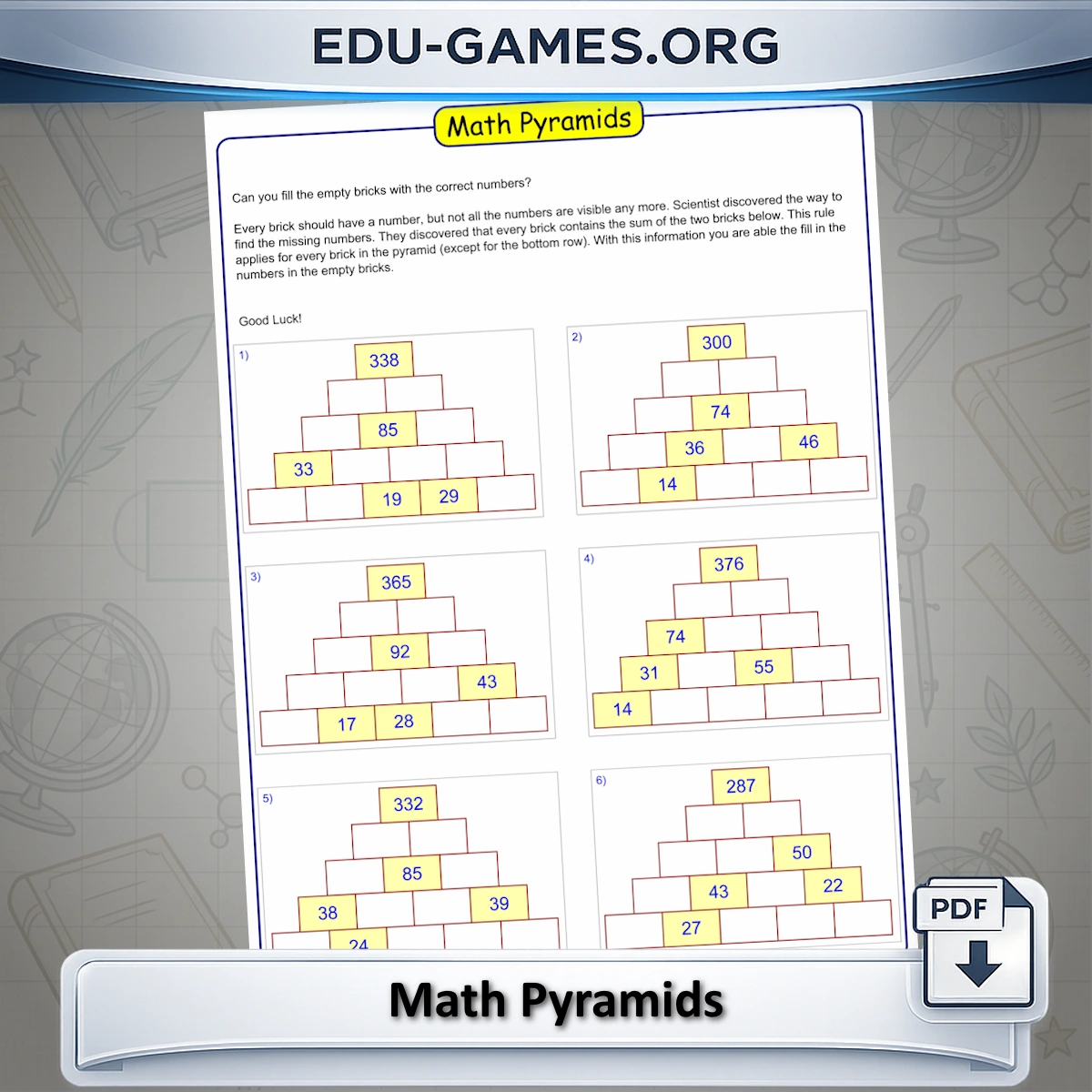
A Math Pyramid is a triangle of numbered bricks where every brick equals the sum of the two bricks directly below it. Some bricks are pre-filled; the challenge is to use addition and subtraction to work out the missing values and complete the pyramid. Each generated worksheet is unique and downloads as a PDF with an optional solution page.
Create Your Math Pyramid Puzzle
How to Use This Math Pyramid Generator
- Click "Generate a New Math Pyramid" — a fresh pyramid appears in the preview with some bricks pre-filled and others left blank.
- Edit the instructions text (optional) — the instructions field lets you type any text that should appear on the printed worksheet, such as a student name line or a differentiated prompt.
- Download the PDF — the worksheet prints on a standard A4 or letter page. Tick "Solution" before downloading if you want the completed pyramid on a second page.
- Generate again for a new puzzle — every click produces a different pyramid, so you can create a unique worksheet for every student or session without repetition.
To play without printing, use the Math Pyramid online game — students can solve puzzles directly in the browser on any device.
Why Use Math Pyramid Puzzles?
Most addition and subtraction worksheets present rows of isolated calculations. A pyramid puzzle does something different: every answer is connected to every other answer through the structure of the pyramid, so a student who makes an error will eventually reach a contradiction — and must locate and correct the mistake themselves. That self-checking property makes pyramid puzzles one of the few arithmetic activities where students get immediate, built-in feedback without needing a teacher to mark the work.
- Addition and subtraction in context — rather than drilling isolated facts, students apply both operations to navigate the pyramid in whichever direction yields the missing value.
- Logical reasoning — students must identify which bricks are solvable first, developing the habit of looking for the most constrained unknown — a foundational algebraic thinking skill.
- Scalable difficulty — the same pyramid format ranges from simple sums within 20 (Grade 1–2) to multi-unknown puzzles requiring systematic reasoning (Grade 5+), so one generator serves the full primary range.
- Engagement — the puzzle structure sustains focus through a goal (completing the pyramid) rather than through volume, which makes it more effective than a plain drill sheet for students who disengage from repetitive practice.
Share this free math pyramid puzzle generator