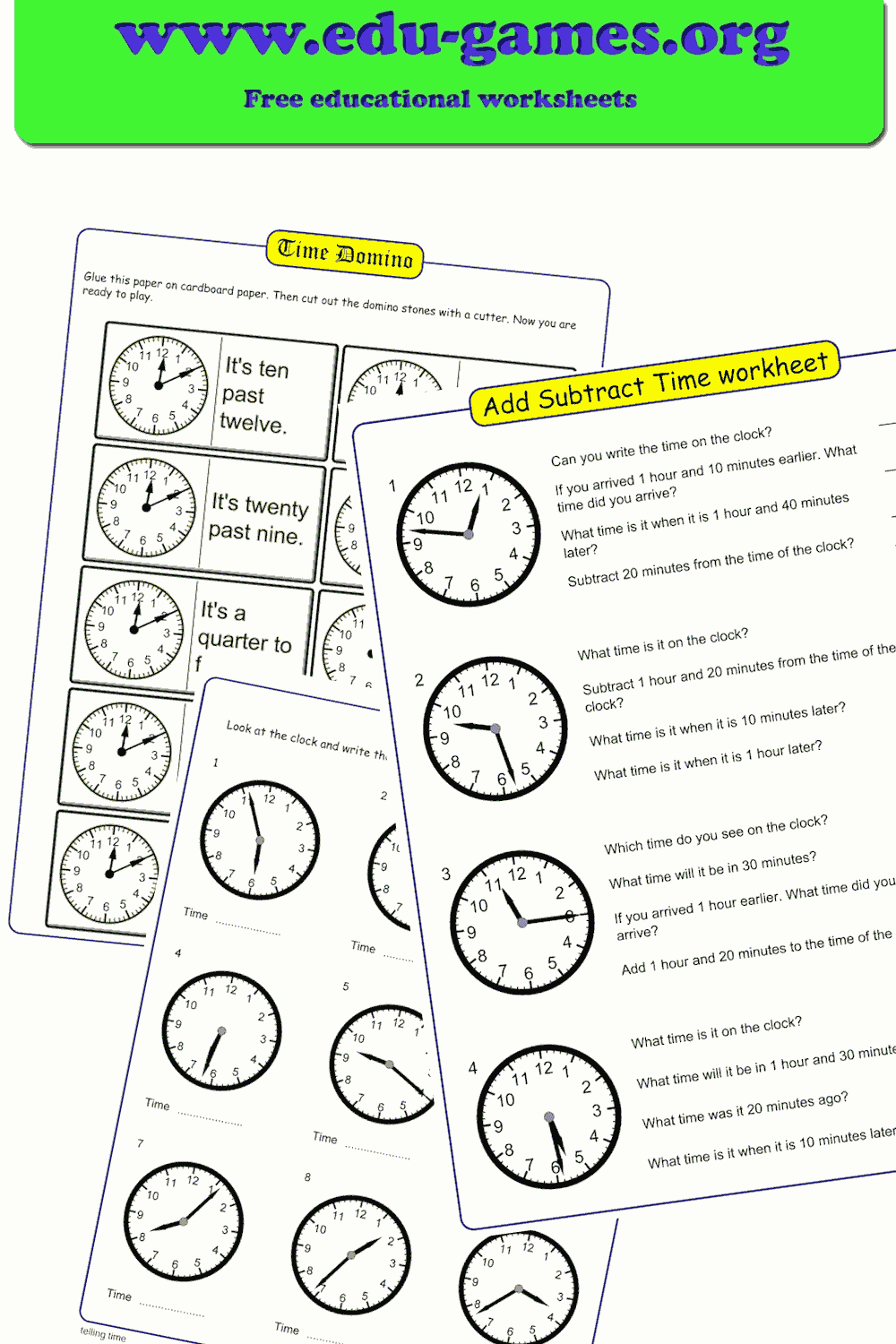
CCSS 2.MD.7 requires students to tell and write time from analog and digital clocks to the nearest five minutes, using a.m. and p.m. This is a significant jump from Grade 1, where only the hour and half-hour were required. These free printable time worksheet generators provide varied five-minute clock-reading practice across the full range of clock positions. Click Generate and a print-ready PDF appears instantly — complete with an answer key. No sign-up, no account, no limit on how many times you generate.
Free Printable Time Worksheets for Grade 2
Draw Hands on the Clock
Grades 1, 2, 3
Reading a clock is one thing — drawing the hands correctly is another! Students see the time written in words or digits and must draw the hour and minute hands in the right position. A hands-on worksheet activity that turns time-telling into a truly active skill.
Telling Time
Grades 1, 2, 3
Generate customizable analog clock worksheets in seconds! Choose how many clocks to include, set the difficulty from full hours to exact minutes, and create the perfect practice sheet for your students. An essential skill made simple and fun to learn.
Time Bingo
Grades 1, 2, 3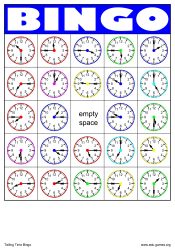
Bingo meets the clock in this wonderfully flexible time-telling game! Players match clocks on their cards to the times called out, with options for 4×4 or 5×5 cards and difficulty ranging from whole hours to exact minutes. A classroom favourite that makes telling time genuinely exciting.
Time Dominoes
Grades 1, 2, 3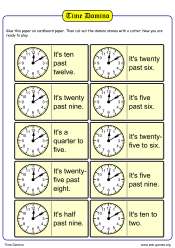
Domino with a twist — every tile shows a clock on one end and a time in words or digits on the other! Students match the clock face to the correct written time as they build the chain. Adjust the difficulty from hourly all the way down to 5-minute intervals for the perfect challenge level.
How to Use the Grade 2 Time Generators
The generators display an analog clock face and ask students to write the time to the nearest five minutes. The key question when selecting a worksheet is whether students are ready for the full five-minute range or still need to consolidate the easier positions. Start with times where the minute hand lands on a clearly recognisable mark — the 12, 3, 6, or 9 — before moving to the full set of twelve positions. Students who can count by fives fluently to 60 are generally ready for the full range.
The most productive practice includes a spread of times across the full clock face — not just the "easy" positions near 0, 15, 30, and 45 minutes. The ambiguous positions (minutes between 35 and 55, where the hour hand has moved conspicuously past a numeral) are where Grade 2 errors cluster. Generating several worksheets and checking that the problem set includes times like 3:40, 7:50, or 11:35 ensures students encounter these harder positions before they see them on an assessment.
These worksheets work well as a short daily warm-up. Five problems at the start of class — done independently, answers checked immediately — builds the speed and automaticity that Grade 3 will depend on when the standard extends to the nearest minute.
Why Five-Minute Clock Reading Is a Key Grade 2 Skill
Reading to the nearest five minutes is the first time students must use the minute hand in a meaningful way. In Grade 1, the minute hand only mattered at two positions — pointing straight up (the hour) or straight down (the half-hour). At Grade 2, the minute hand can be at any of the twelve tick-mark positions, and students must count by fives from the 12 to determine the number of minutes. This requires two skills working together: counting by fives, and translating a tick-mark position into a minute value — a coordination that is new at Grade 2 and needs deliberate practice to become automatic.
The a.m./p.m. component of 2.MD.7 is conceptually distinct but equally important. Students must connect clock times to real-world events — school starts at 8:30 a.m., dinner is at 6:00 p.m. — and understand that the clock cycles through 12 hours twice a day. This context is what gives time-telling its meaning beyond a mechanical reading exercise.
Grade 3 will demand that students read any clock time to the nearest minute — a skill that has no procedural scaffold unless five-minute fluency is already secure. Students who leave Grade 2 still counting individual tick marks rather than reading them automatically will face a significant gap when the minute hand can stop anywhere on the clock face, not just at a multiple-of-five position.
Share these free Grade 2 time worksheets