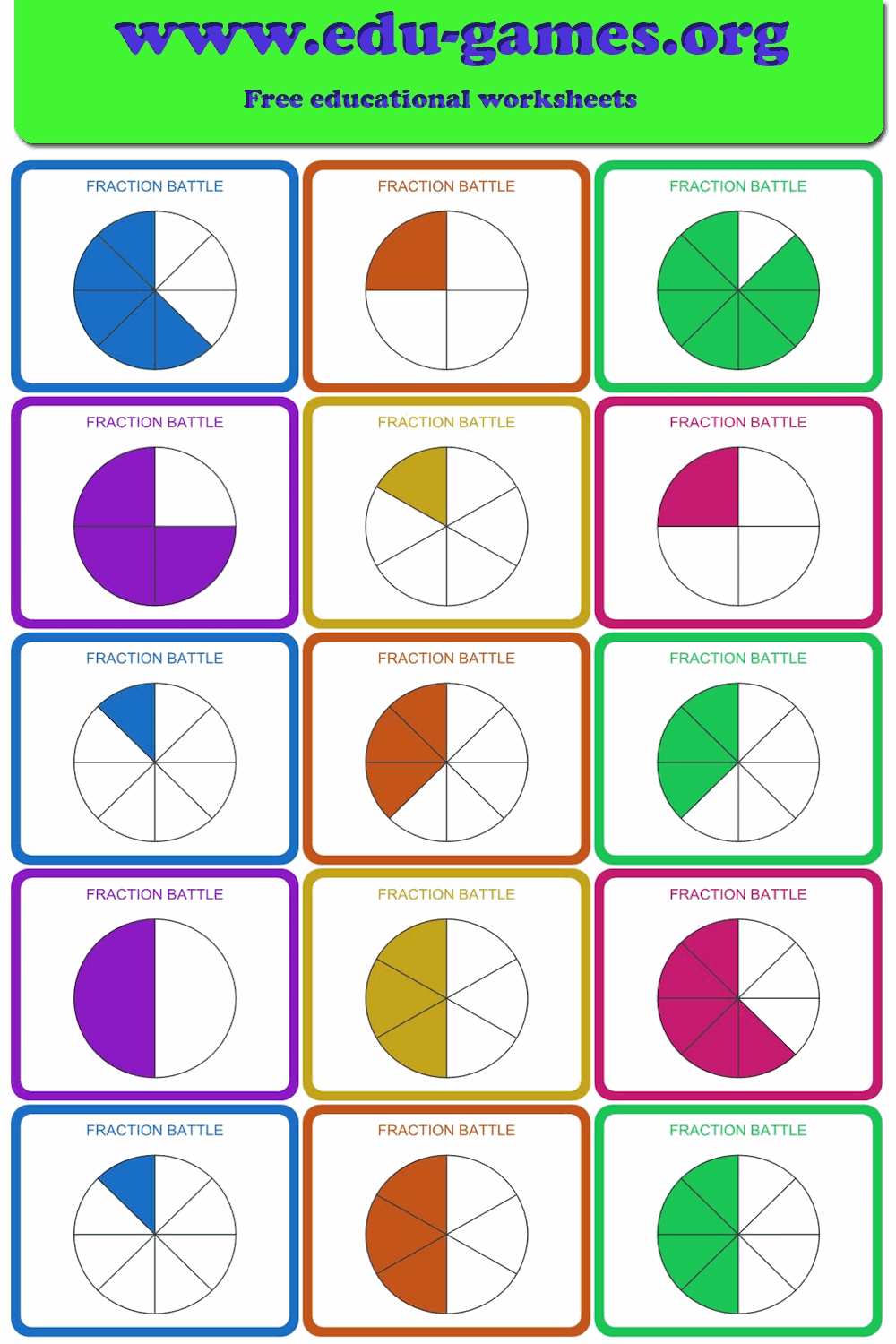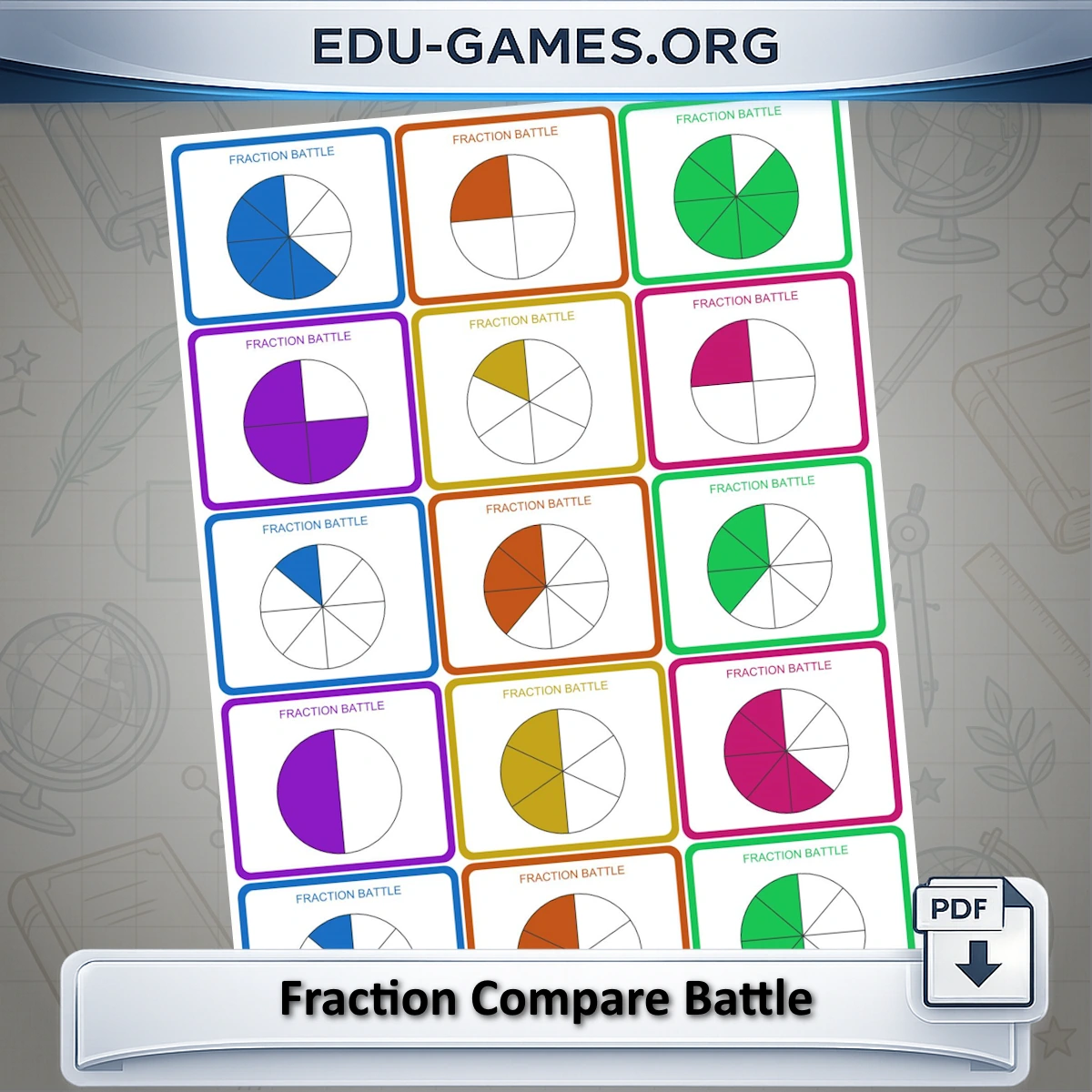
Create printable fraction battle cards
How to Create Your Fraction Battle Cards
- Set the denominator range — enter individual values separated by commas (e.g. 2,4,6,8) or a continuous range (e.g. 2-9). Use the Easy, Medium, or Hard shortcuts to apply a preset instantly.
- Choose the card display — show the fraction as a circle and notation, circle only, or notation only. Circle-only cards suit younger students who are still building visual fraction recognition; notation-only cards focus on comparing written fractions.
- Show game name on cards — the "Show game name on cards" checkbox controls whether the word "Battle" appears on each card. Uncheck it if you prefer a more neutral look — the word battle can feel too aggressive for young players.
- Set cards per page — choose 6 or 15 cards per printed page.
- Enter the number of cards — type any even number from 8 to 120. The deck will contain exactly that many fraction cards.
- Click "Generate fraction battle cards" — the preview updates immediately showing a sample of the cards.
- Download the free PDF — print on cardstock or regular paper, cut the cards out, and play.
How to Play Fraction Battle - also known as Fraction War
Setup
Players: 2 or more. Shuffle the fraction cards and deal them equally face down between the the players.
Game Play
- Each player turns over the top card of their pile and places it face up in the middle.
- Compare the two fractions. The player with the larger fraction wins both cards and places them at the bottom of their pile.
- If the two fractions are equal, there is a battle:
- Each player places one card face down.
- Then each player places one card face up.
- The player with the larger face-up fraction wins all four cards in the middle.
- If the new cards are also equal, repeat the battle until one player wins the round.
- The first player to collect all the cards wins.
Classroom tip
Decide before playing how students should compare fractions — by finding a common denominator, by cross-multiplying, or by converting to decimals. This keeps the game focused on the comparison method being practiced in class.
Also known as Fraction War
This game is also widely known as the Fraction War card game. We call it Fraction Battle because the word war can feel too aggressive for young players. The rules are identical — if you are searching for a printable fraction war game, you are in the right place.
Which Grade Level Is Fraction Battle For?
- Grade 3 — Focus on basic fraction recognition and visual comparison. Younger learners can print cards with only fraction circles to build intuitive understanding at a glance. Choose the easy preset and a smaller deck.
- Grade 4 — Expand visual reasoning and transition toward abstract thinking. Students can use cards featuring both fraction circles and mathematical notation, or mix and match as they practice comparing mixed sets of fractions with denominators up to tenths.
- Grade 5 — Unlock the full strategic challenge. Higher-grade students can print cards with only mathematical notation to focus purely on numeric values. Students apply advanced concepts—such as finding common denominators or using benchmark fractions—to determine the winner in tightly contested rounds
Why Use Fraction Battle in the Classroom?
Fraction Battle gives students repeated practice comparing fractions in a low-stress, high-engagement setting. Once the game starts, students compare fractions on every single turn without teacher involvement.
- Builds speed and confidence comparing fractions
- Generates many comparison events per session
- Works for pairs or small groups
- Easy to set up — print, cut, and play
Fraction Battle — FAQ
How do you play Fraction battle?
Shuffle the fraction cards and deal them equally face down between two players. Each player turns over the top card of their pile. The player with the larger fraction wins both cards and places them at the bottom of their pile. If the fractions are equal, there is a battle — each player places one card face down, then one card face up, and the player with the larger new face-up card takes all four cards. The first player to collect all the cards wins.How many cards should I print?
For two players, a deck of 24 to 36 cards keeps the game moving at a good pace. Larger decks of 48 or more cards suit longer sessions or groups that want more variety. The number of cards must be even so that each player receives an equal share.Can Fraction battle be adapted for more than two players?
Yes. With three or four players, deal the cards as evenly as possible. On each turn all players reveal one card and the player with the largest fraction takes all the cards. If two or more players tie, only those players take part in the battle round. The first player to collect all the cards wins.More Fraction Games
- Fraction Bingo — printable bingo cards with fraction pie charts.
- Fraction Domino — match fractions on domino tiles.
- Connect Four Fractions — roll dice to form fractions and cover your board.
- Balance the Scale — solve for the missing fraction to balance the scale.
Other Battle Games
- Addition Battle — add two numbers on your card; the highest sum wins the round.
- Subtraction Battle — subtract two numbers on your card; the highest result wins the round.
- Multiplication Battle — multiply two numbers on your card; the highest product wins the round.
- Division Battle — divide two numbers on your card; the highest quotient wins the round.
- Adding Fraction Battle — add two fractions on your card; the highest sum wins the round.
- Subtracting Fraction Battle — subtract two fractions on your card; the highest result wins the round.
- Alphabet Battle — the letter furthest in the alphabet wins the round.
Share this free comparing fraction battle game